Recycling e-waste is an important global issue especially since its volume is constantly increasing and it remains little recovered, despite its tremendous economic and ecological potential.
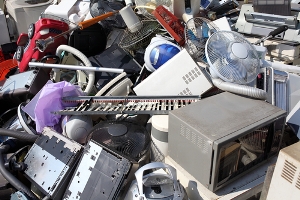
Waste includes screens, cooling appliances and air conditioners but also small household appliances such as vacuum cleaners, microwaves, toasters, and larger ones like those we find in our kitchens (dishwashers, washing machines,..).
The development of digital, electronic and digital technologies lead to the multiplication of objects that, having reached the end of their life cycle, struggle to find a new use. Due to the dangerousness of certain components for the environment, it becomes more than necessary to ensure the storage and recycling of these materials.
To better understand the origin, volume and value of e-waste generated per year, Terra eco (a wealth of information for any recycler and environmentally conscious citizen) offers an interesting infographic. It is a synthetic presentation of the most significant information about this waste.
1. 50 million tons of waste electrical and electronic equipment (WEEE) generated per year
In 2015, 43.8 million tons of e-waste are expected and the 50 million tons mark could be reached as early as 2018 according to the United Nations University (which is more of a Think Tank than a University but whose reports are very well documented).
In 2015, 43.8 million tons of e-waste are expected and the
50 million tons could be reached as early as 2018 according to
the United Nations University ("Think Tank" more than a University but
whose reports are very well documented).
2. Screens and small household appliances largely dominate landfills
Waste is still largely handled by communities. The
cost of collection, treatment and recycling of materials is high, few
materials, few companies are developing today in the ecological sector.
in the industrial ecology sector.
3. Less than 1/6th of e-waste is recycled
For example only 5% of mobiles are recovered each year...
4. 15.6 kg of waste per year per capita for Europeans, including 28.3 kg for Norway.<
Norway is followed by two other small countries that are Switzerland
and Iceland (in terms of number of inhabitants). At the European level, France
France is in eighth place. But it is the United States and
China are the largest producers of e-waste in terms of global volume.
global.
5. 48 billion euros are hidden in e-waste
David Malone, undersecretary general of the United Nations and rector of UNU (United Nations University), states :
"at the global level, e-waste is a valuable mine
urban, a large potential reservoir of recyclable materials." The report published by the UNU mentions 2 million tons of copper or even 300 tons of gold not recycled.
6. 11% of global gold production is contained in WEEE
In this category, cell phones are a gold mine (
no pun intended) because a ton of these devices contains an
350 grams of gold on average. In comparison, it takes a ton of ore
extracted from the ground to harvest only 5 grams of gold.
7. 2.2 million tons of lead-treated glass must be recycled
David Malone also points out that e-waste contains " tons of
hazardous components, such as mercury, cadmium or chromium, a
toxic mine that must be managed with extreme care"(2.2 tons in 2014 alone).
As a complement to this infographic, the TV5 Monde report presents the interesting initiative of a Chilean company, Recycla,
which, with the financial support of banking organizations, was able to release the
the necessary funds to implement this project with an interesting potential.
interesting. A recent initiative that could well develop on a
worldwide.
References
Poirot, Richard. "Le Monde Croule Sous les e-déchets - Libération." Libération.fr. Publication date April 19, 2015. http://www.liberation.fr/terre/2015/04/19/le-monde-croule-sous-les-e-dechets_1252056.
Terra Eco. "Infographic: The World's Trash Bins Are Overflowing With E-waste | Infogram." Create Infographics & Online Charts | Infogr.am. Published date April 22, 2015. https://infogr.am/les_poubelles_du_monde_debordent_de_e_dechets.
TV5 Monde. "TV5MONDE: Coup De Pouce Pour La Planète - Les E-dechets." TV5MONDE. Publication dateNovember 1, 2012. http://www.tv5monde.com/cms/chaine-francophone/Revoir-nos-emissions/Coup-de-pouce-pour-la-planete/Episodes/p-23495-Les-E-dechets.htm.
Illustration: Akiyoko, Shutterstock.com
See more articles by this author