Reasons why we cannot unlearn and reasons why we cannot learn
Publish at May 08 2017 Updated November 19 2025


Living in a city means acquiring a multitude of informal skills. These include orienting oneself in a dense space, anticipating when a particular place might be busy, walking in a compact crowd, mastering the uses of public transport, and so on.
City dwellers know what time to shop or take public transport if they want to travel seated. They also know when certain neighborhoods are busy or gloomy. Skills also extend to behavior and motor skills. When to cross when the traffic light is red? How do you slalom between passers-by if you're in a hurry? How do you say hello when entering a store or public place?
These implicit skills and behaviors are constantly called into question and updated. We only become aware of them when we move to a new geographical environment, a new city, or even a new neighborhood.

In Big Data, penser l'homme et le monde autrement, Gilles Babinet shows how cities learn from their inhabitants to better adapt to them. He gives us a few examples relating to transport, safety and resource management.
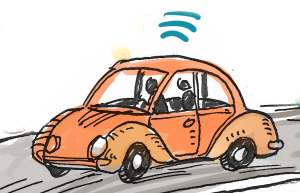
Traffic lights operating with the regularity of a metronome would quickly lead to traffic jams. Traffic flows often have a high throughput that conventional methods can no longer cope with. On the other hand, processing large quantities of data can help. For example, says Gilles Babinet, we know that most people in a car have a smartphone with them. We also know that, on average, there are 1.3 people in a car, a figure that can be refined depending on the city and the time of year. Twenty or so phones making uniform progress and regular stops? Most likely a bus. From now on, we can know in real time the number of vehicles in a lane, the speed at which they are moving, and track the progress of buses.
This makes it possible to adapt the rhythm of the traffic lights, and to call in agents with greater flexibility, almost in real time.
With the anonymous data collected by telephone operators, city departments can analyze traffic conditions at any time, and adapt traffic lights and regulation tools accordingly. We can go even further, and anticipate, for example, school or show exits, traffic jams and accidents that would block traffic flow, or roadworks.
The objetconnecte.com website gives a number of examples of this emerging technology being used on an experimental or long-term basis in major cities, for transport and waste management.
Surveillance, profiling, statistical security
Big Data also offers solutions to security issues... But these solutions raise other ethical and political questions.
By cross-referencing a vast amount of data on offenses and crimes committed in a city (time of day, weather, day of the week, etc.), it becomes possible to calculate probabilities of offenses per neighborhood and per hour. These are purely statistics, but they can help cities organize the deployment of their security teams.
More "Orwellian", video surveillance tools, coupled with artificial intelligence, can identify groupings and spot behaviors that may herald acts of violence. The aim here is to implement prevention, in the manner of Minority Report, even if the method is a far cry from that envisaged by Spielberg.
Among the tools that are gradually being deployed in cities are automatic number plate recognition (ANPR), video surveillance identification of vehicle models, and facial recognition. In this respect, the tools offered by Spikenet , for example, are both impressive and worrying. They make it possible to find an individual in a crowd, even when the definition of the video surveillance camera is poor.
Transport, waste management, shopping... structures can be organized and adapted thanks to the cross-fertilization of vast amounts of data. The skills that made city dwellers proud, and gave them the impression of knowing the city from the inside, are no longer as useful.
Just as orientation and anticipating traffic jams have been transferred from drivers to GPS, the skills of city dwellers are no longer of interest as cities adapt continuously.
Illustration: Frédéric Duriez
Resources
Eric Haehnsen - Biometrics, a massive takeoff imminent April 27, 2016, accessed May 5, 2017 http://www.infoprotection.fr/?IdNode=2534&Zoom=4a584ec99616f15c0cc76b01c327d63e
Gaëtan R. "Smart City : cinq start-ups qui veulent faire de la ville intelligente une réalité" posted on objetconnecté.com April 14, 2017, accessed May 6, 2017
http://www.objetconnecte.com/smart-city-cinq-startups/
Gilles Babinet Big Data Penser l'homme et le monde autrement Édition le Passeur 2015
You might also like:
Comic book and video game by-products: how to materialize them and bring them to life
Objects derived from comic books (Tintin, Asterix...) and video games (Super Mario, Zelda...) transcend their commercial role to become bridges between fiction and reality. From their materialization, craft design (Fariboles, Pixi) and industrial production to their cultural and educational effect, these objects, enriched by technology (AI, augmented reality), inspire creativity and learning.
Why Good People Do Things They Disapprove Of
There are two distinct paths that lead one to act against one’s own values: a gradual shift that goes unnoticed, and a state of confinement in which past decisions close the doors one by one. Consistency is less about the difficult moment itself than about everything that is built up leading up to it.
When "influence" becomes a shortcut to "success" among young people.
The rise of social networks has accentuated the phenomenon of influencers. Increasingly, some young people who want to influence at all costs in order to "succeed" and gain visibility are getting involved in "buzz".
What are the conditions for the emergence of embodied emotion and its potential for learning?