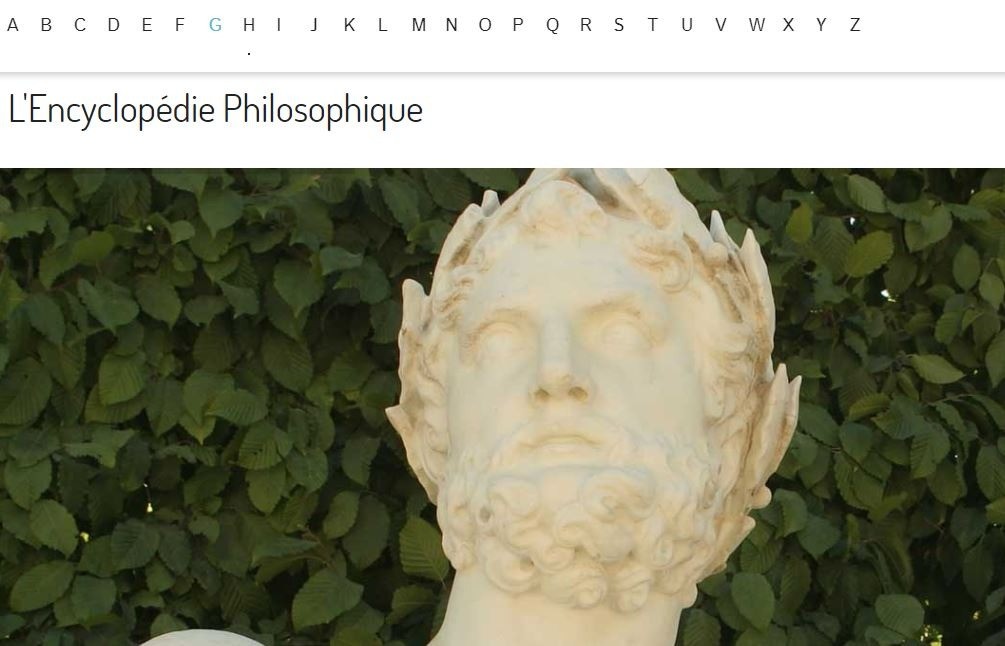
Philosophy is one of the oldest arts of human thought. Since ancient Greece, thinkers such as Socrates, Aristotle and Plato have literally laid the foundations of this fundamental human science.
Since then, other philosophers have left their mark, sparking debate among modern authors who analyze our world and the various aspects of humanity. The curious can always do a little research on Wikipedia or Google to learn more about philosophers or philosophy. Until now, however, it has been more difficult or expensive to unearth academic-level analytical articles.
A collective of authors on philosophy
The Encyclopédie philosophique appeared on the Internet in June 2016. The idea was to bring together academic-quality texts on philosophical subjects on one site. At the time of writing, the site had surpassed one hundred articles submitted, and this by 80 different authors from France, Quebec, Switzerland and Belgium, among others.
By the end of December 2018, this figure is set to rise to over 300. It has to be said that the quality of the articles is paramount to the encyclopedia's legitimacy. That's why each document goes through a reading committee, which suggests modifications, and an editorial committee, which guarantees double-blind proofreading. Last but not least, a scientific committee ensures the seriousness of the content and recommends themes and authors for the encyclopedia to the editorial group.
For the general public
And if all this sounds very hermetic, it's not just for academics. On the contrary, visitors will see that articles are accompanied by a code in brackets. The letter "A" indicates that it is aimed at philosophers, professors and students accustomed to reading more scientific jargon. Those marked "GP" are aimed at the general public, and are intended to be easier to read and understand, while maintaining scientific rigor.
These entries are not in the minority. On the contrary, they account for just over half of those currently on the site. Interestingly, some topics are covered in both ways. For example, the consumer version of the philosophical zombie (yes, there are zombies even in philosophy) can be an interesting introduction to the more elaborate academic version.
The Philosophical Encyclopedia aims to become a must-have for philosophy students and teachers, of course, but also for any Internet user curious to learn more about the concepts of this human science that can sometimes seem obscure to the layman.
Encyclopedia of Philosophy
Learn more about this
resource