"Phalenes! understanding natural selection through play
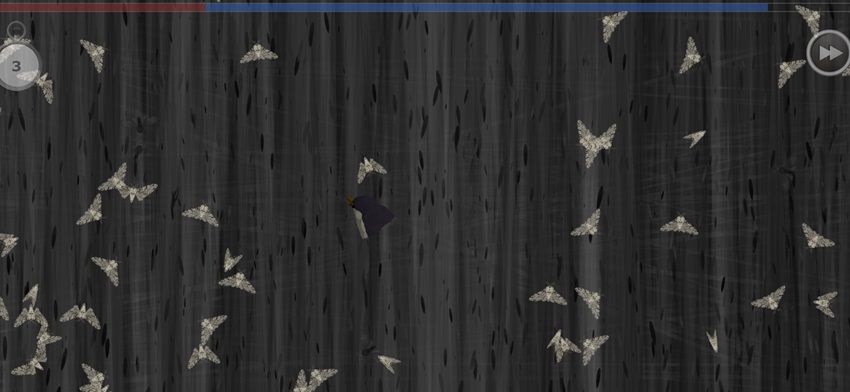
A serious game designed to demonstrate natural selection and its effects on a moth population.
Publish at January 13 2021 Updated April 13 2023


Measuring attention remains a concern in many settings. Some work tasks are not very error tolerant.
Here are a series of sample tests to measure attention in children and adults.
The full tests are fee-based, these are demos but they give a good idea of what is being measured.
This is a classic task measuring the time it takes participants to notice a difference between two images.
The dot probe is a classic task used to assess selective attention.
The classic Flanker Task (or Eriksen Flanker Task) is a "response inhibition" test used to assess participants' ability to not consider cues.
This experiment on inattention and impulsivity is based on a laboratory study conducted by Serena Bezdjian, Laura A. Baker, Dora Isabel Lozano, and Adrian Raine in 2009 on 9- and 10-year-old twins.
This tests alertness, a state of prolonged concentration. Participants must stare at an image of a ticking clock and identify when the second hand jumps more than it should; if it changes size or blinks, it doesn't count. This example has a jump rate of about 8% and lasts a minute, whereas a full task would jump about 0.5% of the time, and last much longer...hours!"
Another version of this test here
This spatial cueing task measures the effects of cues on reaction times to target stimuli. In this example, the participant must press one of two keys when a "green thumb" appears in the corresponding box. Seventy-five percent of the time, a green circle will appear in the corresponding box before the stimulus appears.
A classic sustained attention response test (or SART).
You might also like:
"Phalenes! understanding natural selection through play
A serious game designed to demonstrate natural selection and its effects on a moth population.
A multiplayer game designed for people with disabilities
Video games designed for people with disabilities are already a rare resource. An experience that allows multiple players is even rarer. Yet this latest creation from "Ludociels for All" challenges players to light up an entire maze by walking balls of light.
A fun game about heredity and genetics - Welcome to Thingdom
How do you talk to children about genetics and heredity? A British museum has come up with the method: design a game in which you create a line of adorable creatures with precise objectives. The game is fun, colorful and easy to learn. Even adults will succumb to the charms of the bugs and their large families.
Koam, playing with balanced nutrition
A veritable showcase for public health, Koam was developed by Nutrikeo, a consulting firm specializing in nutritional strategies. Supported by BPI France, the Nouvelle Aquitaine region and Europe, Koam is the result of two years' work by a team of leading specialists in nutrition, childhood, pedagogy, sociology, digital and behavioral theory.