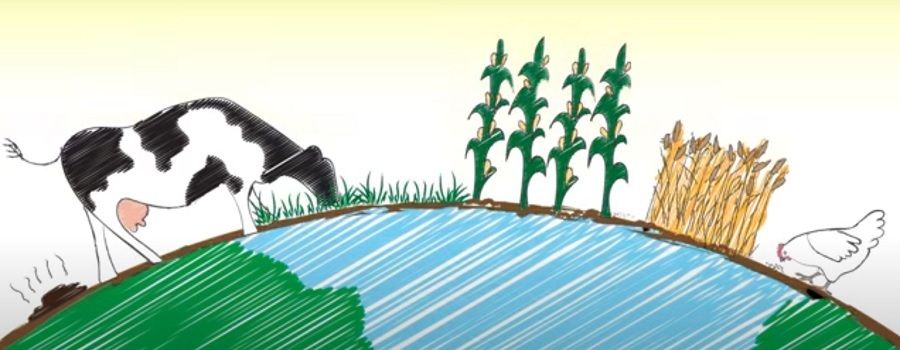
Have you ever considered how many aspects of food production affect the natural environment? Every aspect needs to be considered in attaining the future goal to produce enough food for the growing population while at the same time preserving our planet. It's as difficult as solving a Rubik's cube; changing one aspect may affect the environment in a major way.
Systems theory, or systems thinking, is a way of understanding and working with the complexity of sustainable food production systems, which requires training in different disciplines and an approach that can address this complexity. This environmental studies course enables participants to apply the principles of a systems approach to food production with a focus on environmental sustainability. Sign up as a student if you want to acquire knowledge about environmental sustainability and the way systems thinking helps in decision-making in the complexity of food production.
What you'll learn
- The concept of environmental sustainability and identify the main issues associated with food production
- The basics of systems thinking and understand how the different aspects of a system influence one another and how a system itself is affected by its context
- The relevance of crop and livestock productivity for environmental sustainability
- The environmental indicators and how to measure the environmental impact of food production at farm, village or regional level
- Decision-making and life cycle assessment
- Helpful tools and their strong and weak points
We will analyze production systems at both ends of the spectrum: highly productive systems with relatively high inputs and emissions to the environment, and low productive systems with low input use and depletion of soil fertility. Crop-livestock interaction is a focal point.
Syllabus
Module 1: Complexity of sustainable food production systemsModule 2: Introduction to systems thinkingModule 3: Productivity indicators of food production systemsModule 4: Environmental indicators of food production systemsModule 5: Trade-offs between sustainability indicatorsModule 6: Integration module with two case studiesTo enroll, click here
Learn more about this
training