We possess no good, even in the order of grace, that we cannot lose a moment later through the natural mutability of our desires.
Bossuet
The sound, text and image translation capabilities of generative AI
Mutability is the character of that which can undergo change. It's a term often used in literature and law.
For example, in law, the principle of mutability means that the regime of any public service can be modified to suit the general interest. In literature, mutability can refer to the state of being subject to change.
This character of mutability now affects the forms of our pictorial, auditory or textual creations in a hitherto unknown fluidity that goes much further and faster than the adaptation of a book into a film, for example. AI's ability to translate text into image or sound almost immediately challenges our traditional understanding of reality and perception.
If these different media are interchangeable in an instant, it could mean that our perception of reality is more fluid and subjective than we thought. It could also challenge the idea that each medium has a unique and irreplaceable essence. This AI capability could change our perception of ourselves as human beings.
An AI can perform tasks once considered exclusively human, and this leads us to rethink what distinguishes us as human beings. It's also changing the way we interact with technology, as we begin to see technology not as a tool, but as an extension of ourselves. Techno-conferencing is getting closer to our sensibilities.
The effect of mutability between signifier, signified and referent in education
The "Signo" website (signosemio.com) (from the Greek sêmeiôtikê, from sêmeion "sign") proposes theories and the study of signs and meaning. For some theories, everything is a sign: man himself and the world around him. In particular, signs can be linguistic, pictorial, architectural, sartorial, gestural, olfactory, musical, filmic, and so on.
Today, the mutability of media between image, sound and text made possible by AI is turning semiotics on its head. These media can mutate in the same way as water, which changes state from liquid to solid or gas, depending on the circumstances. The molecules that remain, the substance of water, adapt to different temperatures, hot or cold. The plastic form is extreme, reversible and changes properties. Conduction, hardness and temperature properties evolve. What concerns water can now be transposed to ideas.
AI's ability to translate freely between signifiers could blur the lines between signifier, signified and referent. This could challenge our traditional understanding of meaning and reference, as it suggests that signifier, signified and referent are not necessarily distinct entities, but can be fluid and interchangeable.
In terms of the mutability between signifier, signified and referent, this could have profound implications for how we understand and interpret the world. If these elements can be freely translated and transformed, it could mean that our understanding of the world is more flexible and adaptable than we thought. Like water, the properties of ideas are malleable. This could also have implications for fields such as education and communication, as it suggests that we might be able to learn and communicate more flexibly and creatively.
Semiotic theory distinguished between signifier, signified and referent, but by increasing the mutability between sound, image and text, generative artificial intelligence opens up new perspectives on the very meaning we give to the world and how we project it.
Multimodal learning
The mutability of sound/text/image is likely to foster multimodal learning. Students may be able to learn more flexibly by using different modes of representation (text, image, sound) to understand concepts. In addition, the ability to translate between different media could make communication more accessible to those with different communication preferences or needs.
The ability to freely transform signifier, signified and referent could encourage more creative and innovative thinking, since the functions of ideas specific to each media are altered.
Finally, the possibilities for personalized teaching could be enhanced. Teachers might be able to tailor their teaching to students' individual learning preferences, using the medium that best suits each student.
Improved intercultural understanding can also be expected thanks to the ability to translate between different media, as this navigation between different media would enable a better understanding of the ways in which cultures express the same concepts or ideas.
If we follow the metaphor of the cycle of water states, what will it mean tomorrow for a meaning to solidify, vaporize, condense or merge? Will we see widespread synesthesia , a confusion of the senses? A surplus of nuances in the way we apprehend the world?
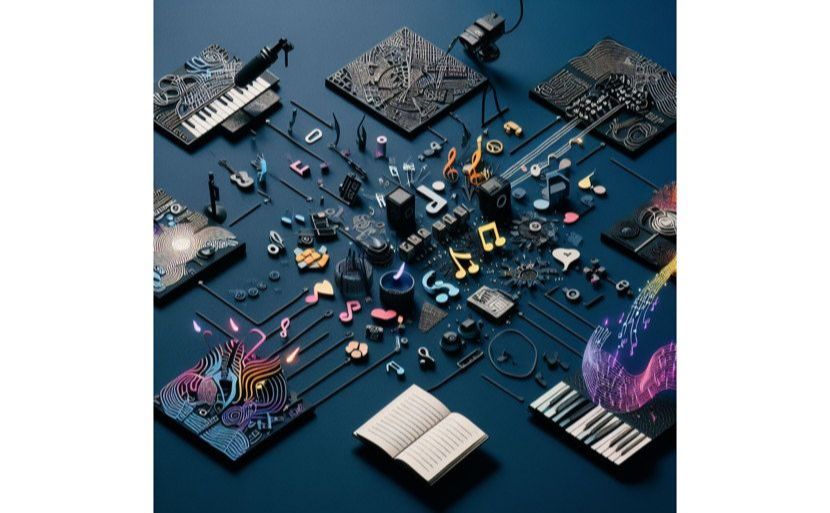
Illustration: Dall-E - "The transformation of text and type into image, music and sound".
Sources
La langue française la mutabilité https://www.lalanguefrancaise.com/dictionnaire/definition/mutabilite
Signo - Applied semiotic theories http://www.signosemio.com/
Pedagogical innovation and transition. Technoconference
https://www.innovation-pedagogique.fr/article14865.html#:~:text=D%C3%A9crit%20au%20sein%20de%20la,famille%20dans%20la%20vie%20quotidienne%20%C2%BB.
LES ETATS DE L'EAU - Blog31 https://edu1d.ac-toulouse.fr/blog31/elem-montaudran-toulouse/files/LECON-Etats-et-changement-detats-de-leau.pdf
Synesthesia - Wikipedia https://fr.m.wikipedia.org/wiki/Synesth%C3%A9sie
See more articles by this author