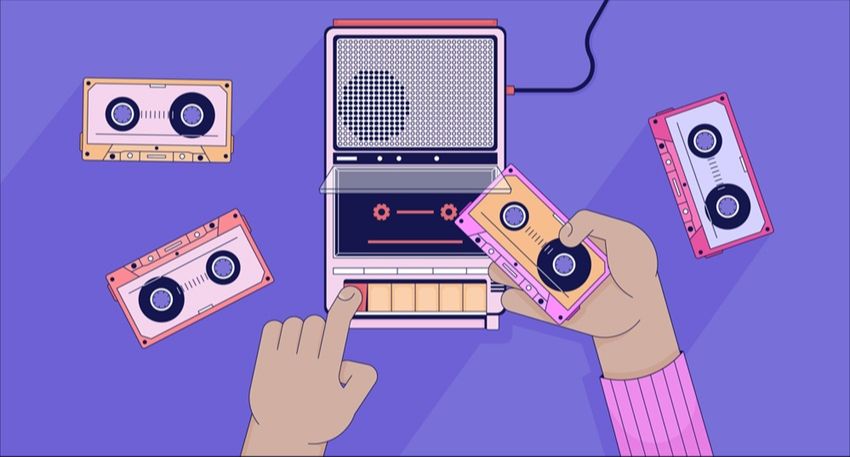
Why is this type of old-fashioned music so popular online?
If you've spent any time at all on YouTube, it's quite possible that you've seen this cartoon image (close to the Japanese style) of a young girl concentrating on a job with headphones on, occasionally looking out the window at her lounging cat. All with an important note: "lo-fi". If you've listened to this channel, you'll have noticed the sound of various songs that are as if muffled, slowed down or sped up, giving a feeling of relaxation.
This is what motivates the "lo-fi" movement, which sees itself as the opposite of "hi-fi", a counterculture to modern mixes of different genres. Incidentally, this protest movement didn't start with the Internet. Artists from grunge to hip-hop were quick to adopt this "more authentic", less studio-based sound quality as a way of denouncing standardization. Today, this has become even easier, thanks to sound editing and editing tools that are very easy to learn and use.
As a result, many Internet users love "lo-fi" because it makes them feel relaxed, like they're listening to distant tunes, and so on. Studies have even shown that this type of music can improve concentration and reduce stress. A nostalgic approach that serves an online broadcasting giant like YouTube well, as it seeks to gain a foothold in the presentation of live online broadcasts.
Just like school rhythms, the organization of school time is an issue of educational reform but one that receives little media attention. The division of school time seems to be fixed for eternity. However, it constitutes a brake on pedagogical innovations. Worse, it hinders the construction of the meaning of learning.
Learning about living things, with them, from them and about them, takes us from discovery to veneration. It's an essential step towards protecting our planet.
AI is revolutionizing our relationship with knowledge. Beyond fantasies, thoughtful and proactive use of AI can make it a powerful lever for "learning to learn". This involves developing specific meta-skills (questioning, checking, exploring, alternating) and key attitudes (AI as a partner, reflexivity, frustration tolerance). The challenge is to build a human-machine cognitive ecology in which AI enhances our intelligence without replacing it.
It is commonly believed that some people are born geniuses, while others have to make do with average performance. But this belief, which has had a major impact on the very foundations of our education system, is increasingly being challenged by recent neuroscience findings.
"Experiencing daily, often painfully, the complexity of clay transformations, constantly questioning the rightness of what is felt and whether it can be shared with others, students do not learn to know so much as to acknowledge their ignorance, as to experiment from what they cannot control."