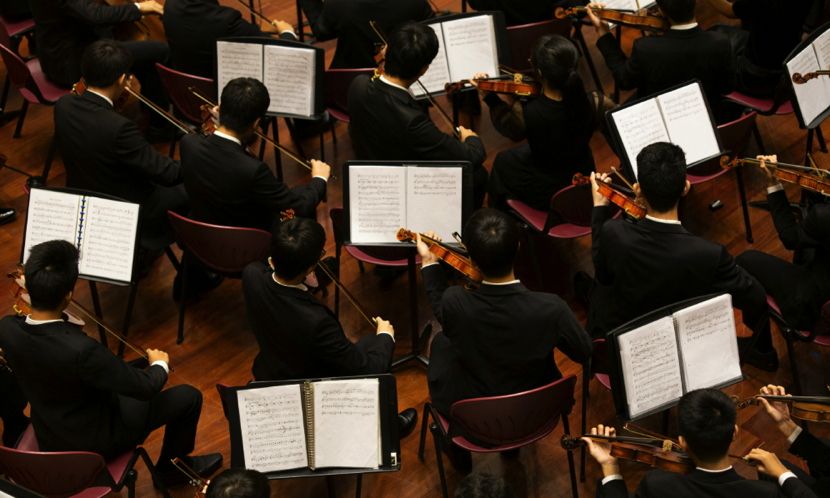
The art of conducting consists in knowing how to abandon the baton so as not to hinder the orchestra
The aesthetics of collective composition: forms, textures, timbres
Composing a human group means shaping a space where each voice finds its place, in the manner of a musical arrangement. This analogy between a group and a musical work is more than a suggestive metaphor: it provides an operating framework for understanding collective dynamics as a living aesthetic. The group thus becomes a "sensitive formation", a form in which the sensitive, the symbolic and the relational intertwine.
In contemporary music, composers such as John Cage have introduced open forms in which performers are invited to reinvent the unfolding of the piece, or even to integrate silence as an event in its own right (Cage, 1961). Transposed to facilitation, this formal openness evokes the co-construction of rules, the plasticity of roles and the integration of the unexpected. Like a sound fabric, a well-composed group is not defined by uniformity, but by the complementarity of human textures, the diversity of "relational timbres" and the articulation between dominant and marginal voices.
Christopher Small's work (1998) on the concept of "musicking" is a good illustration of this conception: music is not an object but a relational act, a mode of being-together. Applied to group composition, this perspective invites us to think of belonging not as an assignment of place, but as a commitment to a collective process, a co-performance.
Relational counterpoint: dialogue, tension and the cohabitation of differences
A well-composed group, like a complex musical work, does not eliminate dissonance; it welcomes it, transforms it and links it together. Counterpoint - a musical technique involving the dialogue of several independent melodic lines - offers a powerful image of cooperation here: each member follows his or her own line of action while listening attentively to the others. This relational model avoids the temptation of fusion or rigid hierarchy, in favor of a dialogical logic (Bakhtine, 1977).
Research on creative groups shows that collective effectiveness relies less on conformity than on orchestrated heterogeneity (Sawyer, 2007). What counts is not so much the alignment of individuals as their ability to create a collective form out of productive tensions. In this way, dissonance is no longer a flaw to be eradicated, but a resource to be harmonized. The facilitator then acts as a conductor of the unexpected, organizing moments of fertile confrontation, breaks in rhythm and modulations in relational tonality.
In collaborative pedagogy, this means creating devices that allow for polyphony of viewpoints, the syncopation of reflective silences and the fugues of personal initiative. The aim is not fusion, but mutual listening in the midst of divergence. Group composition thus becomes an art of dosage, an unstable balance between structure and improvisation (Akkerman & Bakker, 2011).
Temporality, improvisation and living form: the band as a work in progress
Music unfolds over time; a band transforms itself over time. In both cases, the form is never fixed. It's the result of an evolving balance between intention and event. The band's temporality is not linear but rhythmic, punctuated by cycles, forks and breaths. Like jazz or minimalist music, the collective dynamic is based on creative repetition and situated improvisation.
Musical improvisation, far from being chaos, relies on fine-tuned listening, shared memory and an implicit framework. In facilitation, this corresponds to the group's ability to modulate its interactions, to respond to the unexpected while maintaining a coherent intention. The group becomes a living organism, self-affected by its own play. This concept is in line with the work of Francisco Varela (1993) on embodied cognition and autopoiesis: the group does not react mechanically to stimuli, but co-creates itself in the act of doing together.
The musical form of the group is therefore a living form, not determined in advance, but sensitive to micro-events, inflections of energy and slow metamorphoses. Such a perspective calls for an aesthetic of attention: making room for silence, for shifts, for the undecidable. This approach ties in with the contributions of art education, notably Dewey (1934), for whom aesthetic experience is the very model of living learning, integrating body, emotions and reflexivity.
Uncertainty as creative material
To compose a group like a piece of music is to envisage the collective dynamic not as a functional mechanism, but as a sensitive, evolving, dialogical work. It also means abandoning the idea of total mastery and embracing uncertainty as creative material.
This aesthetic look at group composition enables us to invent new forms of organization, where diversity becomes an orchestrated richness, dissonance a promise of transformation, and silence a moment of deep listening. Music, as the art of arranging the living, reminds us that the quality of the collective is not measured by its immediate performance, but by its capacity to create a world, a link, a work of art - the art of facilitation.
Sources
Akkerman, S. F., & Bakker, A. (2011). Boundary crossing and boundary objects. Review of Educational Research, 81(2), 132-169.
Bakhtine, M. (1977). Marxism and the philosophy of language. Minuit.
Cage, J. (1961). Silence: Lectures and xritings. Wesleyan University Press.
Dewey, J. (1934). Art as experience. New York: Minton, Balch & Company.
Sawyer, R. K. (2007). Group genius: The creative power of collaboration. Basic Books.
Small, C. (1998). Musicking: The meanings of performing and listening. Wesleyan University Press.
Varela, F. J. (1993). Ethical know-How: Action, wisdom, and cognition. Stanford University Press.
See more articles by this author