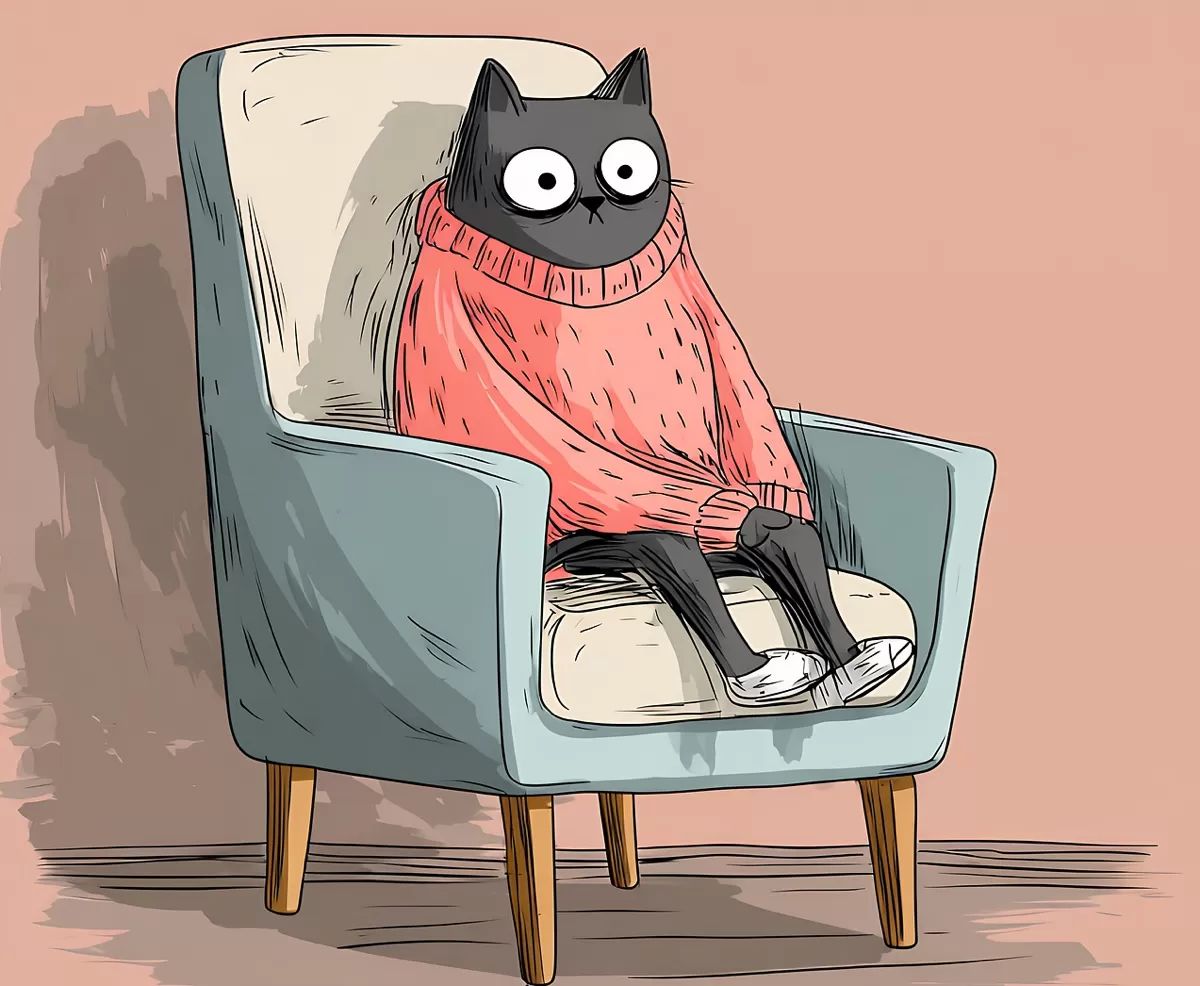
When a machine learns to recognize a cat
Teaching a machine to recognize a cat is a bit like showing it millions of photo albums. It is presented with a multitude of images: some labelled "cat", others "not cat". The algorithm looks at each image, suggests an answer, then is told whether it was right or wrong.
With each error, it adjusts its calculations to do better the next time. This back-and-forth is repeated millions of times until the machine spots, by itself, the clues that often come up when there's a cat: two pointed ears, vertical pupils, shiny eyes, fur patterns.
In reality, the machine doesn't understand what a cat is. It picks out statistical regularities in the pixels: areas of color, contrasts, shapes that often recur together. This is purely visual learning, with no context or experience. If the cat is from the back, in a drawing, or blurred, the system may make a mistake. Sometimes, all it needs to do is change the texture of the fur to see something else. The algorithm therefore "recognizes", but without knowing. It doesn't perceive body heat, meowing or the curiosity of a living animal. In reality, the machine doesn't learn, it categorizes.
How a human learns what a cat is
A child doesn't need millions of images. He sees a cat, strokes it, is scratched, hears a meow. He gradually associates the word "cat" with a range of sensory experiences: the softness of the fur, the supple movement, the warmth of the body, the reaction to the voice.
Human learning is embodied, i.e. it involves the body, emotions and relationships. It's also social: we tell him "that's a cat", we tell him stories, we teach him to tell the difference between a cat and a dog, a tiger or a cartoon. Humans learn quickly because they understand meaning. They don't just add up images: they connect, generalize and invent.
They can recognize a cat in a Chinese shadow, in a child's drawing or in an abstract sculpture. He knows that a cat is a living being, that it eats, sleeps and plays. What he learns is not an appearance but a presence, a way of existing. The human contextualizes while the machine decontextualizes to identify classifying details.
Deceptive similarities, fundamental differences
At first glance, humans and algorithms do the same thing: they recognize shapes. But that's where the similarity ends.
- The machine categorizes by frequency, the human understands by experience.
- The machine adds up examples, the human weaves meaning.
- The machine needs huge quantities of images, the human learns from a few encounters.
- The machine remains trapped within the framework of its data; the human adapts, interprets and improvises.
Above all, the machine does not recognize in the human sense of the word: it classifies. It has no memory, no emotion, no responsibility. It doesn't see a being; it sees a pattern that corresponds to a label. Learning and living are strictly synonymous; the machine has no access to the living, so the term learning for an algorithm is an abuse of language.
What this difference tells us about learning
This difference sheds light on what "learning" really means. Learning isn't just about spotting regularities: it's about giving meaning to an experience. Humans learn by being touched, surprised and moved. The machine adjusts its calculations, but feels nothing. And yet, in education, it is often these sensitive dimensions that anchor knowledge: curiosity, fear, the joy of understanding, the encounter with a living being.
On a practical level, algorithms are powerful: they can sort billions of images, spot patterns invisible to the human eye, help diagnose disease or classify documents. But when it comes to interpreting, feeling or contextualizing, the human eye remains irreplaceable.
It's the same with learning: no artificial intelligence can experience the astonishment or emotion of a discovery for us. Humans are storytellers, whereas algorithms are number-crunchers.
An ethical and sensitive issue
Entrusting the machine with the task of recognition also means delegating to it the power of attention. It decides for us what deserves to be seen, sorted and preserved. However, this power is based on data built by humans: they may be biased, incomplete or partial.
If an algorithm has only seen white cats, it will fail to recognize black cats. If the images come from a single cultural environment, it will miss other contexts. So the issue is not just technical: it's ethical and political. Who chooses the images? Who decides what "a cat" is?
If technology is to remain a tool for emancipation, we need to retain control over what is learned, how the machine renders the data and how we use it. Transparency of models, traceability of data and diversity of sources thus become democratic requirements.
Cultivating a fruitful difference
The gap between algorithms and humans is not a flaw: it's a complementarity that needs to be orchestrated. One classifies, the other understands. One calculates, the other feels. Together, they can broaden our perspective. The future of education and work lies not in substitution, but in co-learning: learning to see with machines, without ceasing to see for oneself.
This cohabitation requires vigilance, however: the more we entrust our perceptions to automated devices, the more we risk losing the finesse of our sensitive discernment. By letting the machine recognize for us, we could forget how to truly recognize - i.e., to be touched by what we see through our own senses.
The temptation of pareidolia
There's a fascinating phenomenon known as pareidolia: our tendency to see faces in the clouds, on the moon or in a tree trunk. It illustrates our deep-seated need to shape and connect.
We project meaning onto the world to make it habitable. Algorithms, too, sometimes make "digital pareidolia": they think they see a cat in a pattern of fur or a face in a cluster of pixels. The difference is that humans can see this.
Deep down, we know that the cloud has no face, and it's this awareness that makes our error an occasion for wonder. The algorithm, on the other hand, has no doubts. Nor does it dream. Perhaps the challenge of the years to come will be to keep this gap between calculation and meaning, between recognition and wonder, alive.
Learning to learn with machines means learning not to be like them, to preserve our capacity for attention, imagination and connection.
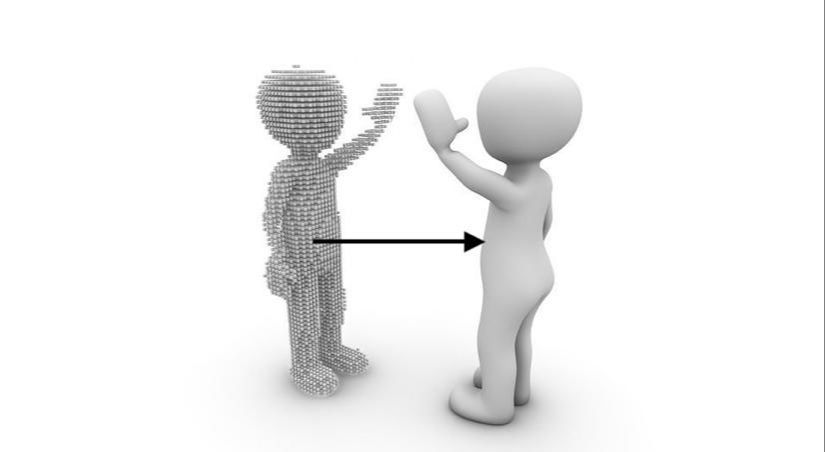
Illustration: Vilius Kukanauskas - Pixabay
References
CNIL. (2017). How to allow humans to keep their hand in? The ethical challenges of algorithms and artificial intelligence. Paris: Commission nationale de l'informatique et des libertés.
Geirhos, R., Rubisch, P., Michaelis, C., Bethge, M., Wichmann, F. A., & Brendel, W. (2019). ImageNet-trained CNNs are biased towards texture; increasing shape bias improves accuracy and robustness. International Conference on Learning Representations (ICLR).
Immordino-Yang, M. H., & Damasio, A. (2007). We feel, therefore we learn: The relevance of affective and social neuroscience to education. Mind, Brain, and Education, 1(1), 3-10.
Krizhevsky, A., Sutskever, I., & Hinton, G. E. (2012). ImageNet classification with deep convolutional neural networks. Advances in Neural Information Processing Systems (NeurIPS), 25, 1097-1105.
Lake, B. M., Ullman, T. D., Tenenbaum, J. B., & Gershman, S. J. (2017). Building machines that learn and think like people. Behavioral and Brain Sciences, 40, e253.
LeCun, Y., Bengio, Y., & Hinton, G. (2015). Deep learning. Nature, 521(7553), 436-444.
Villani, C. (2018). Making sense of artificial intelligence: For a national and European strategy. Paris: La Documentation française.
Varela, F. J., Thompson, E., & Rosch, E. (1993). L'inscription corporelle de l'esprit: sciences cognitives et expérience humaine. Paris : Seuil.
See more articles by this author