Publish at November 19 2025Updated November 19 2025
Astronomers baffled by a tiny star and its giant planet that shouldn't exist
The probability of finding giant planets in our galaxy has completely changed
When Galileo pointed his telescope at Saturn and Jupiter, he had just discovered the nature of two giant planets. Later came Uranus and Neptune, two more gas giants. Since then, astronomers have expected to find planets of this kind in all systems related to our own, with a massive star at the center.
Based on several observations, scientists have calculated a ratio between the mass of the star and the probability of finding gas giant planets at certain distances. This led to an estimate of the number of such giant planets in our galaxy (several hundred billion).
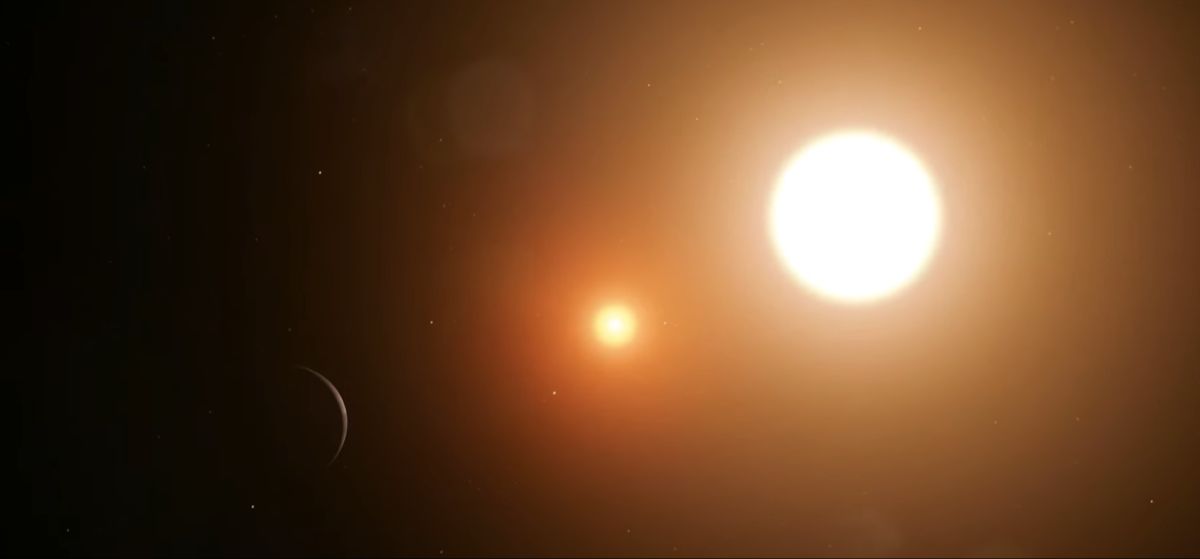
All was well until TOI-6894b, a planet slightly larger than Saturn and orbiting a tiny red dwarf, a star only 1/5 the mass of our sun. Such a gaseous planet could not technically exist near such a small star.
A question of observation
It's easy to observe bright stars, and until now we've mostly done so to develop our theories. But now that new observing devices like TESS and new techniques have been developed, it's possible to make much more precise observations than before, including observations of faint red dwarf stars.
But don't think it's just a matter of finding them: researcher Edward Bryant searched for over 91,000 red dwarfs before being able to detect such a planet with the help of one of the world's largest telescopes, the ESO VLT (European Southern Observatory - Very Large Telescope).
The problem is that, according to theory,
a small star does not offer the right conditions for the accretion of such a massive planet;
dwarf stars normally only have thin disks of matter that eventually disperse before a planet can form.
Scientists are testing several hypotheses to explain this discovery, including that of lower condensation temperatures in the vicinity of a red dwarf, but so far no hypothesis fits the calculations well enough to be retained.
We'll have to wait for confirmation of the composition of the planet's gases by the James Webb telescope in 2026 before we can choose one approach over another...
In the meantime, according to Daniel Bayliss, astrophysicist at the University of Warwick (England), this discovery calls into question the already enormous number of potential exoplanets in our galaxy.
Effort is part and parcel of learning, whatever that may be. Until this reality is better rewarded by the school system, it would be in the interests of all concerned to create an environment where effort is as important, if not more so, than grades.
AI is covered in all the evils and would spoil the human genius and if AI was cure and poison in the opportunities and risks that this computing power offers us?
Robotics enables the direct integration of several disciplines: programming and computing, industrial design and 3D printing techniques, mechanics and electronics. The practical educational benefits of robotics can keep you busy for years. Many robotic projects touch on social, environmental, scientific or artistic fields. Everything you need to get started.
The issue of competency-based knowledge is increasingly present in higher education. Rather than asking students to be dumb copiers of the material, they must prove that they can use it. This poorly thought-out approach can do great harm.