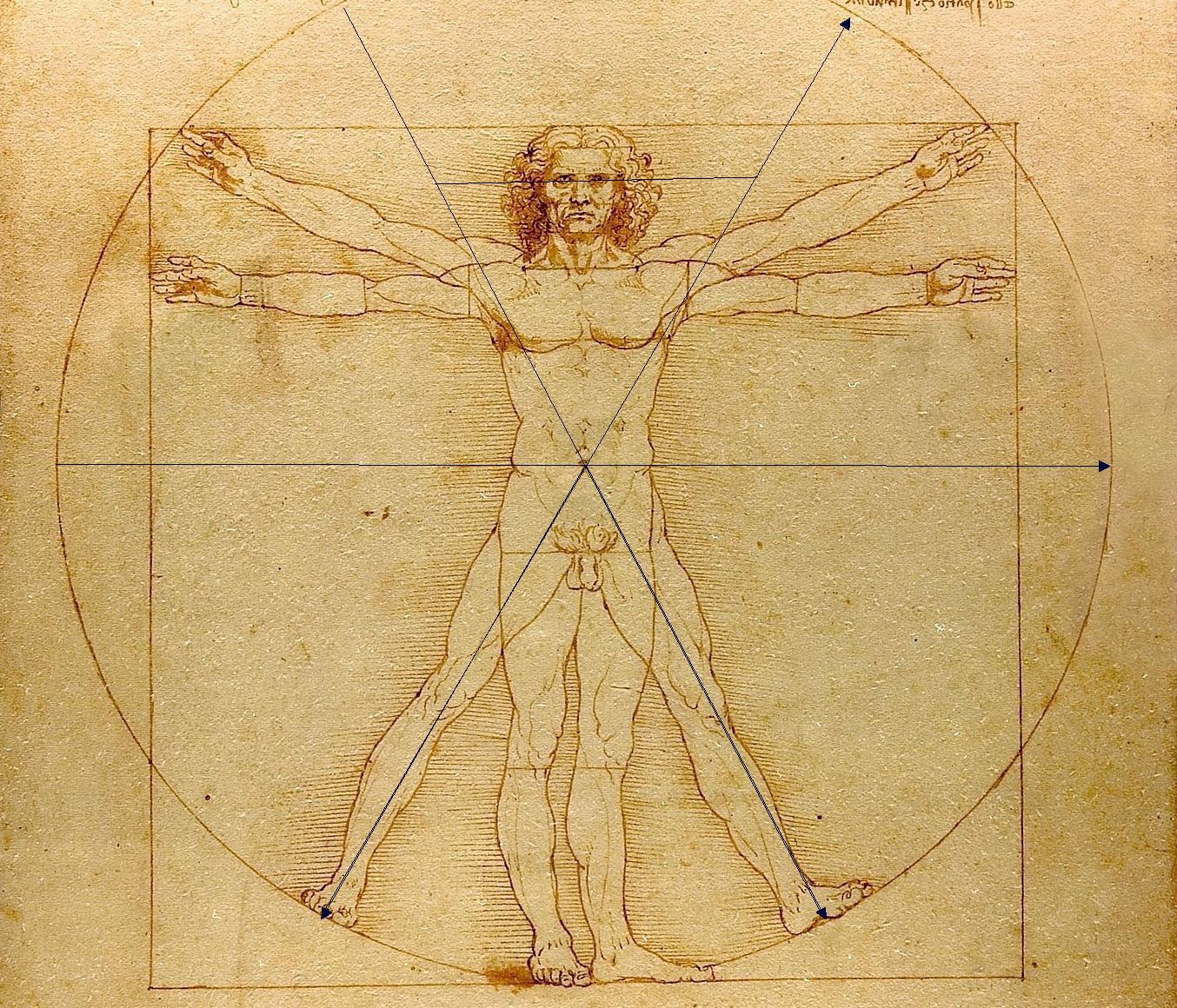
Leonardo da Vinci left such an indelible mark on the world that the famous inventor, artist, and many other epithets is forever perceived as the Renaissance man in all his glory. He is the model for those individuals who change the world through their inventiveness. Among his many popular creations, it is impossible to overlook the Mona Lisa, of course, or some of his sketches of fascinating flying machines. His second greatest achievement, however, is very simple, yet iconic: the Vitruvian Man.
The mystery of a central image of the Renaissance
The drawing, produced around 1490 by the famous Florentine artist, was largely inspired by the works of Vitruvius, a Roman architect whose book De architectura would be a major influence on da Vinci. Inspired by the idea of proportions, he composed this sketch of a human body perfectly inscribed within both a circle and a square, shapes considered perfect at the time. This important image perfectly represents an era in which paradigms were changing and man was at the center of the universe.
Several specialists believe that the famous artist achieved this image of almost divine proportion through the golden ratio, the famous ratio found in many natural forms and often associated with beauty and elegance. This is despite the fact that the myth surrounding the number has since been discredited by other studies. Furthermore, calculations made refute this golden ratio hypothesis.
In 2025, a dentist took an interest in the work and noted a little-observed element that nevertheless further explains the thinking behind Leonardo da Vinci's creation.
A detail between the legs
Dr. Rory Mac Sweeney was interested in one particular part of Vitruvian Man: his crotch. Although at first glance there is nothing unusual about the drawing, the doctor noticed through calculations and sketches that an equilateral triangle was formed in this area, following the model's two spread legs.
According to him, da Vinci started with an equilateral triangle drawn in a circle and was thus able to divide his work so that it respected the following ratio: √(8/3). This ratio is found in many elements, including three-dimensional tetrahedrons and, biologically, in Bonwill's equilateral triangle formed by the contact points of the mandibular central incisors and condyles (in the jaw joints). This triangle is used in the construction and use of fixed articulators.
A discovery that remains to be confirmed
For the moment, no scientist has examined Dr. Mac Sweeney's hypothesis. Nevertheless, his article published in the Journal of Mathematics and Arts could well lead to a new understanding of the famous Florentine's thinking. It could even show that optimal natural structures respond more to this ratio than to others.
References
Hidden Detail in Crotch Solves a 500-Year-Old Leonardo Da Vinci Mystery - https://www.sciencealert.com/hidden-detail-in-crotch-solves-a-500-year-old-leonardo-da-vinci-mystery
Homme de Vitruve - https://fr.wikipedia.org/wiki/Homme_de_Vitruve
Leonardo's Vitruvian Man: modern craniofacial anatomical analysis reveals a possible solution to the 500-year-old mystery - https://www.tandfonline.com/doi/full/10.1080/17513472.2025.2507568#graphical-abstract
Imaginer le futur comme Léonardo Da Vinci - https://cursus.edu/fr/22475/imaginer-le-futur-comme-leonardo-da-vinci
The Golden Ratio Test For Beauty Is Completely Bogus. An Expert Explains Why - https://www.sciencealert.com/expert-explains-why-the-golden-ratio-test-for-beauty-is-completely-bogus
Triangle de Bonwill - https://fr.wikipedia.org/wiki/Triangle_de_Bonwill
THE LEONARDO PROJECT - https://rorymacsweeney.com/the-leonardo-project/
Codex Atlanticus - Les travaux de Léonard de Vinci - https://cursus.edu/fr/34513/codex-atlanticus-les-travaux-de-leonard-de-vinci