Boualem Sansal, after a terrible year of imprisonment in
Algeria, returns to France to take part in La Grande Librairie on
November 27, 2025 (1). He is 81 years old and looks ten years younger,
with his joy, simplicity, optimism and determination. Is it resilience
or creative writing that keeps him so young, physically and
psychologically? Others, more recently, have spent twenty days in
prison, pretending they could write a book in such a short space of
time, but still look older than their years...
Jean-Claude Casadesus,
guest on France Musique's La Matinale on November 19, 2025 (2),
announces the tribute concert to be held in January 2026 at the Théâtre
des Champs-Elysées, in honor of his 90th birthday. He will be
conducting. And his projects are numerous in Europe and around the
world. He is 90 and looks ten or fifteen years younger, thanks to his
simplicity, his quality of diction, his clarity of thought, his memory
of what he has lived through. Is it the public that gives him this
energy, or is it serving music that keeps him so young?
Pierre Soulages is
creating three more monumental canvases to mark his 100th birthday, for
the retrospective exhibition at the Louvre in 2019. (3). In his
interview, he describes his discovery of outre noir after sleeping. An
incredible demonstration of creative processes: sleep, like boredom,
often provides the creative spark (4). He says that death is only
possible if true life exists. And "true" life for him is a life of love,
art and creation.
Three examples among many that demonstrate the
power of creative activity on brain function, and more precisely, on
slowing down the aging process.
Boualem Sansal, Casadesus, Soulages: is creation the secret of eternal youth?
It's
well known that creative experiences can improve both our mental and
physical health, but the underlying measures and mechanisms were poorly
understood until the publication of a study in October 2025 (5). A team
of researchers recently published a study that demonstrates the
influence of these activities on brain clocks "that detect deviations
from chronological age (i.e. accelerated or delayed brain aging)"
"Using this framework, we reanalyzed previously published datasets
of matched expert and non-expert participants in dance, music, visual
arts and video games, as well as a pre/post-learning study ( N = 232).
We
found delayed brain aging in all domains, with proportional effects.
The higher the level of expertise and performance, the greater the delay
in brain aging. Brain areas vulnerable to aging showed increased
connectivity related to creativity, particularly in areas associated
with expertise and creative experiences."
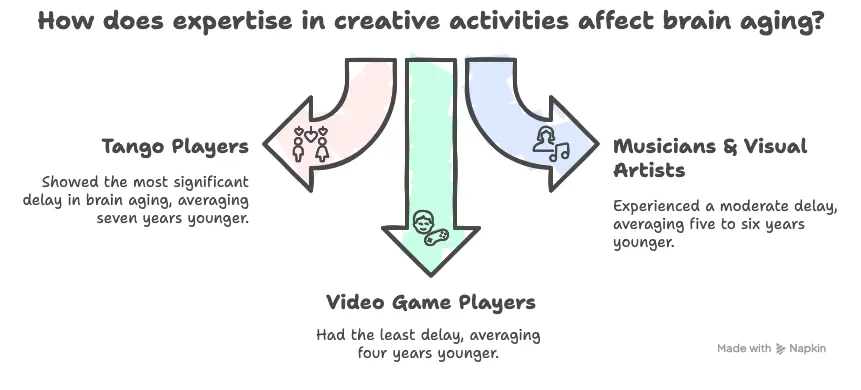
The first
study involved 1472 subjects engaged in a variety of creative
activities, ranging from tango to music, from visual artists to video
game players. Tango players were on average seven years younger than
their biological age, musicians and visual artists five to six years
younger, and video game players four years younger (6) (7).
In a second study, the before-and-after effects of playing a Star Craft II video game for thirty hours were investigated.
"Even in this short-term experiment, after only 30 hours of creative
training, participants' brain clocks moved backwards, showing a
reduction in brain age of two to three years."
Brain
plasticity seems to be at the heart of this phenomenon. For a long time,
it was thought that in adulthood, the brain no longer produced new
neurons, or even destroyed some without recreating any.
Pierre-Marie
Lledo, research director at the CNRS, head of the "Perception and
Memory" unit at the Institut Pasteur, and director of the "Genes,
Synapses and Cognition" laboratory, has demonstrated and regularly
communicates on cerebral plasticity, showing that what he calls "baby
neurons" have been discovered in centenarians who practiced intellectual
or artistic exercises on a daily basis. (8)
In short,
creation - whether in the form of a novel, a symphony, a painting, or
even a strategic video game - is much more than just a pastime. It's
preventive medicine for the brain. It offers the promise of a "real"
life, where subjective and biological time can be mastered.
It's up to each and every one of us to make the most of this powerful and accessible tool for living longer and dying younger.
References
1 "Boualem Sansal talks about his imprisonment - La Grande Librairie" 27/11/2025
https://www.youtube.com/watch?v=gL7WlDBdp60
2 "La Matinale with Jean-Claude Casadesus, baguette tradition "
https://www.radiofrance.fr/francemusique/podcasts/musique-matin/la-matinale-avec-jean-claude-casadesus-baguette-tradition-5482435
3 "Pierre Soulages: one hundred years of plenitude " https://www.youtube.com/watch?v=ylZGz3NuidA
4 "Igniting students' creative spark" Thot Cursus- 18/4/2023- Alexandre Roberge
https://cursus.edu/fr/27451/allumer-letincelle-creative-des-eleves
5 "Creative experiences and brain clocks" Nature - Carlos Coronel- Oliveiros & co- 3/10/2025
https://www.nature.com/articles/s41467-025-64173-9
6 "One type of activity is particularly effective at keeping your brain young" - Science Alert- 29/10/2025
https://www.sciencealert.com/one-type-of-activity-is-particularly-effective-at-keeping-your-brain-young
7 "Gamers, creative beings" Thot Cursus-2/6/2013- Alexandre Roberge
https://cursus.edu/fr/9277/les-joueurs-ces-etres-creatifs
8 "La plasticité cérébrale : c'est fantastique" - France Culture- 10/2/2020- https://www.radiofrance.fr/franceculture/podcasts/la-methode-scientifique/plasticite-cerebrale-le-cerveau-c-est-fantastique-6577579