
The evolution of organizational optimization
To optimize organizations, change has to be managed. Several decades have seen the exploration of numerous change management methods.
Publish at January 14 2026 Updated January 14 2026


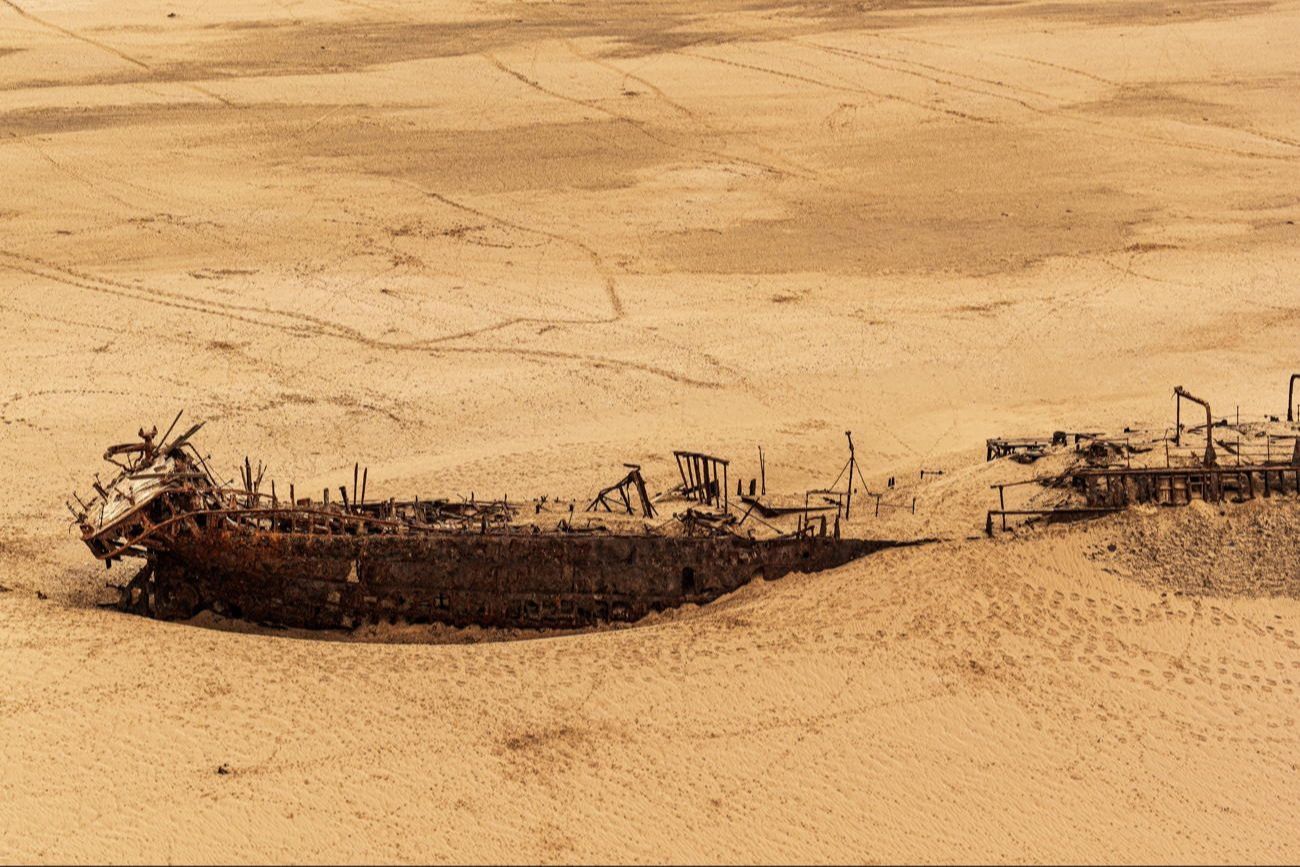
In the sandy hell of Namibia'sSperrgebiet desert, time seems to have crystallized. This 26,000 km2 territory, controlled since 1908 by the German colonial authorities and then by diamond giant De Beers, is one of the most inaccessible places on the planet. Here, the law is simple: anyone entering without authorization risks imprisonment, for beneath this blanket of dust lies the world's largest alluvial diamond deposit.
In 2008, to the astonishment of the miners working there, they came across a wooden ghost from a bygone era. The Bom Jesus, a Portuguese carrack (an old sailing ship, equivalent to our modern cargo ships), which disappeared in 1533 on its way to the Indies. Sealed by the aridity of the Namib desert, excavators have unearthed a veritable time capsule. With its holds full of riches, this forgotten wreck has much to teach us: dive into the secrets of a treasure jealously guarded by the hot sands of southern Africa.
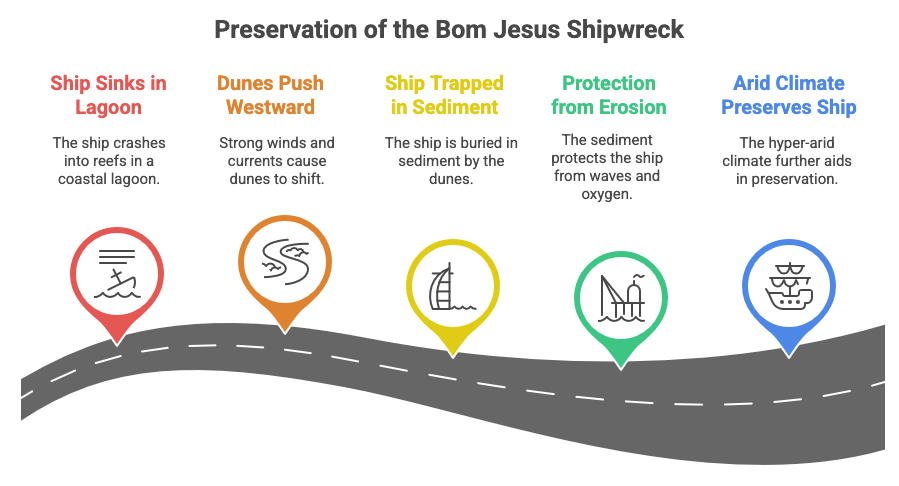
The majority of shipwrecks from the era of the Great Discoveries now lie at the bottom of the ocean abyss or in shallow bays. Oxygen from seawater and teredos (sea worms) have plenty of time to eat away at the organic material of the carcasses, leaving them in a pitiful state of preservation.
The Bom Jesus, on the other hand, was found several hundred meters inland, in the middle of the dunes. When it sank in 1533, the ship probably smashed against the reefs in a coastal lagoon. As the Namibian coast is one of the most shifting in the world, under the action of violent winds and ocean currents, the shifting dunes pushed the Atlantic westwards, nibbling away at the sea and trapping the ship in its sediment sarcophagus.
This natural shroud served to protect the wreck from the devastating erosion of the waves and the oxygen responsible for the decomposition of the wood. The hyper-arid climate of the Namib finished the job and the Bom Jesus was miraculously preserved.
As Dr Bruno Werz, Director of AIMURE(African Institute for Marine and Underwater Research, Exploration and Education), explains:
" Much more than a simple excavation site, this is a veritable time capsule. This ship is the material witness of the very first globalization: it doesn't give us vague vestiges, but a complete and intact system, frozen in time ".
Like any good carrack, the Bom Jesus not only transported material wealth, but also the workings of a financial empire run from the banks of Augsburg.
A Renaissance black box: the enigma of the Bom Jesus' holds
When it was discovered in 2008, the ship contained 2,000 gold coins ( Portuguese and Spanish excelents), a treasure of great value, both pecuniary and historical. But in the depths of her hold, archaeologists unearthed 22 tons of copper ingots marked with the trident seal of the Fugger dynasty.
This mark is further proof that the Great Discoveries could never have taken place without the first players in private finance. Indeed, during the Renaissance, the Fuggers of Augsburg were a family of bankers and merchants in the service of emperors and popes. Since the Middle Ages, they had built up a sprawling financial empire, and are considered today to be the precursors of modern capitalism and financial practices.
By branding these ingots, they signed their grip on the transcontinental trade network that the Bom Jesus fed. Copper, an indispensable metal for the exchange of spices in India, served as a de facto currency. Seeing this seal again under the Namib sands proves that the Portuguese empire, despite its maritime power, was entirely dependent on this wealthy family, originally from the Holy Roman Empire.
As maritime historian Alexandre Monteiro points out, the Bom Jesusis, in this respect, material proof of the occult financial circuits of the Renaissance. In archaeology, it's very rare for objects to correspond exactly to archives; here, they do. His research, based on investor letters unearthed from the royal archives in Lisbon, reveals that a colossal sum of 20,000 cruzados in gold had been transferred to Seville just a few weeks before the fleet set sail in March 1533.
The ship carried a motley cargo of Germanic copper, West African ivory (a rare and expensive resource) and Spanish gold. It was thus at the service of rigorously constructed logistics, an instrument serving what might be called a rudimentary multinational.
A financial set-up in which roles were perfectly distributed: the Fugger dynasty provided capital and raw materials, Portugal contributed its maritime know-how and fleet, while Spain invested its liquidity via gold coins. The Bom Jesus could almost be compared to a complete " vacuum-packed " financial system, or a vehicle for an Ibero-German multinational, long before the advent of the great India Companies.
It is estimated that the ship carried 300 sailors, soldiers and clergymen, but excavations begun in 2008 revealed only one human remains: a fragment of toe bone, still trapped in a decomposing leather shoe.
Despite the age of the discovery,Portugal officially relinquished its rights to the wreck in 2016 and chose to leave the entire cargo to Namibia, a gesture welcomed by historian Alexandre Monteiro. The conservation studies, carried out between 2014 and 2023, have now been completed, and the country has decided to exhibit this exceptional heritage in the new Oranjemund Museum, inaugurated in 2024 to anchor this discovery in Namibia's collective memory.
Visitors can now contemplate everything that was stored aboard the Bom Jesus. This concludes the final chapter of an odyssey that began in Lisbon almost 500 years ago. Even if it never reached its destination, it still ends triumphantly, as this treasure now belongs to the land that protected it so well.
Illustration: Shutterstock - 2617074347
References
500-Year-Old Treasure Ship Found Buried in Namib Desert, Packed With Gold, Ivory, and Lost Empire Secrets https://dailygalaxy.com/2025/12/500-year-old-treasure-ship-found-in-namib-desert-gold-ivory-lost-empire-secrets/
The Diamond, the wreck of the forbidden zone - Roff Smith - https://www.nationalgeographic.fr/histoire/le-diamant-lepave-de-la-zone-interdite
Análisis de los cambios en las cubiertas del suelo de la cuenca del río Fluvià (Girona) en el período 1987 - 2002 y sus efectos sobre la evolución de los servicios de los ecosistemas.- Soy-Massoni, E., Varga, D., Pintó, J. 2014 - https://www.researchgate.net/publication/272090257_Soy-Massoni_E_Varga_D_Pinto_J_2014_Analisis_de_los_cambios_en_las_cubiertas_del_suelo_de_la_cuenca_del_rio_Fluvia_Girona_en_el_periodo_1987_-_2002_y_sus_efectos_sobre_la_evolucion_de_los_servicios_de_
Fugger family - https://fr.wikipedia.org/wiki/Famille_Fugger
Oldest intact shipwreck found - Thot Cursus - https://cursus.edu/fr/16352/la-plus-vieille-epave-intacte-a-ete-trouvee
You might also like:
The evolution of organizational optimization
To optimize organizations, change has to be managed. Several decades have seen the exploration of numerous change management methods.
Involvement in the community: a powerful educational experience
You don't have to sit in a classroom to learn. Contact with people and real-life situations can be just as valuable as reading a textbook. Some courses even include community involvement as part of the curriculum.
Urban planning for all with Minecraft
In general, the citizens of a city have little interest in the urban planning of their locality. Yet place them in a game setting where they have the freedom to modify their neighborhoods at will and they will design workable, practical structures. A United Nations project is using the video game Minecraft to improve public places in cities in developing countries.
In the game of competition, don't pick the wrong opponent!
In a society that prides itself on performance, isn't competition the reflection of a race against both oneself and others? What kind of performance are we talking about? Is it the one that pulls us upwards and makes us explore the best of ourselves, or is it the one that bends us under the yoke of systems of thought, driving us to exhaustion and sometimes forsaking our own aspirations along the way?