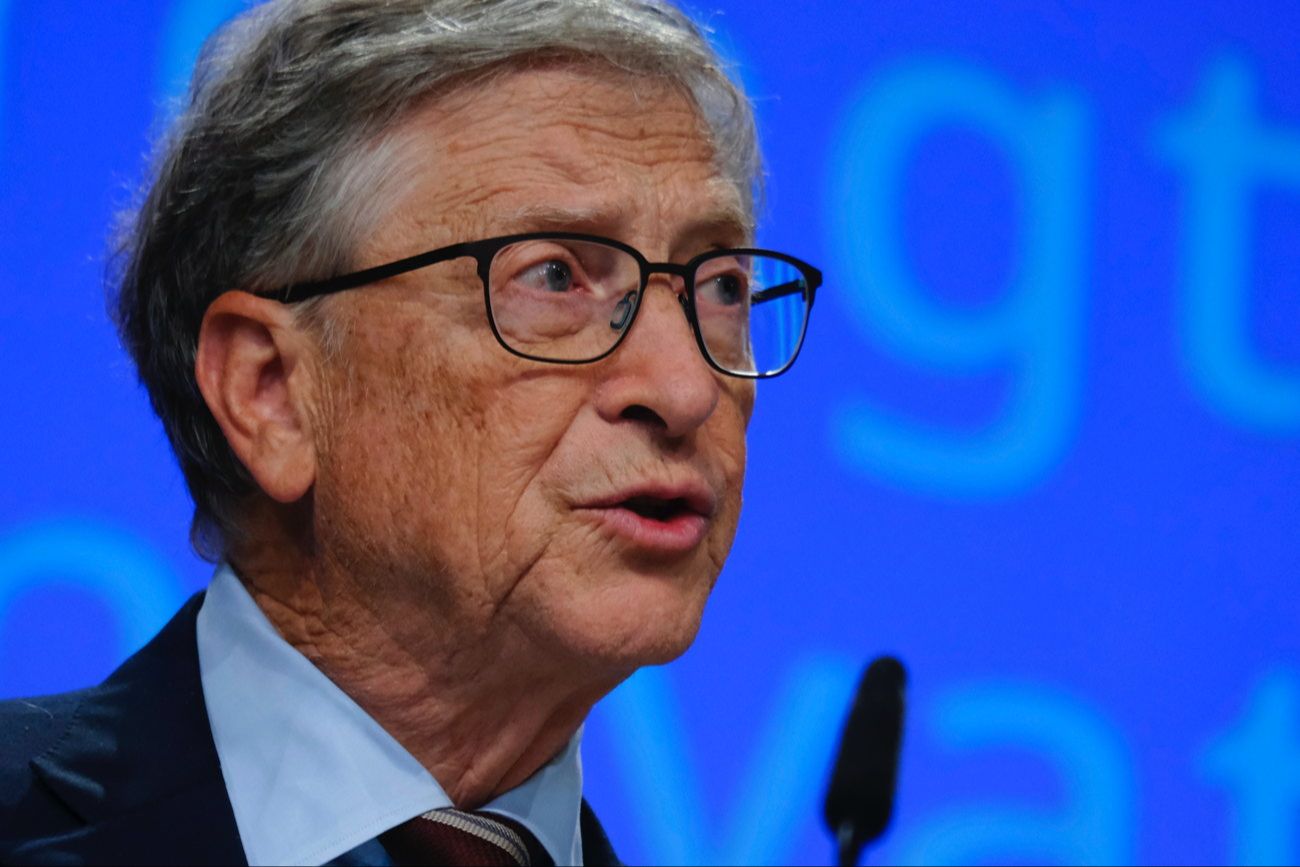
Bill Gates (1), who stepped down as Microsoft's Chief Executive Officer more than 25 years ago (2), is no longer the toothy young wolf of Redmond. But as a former businessman and philanthropist, he has not been idle:
- creation of Gavi (the Vaccine Alliance), which has helped immunize a billion children (3),
- almost total eradication of polio,
- colossal investments in Breakthrough Energy to decarbonize heavy industry...
His last quarter-century has not been an easy one, and he has never really stopped commenting on the world and its evolution, without taking his eyes off the tech world.
For the first time since 2000, the number of children dying before the age of five has risen again, from 4.6 million in 2024 to 4.8 million in 2025. A civilizational failure that signals the start of an ominous era for Gates, who has spent the last 20 years playing the role of global health diplomat.
Elon Musk's DOGE in the dock
Gates makes a frontal attack on Elon Musk's actions, notably when he was at the helm of DOGE (Department of Government Efficiency), a budget chainsaw created under the Trump administration in 2024. Closed in November 2025 due to a disastrous track record, the government department still had time to leave an indelible mark.
By arbitrarily slashing foreign aid contracts (particularly those with USAID), DOGE imposed an austerity strategy that Gates describes as nothing less than a death sentence for thousands of children.
This is where the dialogue of the deaf begins. Musk, true to his obsession with provocation, publicly demanded proof that these contract cuts had any lethal impact. For Gates, it's a statistical backlash: if infant mortality figures are rising again for the first time in 25 years, it's, in part, because the financial safety net that DOGE dismantled has just let go.
"The thing that outrages me most is the fact that the world went backwards last year on a key indicator of progress"
says Gates in his letter, linking this historic setback directly to the financial disengagement of rich countries. For him, what Musk calls administrative inefficiency is really the price of human lives. If development aid continues to fall by 20%, the sentence is already written: 12.5 million additional child deaths by 2045, according to projections by the IHME (Institute for Health Metrics and Evaluation).
Bill Gates' wager: $200 billion to fight obscurantism
Faced with what he no longer hesitates to call the risk of a return to the "dark ages", the former Microsoft boss has decided to inject $200 billion into his foundation. By announcing that he was bequeathing almost his entire personal fortune (around 100 billion euros), while demanding that it be spent in full within 20 years, Gates is attempting to transform a private estate into a sovereign wealth fund for humanitarian emergencies.
It's a substitution strategy, because Gates knows perfectly well that governments are volatile, so he wants to create a financial fund with sufficient inertia to withstand political cycles. But he also knows that money is only one lever among many.
His real bet, the one that keeps him optimistic, is Artificial Intelligence. In his view, AI-accelerated innovation is the only bulwark capable of compensating for the erosion of public funding by automating the discovery of new vaccines or optimizing agricultural systems in poor countries.
This outpouring of resources goes hand in hand with a particular statement from Gates, which can be read as a watermark: healthcare, on a global scale, has become the hostage of billionaires. With Oxfam counting 2,769 billionaires in 2025, and predicting the appearance of the first trillionaires within a decade, Gates issues a warning to his peers.
"The idea of treating others as you would like to be treated doesn't just apply to rich countries. It must include the philanthropy of the very wealthy".
He thus calls on the giants of tech and finance to join the Giving Pledge initiated in 2010 with Warren Buffett. The principle is simple: billionaires who join the movement publicly pledge to donate at least half their fortune to charity, either during their lifetime or after their death (through a will).
"The next five years will be tough as we try to get back on track," Gates warns. However, he tempers: "Despite the toughness of the past year, I don't believe we'll be sliding back into the dark ages".
Gates is thus building the strategy of the last bastion, protecting the world from the arbitrary decisions of government agencies. It almost seems as if he wants to create an artificial progress bubble, boosted by his finances, to force healthcare infrastructures to modernize before he goes.
It's a sprint against the disengagement of rich countries, a two-decade sprint to make progress irreversible. In this respect, it's hard to see it as an act of charity; it's the erection of an economic counterweight to secure the planet in the face of the budget-cutting blows sent out by certain supranational bodies.
Illustration: Shutterstock - 2374506079
References
Bill Gates warns the world is going 'backwards' and gives 5-year deadline before we enter a new Dark Age https://fortune.com/2026/01/09/bill-gates-world-backwards-funding-fears-dark-ages/
Can anyone become Bill Gates? https://cursus.edu/fr/21518/tout-le-monde-peut-il-devenir-bill-gates
Bill Gates https://fr.wikipedia.org/wiki/Bill_Gates
Gavi https://www.gavi.org/fr/notre-alliance/a-propos
AI in the driver's seat - https://cursus.edu/fr/32383/lia-aux-commande
Elon Musk is going to be a minister in the Trump administration and it's no joke https://www.presse-citron.net/elon-musk-va-devenir-ministre-de-ladministration-trump-et-ce-nest-pas-une-blague/
United States: Elon Musk's DOGE is shut down by Donald Trump, his record is catastrophic
https://www.presse-citron.net/etats-unis-le-doge-delon-musk-est-ferme-par-donald-trump-son-bilan-est-catastrophique/