Collaboration between teachers: trust at stake.
An institution can encourage collaboration and even get involved, but without ever betraying the necessary trust and independence of those involved. This is how responsible practice develops.
Publish at January 28 2026 Updated January 28 2026


It's quite comical that when a conference or presentation is given on the possibilities and prospects of AI, someone in the audience asks:
"Will AI replace me in my job?"
When the person has been reassured, they follow up with an antinomian question:
"How can I use AI to do my job for me?"
In both cases, the answer needs to be nuanced, as there is no universal truth. Indeed, the real issue lies elsewhere: complementarity!
Rather than seeing AI as a threat, why not see it as an opportunity for "enhanced quality"? The idea is not to leave the machine in charge, but to entrust it with tedious checks and tasks that require processing a lot of information or data. By freeing ourselves from this kind of burden, we regain time for what makes us truly valuable: intuition, ethical judgment and strategic vision. It's no longer a competition, but a collaboration in which AI takes care of the structure and the human takes care of the signature (critical thinking, emotional nuances, etc.).
Achieving the highest quality in our work now relies on a system of cross-checking. While artificial intelligence protects us from our own biological limits, human expertise remains the indispensable bulwark against algorithmic drifts and "absurdities".
AI has virtues we'll never have: it knows neither fatigue, nor distraction, nor the stress of an imminent deadline that makes us skip a line of verification. By processing large volumes of data with metronome-like regularity, it stands as a bulwark against what we might call "standardized mediocrity". It takes on the thankless tasks that saturate our minds. By entrusting technical conformity and mass sorting to the algorithm, we provide ourselves with a safety net that guarantees a sound and rigorous basis for our work.
Anyone who uses LLMs like ChatGPT knows that AI is not infallible. It can even be bizarrely creative, in which case it's said to be hallucinating. While it can process data, it doesn't always understand it. This is what's at stake in the Human-in-the-Loopmodel supported by players like Google Cloud: the machine does the heavy lifting, but the expert has the last word.
Whether it's adjusting a model or checking an answer that seems coherent but turns out to be absurd, human vigilance is the final filter. The machine brings power and rigor, but it's the human who ensures that the course is the right one and that the result makes sense. Source https://cloud.google.com/discover/human-in-the-loop
AI excels at analysis, but remains blind to meaning. While it can process millions of pieces of information in a second, it is incapable of understanding why this information matters to us. True quality is born where calculation ends and expertise and judgment begin.
AI can identify angry or happy keywords in a text, but it doesn't feel anything. As the ESCP study points out, the strength of humans lies in their ability to capture the unspeakable: the irony of a customer, the unease of an employee or the atmosphere of a negotiation. Where algorithms see correlations, we see intentions. This human "signature" is our ability to interpret the context and transform raw data into a fair and empathetic action. Source https://escp.eu/news/artificial-intelligence-and-emotional-intelligence
Algorithms can be extremely efficient at optimizing profit or performance, but they are totally amoral. It has no conscience. It's up to us, as professionals and educators, to ask the life-saving question: "Is this fair?". AI provides us with the infrastructure, but it's the human who provides the ethical direction. Our added value today no longer lies in the calculation, but in our responsibility to give meaning to the result and make sure it respects our fundamental values.
To humanize this part, we need to tackle the feeling of dispossession that many professionals feel. The idea is to transform the image of the AI user: it's not someone who "presses a button", it's a professional who uses a tool.
For a long time, the value of a job was confused with the arduousness of its execution, or the skill required to perform it. With AI, the game is changing: pride no longer comes from the ability to repeat a task without error, but from the ability to direct a technology to achieve a result of excellence.
For a teacher or executive, the key skill is no longer knowing how to do what AI can already do in three seconds. The real talent now lies in piloting. This requires a new kind of intelligence: knowing when to trust the machine, when to contradict it and how to refine its results. We're leaving behind the posture of executor for that of orchestra conductor. It's a qualitative leap that allows us to focus on what's essential: strategy, solving complex problems and, above all, people.
Make no mistake: delegating a technical task to an AI does not absolve us of any responsibility. On the contrary, it reinforces our role as guarantor. We can entrust execution to the algorithm, but we can never relinquish final responsibility to it. This is what we call the ethical "last mile". The pride of tomorrow is to be able to sign off a job by saying: "The AI provided the power, but I'm the one who guarantees the relevance and impact of this result". We're not being replaced, we're being empowered.
Quality management takes on a spectacular dimension with proactive assistants like ClawdBot. Here, we go beyond simple dialogue: this autonomous agent carries out concrete actions - email sorting, scheduling or diary management - directly from your everyday tools. The real revolution lies in its collaborative configuration: the human no longer simply commands, he "educates" his AI by transmitting his own working methods. It's the perfect incarnation of the "Centaur" model: the individual delegates logistics to refocus on intention.
Our pride in being a "conductor" then comes into its own: excellence no longer depends on our technical speed, but on our talent for parameterizing and supervising a tireless teammate. Source. https://zumim.com/fr/clawdbot.html - https://clawd.bot/
Science is beginning to confirm what we suspected: the best performances come neither from an ultra-powerful AI, nor from a brilliant human working alone, but from their alliance. This is what institutions like Stanford call the "Centaur" model.
The image comes from the world of chess, where hybrid teams (a human assisted by a machine) systematically beat the best computers and the greatest champions. Why is this? Because the human brings flair, daring and overall strategy, while the AI offers tireless memory and absolute computational precision. It's no longer a duel, it's a resonance: one guides exploration, the other secures execution.
Transposed to our professions, this model changes our vision of competence. Tomorrow's professional will be the one who can "augment" his or her own capabilities with AI, without ever sacrificing his or her personal touch.
In an increasingly complex world, quality will no longer be just about being technically "right", but about being able to produce solutions that are both mathematically correct and humanly inspiring. Therein lies the real key to navigating uncertainty. Source : https://digitaleconomy.stanford.edu/app/uploads/2025/06/CentaurEvaluations.pdf
Hybridization is the real challenge for AI applications. By becoming "professional centaurs", we increase our skills and productivity. The machine brings power and rigor; the human brings meaning and responsibility. Tomorrow, excellence will no longer mean knowing how to do everything, but knowing how to manage everything without ever abandoning judgment.
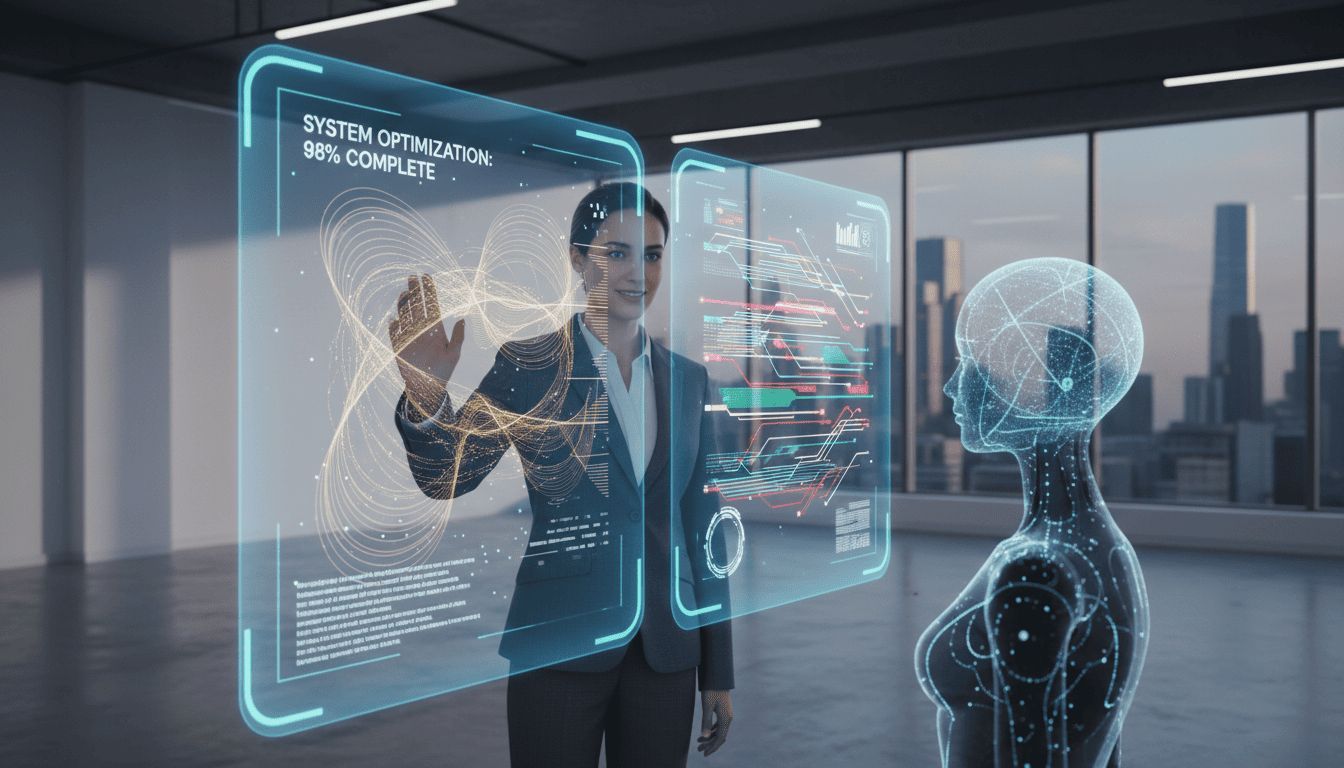
Illustration: Nano Banana
You might also like:
Collaboration between teachers: trust at stake.
An institution can encourage collaboration and even get involved, but without ever betraying the necessary trust and independence of those involved. This is how responsible practice develops.
Self-discipline: a better predictor of academic success than IQ
Self-discipline is one of the fundamental conditions for success in distance learning, and we have every interest in seeing students develop it.
The role of education in Africa's smart cities and initiatives
Smart city projects and initiatives take into account the educational aspect of transforming Africa into a true engine of growth. However, it is crucial to develop ways of not only bringing the benefits to all Africans, but also ensuring better follow-up for their long-term effectiveness.
Crawford invites us all to reflect on the meaning of our work. No doubt we won't all make decisions as radical as his. But in these times of crisis, it can be salutary to remember that repair jobs provide satisfaction and a decent income, whereas many so-called intellectual tasks are in fact nothing more than mechanical operations paid by the slingshot.
Tourism and climate change, culprit and victim
Ghislain Dubois became involved in the question of the relationship between tourism and climate change at a very early stage, starting his research at the end of 1990. His doctoral thesis, presented in the form of a reasoned compilation of his work, traces the methodological, epistemological and prospective developments in this field of research, which was virtually born before his very eyes.