
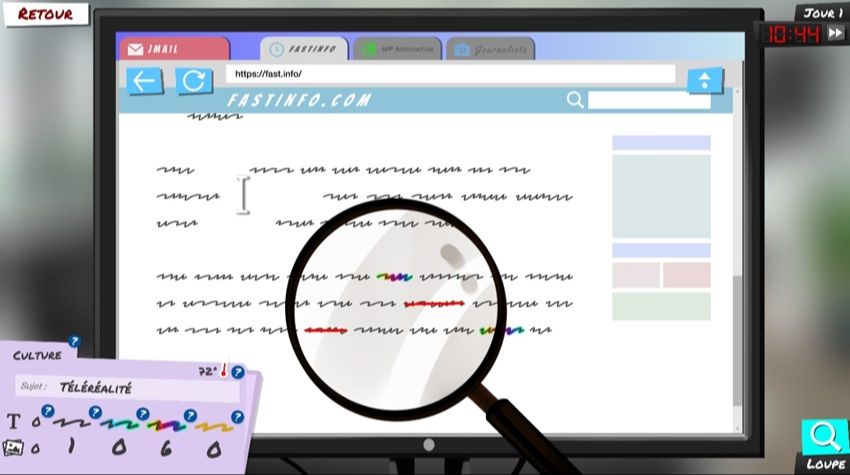
Newscraft: the game that puts you in the shoes of a reporter
A serious game that explains and brings to life the notion of news selection and the editorial line of different types of media.
Publish at March 17 2026 Updated March 17 2026



The relationship between artificial intelligence and art is a complicated one. Already, the question of generative algorithms has raised all kinds of questions about what is or isn't art, and how it should be defined. What's more, its proliferation on the networks has led to all kinds of online reactions, and not always the best ones.
Michael Jones, a British woodcarver, had left his mark on the Internet with incredible creations of animals or mythical creatures such as a centaur from carved and polished logs. However, as we all know, AI gobbles up everything, including previous works. As a result, he was unpleasantly surprised to see people producing images very much inspired by, or copying, his artistic style online. Individuals invented on Facebook pages under the pretext of having created these sculptures, and who delight and interact with older people on Facebook, among others. Specialists call these "boomer traps", since it's usually this generation that likes and shares this type of post created entirely by AI.
Conversely, for the artist, more and more people are claiming that these creations he documents are fake, made by AIs. A remark that leaves Michael Jones a little bitter, although he tries to see it as a compliment. Which just goes to show the need for a "label" to clearly identify what is and isn't AI-generated. So far, however, legislation is stagnant, and watermarking technologies can be circumvented.
Running time: 3min48
Image: Manfred Loell from Pixabay
You might also like:
Newscraft: the game that puts you in the shoes of a reporter
A serious game that explains and brings to life the notion of news selection and the editorial line of different types of media.
Elude: a serious game for understanding depression
An original approach to depression. The game's metaphor is well conceived, a little dark and informative about a problem that affects millions of people.
A fun game about heredity and genetics - Welcome to Thingdom
How do you talk to children about genetics and heredity? A British museum has come up with the method: design a game in which you create a line of adorable creatures with precise objectives. The game is fun, colorful and easy to learn. Even adults will succumb to the charms of the bugs and their large families.
Tests of vigilance and attention
Measuring attention remains a concern in many settings. Some work tasks are not very error tolerant. Here are a series of sample tests to measure attention in children and adults.
The Englishes MOOC course was developed by an artist and is designed for anyone interested in the (English) language. It explores the history of English, its pronunciation, and its relationship to the art world.


