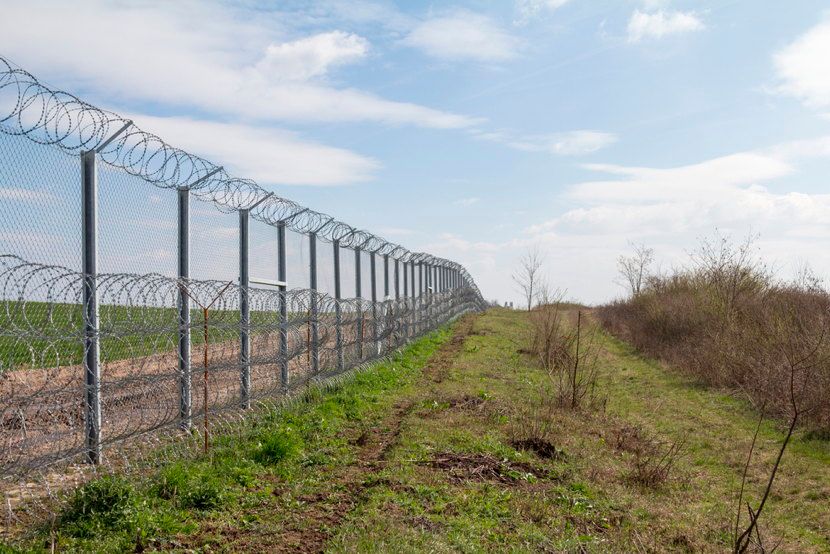
The wall, symbol of resistance to invaders
From the fortified castle wall to the Maginot Line, the wall represents the most basic and common form of defense. It also symbolizes the fear of the "strong" against the "weak", the latter being perceived as a diffuse threat, challenging the rules of the game in which the strong excel.
The most tragic example of this obsession with enclosure as the main means of defense is of course the wall that separates Israel from the Occupied Territories, by encroaching on the latter. Here, the wall has fulfilled its initial objective, which was to stop (or reduce) terrorist attacks on Israelis; but on the one hand, its initiators have retaliated in defiance of the law, and on the other, while the original problem has disappeared, it has been replaced by another of at least equal gravity, which in turn has generated an even stronger response.
Another example, no more glorious, of this desire to push the Other out of one's own territory, is the wall built on the Mexican border by the U.S. How many kilometers of wall will it take before Latin Americans are no longer fascinated by the wealth and dynamism of the U.S.?
And yet, history could teach us a few lessons, especially when we see, in the four corners of the world and in all eras, that these border walls have never enabled any power to survive, in an isolation that can be described as splendid or sinister, depending on which side of the wall you choose...
Of course, the Berlin Wall served its purpose for some forty years, before being destroyed by the descendants of those who built it. For the great geopolitical balances had changed radically during this period; the greatest enemy of walls is time, the time that shifts the lines and sees new players appear in a play whose end is never known.
The biggest wall in the world... absolutely ineffective
The Great Wall of China: a wall that lasts! Without having to climb to the moon, Google Earth lets us see it from the sky. Its construction occupied the successive emperors of a China of variable geometry for more than two thousand years... Once again, the sole purpose was to protect against foreign, "non-Chinese" tribes, as if the mixture was in itself fraught with danger... But did the Great Wall live up to its promises? Apparently not, as the Terra Nova website explains:
In 1279, the Great Wall did not stop the Mongols. They established their own dynasty, the Yuan.
Until 1368, the Great Wall fell into oblivion. Then the Ming dynasty drove out the Mongols.
It was they who built most of what we know today. Under this dynasty, there were up to a million soldiers on the wall.
Yet the strategists of the time must have known that this wall would not stop the enemy. That's one of the mysteries we still haven't solved.
As imposing as it was, it never prevented incursions by the Xiongnu (nomads from the north and west).
In 1644, history repeated itself. The Manchus invaded China without a hitch. The Manchu Qing dynasty reigned until 1911.
"Talking to a wall means talking to someone who won't listen; the wall symbolizes the failure of communication, or rather, the victory of communication alone through violence. Other spaces must open up, like so many breaches, which allow the political expression of adversaries, provided that all respect the commitment to lay down their arms; other spaces must open up, which allow the richest to work effectively to enrich the poorest, not only out of a spirit of charity, but to protect their own interests.
Illustration: BalkansCat - DepositPhotos
See more articles by this author