A summer high school on the Internet. International, of course.
Publish at June 12 2016 Updated June 10 2025


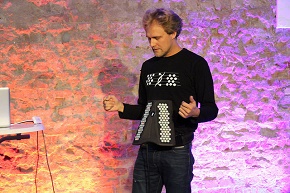
Not everything has been invented, far from it. There are many inventions that are, for the time being, only fiction, and which will see the light of day after years and decades of research. In some fields, it's hard to imagine what more could be invented. In music, for example, the instruments that produce the melodies are no more than variations. Percussion, brass, string and wind instruments or keyboards; do you see a new way of making music?
And yet, that could change. A Frenchman has decided to design a strange instrument, a hybrid between an accordion and a synthesizer that not only allows you to play tunes, but also to learn how to play them without having to learn any real methods: the Dualo Du-Touch.
The project is ambitious. Indeed, anyone who has ever listened to an amateur musician recalls certain auditory tortures such as the shrill sounds of a flute and the squeaks of a violin. So to imagine an electronic device with a totally new architecture in the hands of beginners is enough to make one shudder. And yet, the project aims to be an easy way to make music. Not that Dualo players won't do just about anything at first.
However, the design has been conceived so that notes playing a suitable tune are placed next to each other. What's more, thanks to its hexagonal note system showing different colors, the musician will quickly grasp the notion of chord, pitch and so on. He can also create different loops and play them to easily compose a melody. Better still, by downloading specific scores from the Internet into the device, the notes will be displayed in color, making it possible to produce complex tunes.
The idea came from Jules Hotrique, a musician and mathematician by training, who used geometric concepts to create an instrument that is easy for anyone to handle. He was inspired by an African instrument, the sanza, which is a small thumb piano made of metal strips with a wooden resonance box and a five-note scale. Based on this discovery, he envisioned a device that would, however, play seven-note scales - a more European standard.
The prototype was born in 2007, but it wasn't until 8 years later that a first successful crowdfunding campaign financed the first wave of instrument production. In the weeks and months that followed, videos began to be shared on the Internet of the first lucky ones practicing with the Dualo.
The device sells for around 500 euros... But amateur musicians aren't going to be prepared to spend that kind of money. So the young company has been working on a smaller model, with just as many functions as the basic model. This would cost considerably less (around 350 euros). Thanks to another successful crowdfunding campaign, this time on Kickstarter, the second wave of production could begin, with deliveries expected by the end of 2016.
Although the instrument is less than 2 years old, there is a community of Dualo musicians. They share scores on the Internet and help the company to promote creation. However, the community is mostly made up of musicians in apprenticeship. Most professionals have no desire to learn a new instrument after working for so many years to master one. It's just a matter of convincing a few of them to take it up.
However, the future looks bright for Dualo. Interest in the instrument is on the rise, and the small company will surely have to grow to meet all the orders. What's more, it's not impossible that prices will come down over time. La gazelle has no intention of stopping there. In fact, the company plans to create an instrument learning method using a video game approach.
Illustration : musictechfest via Foter.com / CC BY
References
Cadot, Julien. "Dualo : C'est L'histoire D'un Mathématicien Qui Voulait Réinventer La Musique." Numerama. Last updated April 22, 2016. http://www.numerama.com/pop-culture/163582-dualo-cest-lhistoire-dun-mathematicien-qui-voulait-reinventer-la-musique.html.
"Dualo Du-Touch S: L'instrument De Musique Pour Tous." Chasseurs De Cool. Last updated: April 25, 2016. https://chasseursdecool.fr/dualo-touch-s-linstrument-de-musique/.
Dualo. Accessed June 9, 2016. https://dualo.com/dualo/
Kastrenakes, Jacob. "The Du-Touch S is a Weird and Wonderful New Instrument." The Verge. Last updated May 5, 2016. http://www.theverge.com/circuitbreaker/2016/5/5/11603132/dualo-du-touch-s-instrument-kickstarter.
Morin-Maréchal, Eva. "Dualo Du-Touch: L'instrument High-tech Accessible à Tous." StayAwake Radio. Accessed June 9, 2016. https://www.stayawake.fr/Actualites/high-tech/dualo-du-touch-s-une-musique-connectee-accessible-a-tous/.
Pépin, Guénaël. "Dualo Du-touch S: Un Instrument Pour Debuter La Musique Sans La Théorie." Next INpact. Last updated April 18, 2016. http://www.nextinpact.com/news/99512-dualo-du-touch-s-instrument-pour-debuter-musique-sans-theorie.htm.
You might also like:
Learn how to detect and reduce botnets
Today, the mass of existing robots has led to networks of online bots. A seemingly harmless reality, but one that is unfortunately often used for malicious purposes. How can we protect ourselves against them when platforms do nothing?
Robots as assistants for autistic pupils
In a context where, fortunately, diagnosis of autism is improving and becoming more rapid than in previous decades, robotic solutions will not be out of place. They will be able to help children on the spectrum, among others, with exercises to improve their communication skills.
Writing in the age of artificial intelligence
Artificial intelligence will have a major impact on many human activities, including writing. Authors and students alike can in fact use it as an ally, provided they don't depend entirely on it and inject a little soul into their writing.
The future of megadata, massive data, big data
For half a decade, megadata (big data) have been part of the digital reality. What future can we foresee with their growing use? What if education used it as a pedagogical source or to offer personalized follow-ups for each learner...