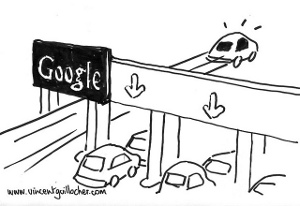
A recent sociology dissertation studies digital visibility in the context of the job search; can the information that recruiters can gather about a potential candidate, through social networks or simple google-ization, reverse the information asymmetry and margin of the unknown that, until now, characterized a recruitment process?
The thesis is structured in three main parts.
- The first deals with individual traces scattered on the internet, social networks etc. Data that the individual, often, chooses to publish, without anticipating their harmful nature.
The author deals in particular with the search engine Google.
The tendency to google-ize a candidate is downplayed by recruitment professionals, but would seem to be commonplace, as shown by several examples of surveys and studies cited by the author.
To wit, since the establishment in Europe of the right to digital oblivion (2014) Google has received 700,000 requests for removal of privacy-related content concerning almost 2 million URLs (de-indexing from the search engine in its European version, for searches that include the name of the individual). For more information, see the Google page on information transparency.
- The second part of the thesis focuses on the online reputation market, services performed through the use of automated monitoring software or the use of mechanisms specific to insurance systems.
The e-reputation players are progressively asserting themselves as prescribers of what is a "good" online reputation, following the example of the Klout score (measuring the level of online influence).
The key issue would be to "cultivate singularity", notably through image.
- The third part addresses the transformation of uses in the recruitment relationship: both candidate and recruiter play with technologies to increase their visibility. On the side of companies the use of social networks can be part of a differentiation and communication strategy (young and innovative company).
Questions
A first observation concerns the non-negligible savings, for HR actors, in terms of subscriptions: a subscription to LinkedIn being 4 times less than traditional employment sites; a testimony also evokes "a cost divided by 7 for the rarest recruitments".
Some skepticism remains, however, in terms of return on investment; several feedbacks reported by the author seem to indicate a very low proportion of recruitment carried out through these channels (internet, social networks).
Many questions are raised:
- in terms of services: the evolution of professional social networks towards the offer of complementary services such as the authentication of diplomas to compensate for falsely embellished CVs;
- in terms of limits of use: researchers have developed in 2016 a predictive algorithm of depression trends based on the dominant hues of images posted on Instagram;
- in legal terms: after the first high-profile dismissals related to content posted on facebook, the author reports an example of a complaint from a young person against her parents, due to the overexposure of her image on social networks, from an early age, without consent.
With an interesting question from the author in conclusion:
"Will the importance given to these images tend to decrease with the diffusion of new conventions or, on the contrary, contribute to increase discrimination against individuals who have not known how to master their visibilitý online? "
Illutration: Vincent Guillocher via Foter.com
References
C. Georgy. Digital visibility and recruitment. A sociology of the evaluation of skills on the Internet. Université Paris-Saclay (2017) https://hal.archives-ouvertes.fr/tel-01468203
(Last accessed March 2017)
See more articles by this author