
We have what it takes to build pedagogies based on experience and thus privileging the knowledge in the being.
Publish at November 25 2018 Updated February 04 2022


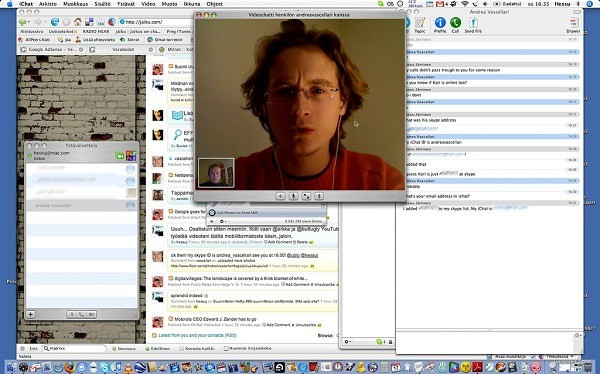
Technology has made communication easier. It is easy to communicate between people in different regions and countries with little or no latency. Yet, if the means to talk to each other have improved, what about the connection between people? Someone can hear without listening, just as another can read without really understanding what is being written. In short, despite the means, nothing guarantees the quality of the human link. This is all the more important in an educational context in which human interaction is essential. Learners need to feel that they can always count on human supervision in their acquisition of knowledge.
Electronic learning formats can seem colder to many. An article on the Canadian site University Affairs highlights this problem of inclusion in online learning. While the flexibility of the device provides an opportunity to theoretically include more students who cannot travel to campus, it is also complicated in human terms. Indeed, the authors note that unlike the classroom where life rules are collaborative, those online are decided unilaterally by the teacher.
And then, online teaching does not, or rarely, allow for seeing the learners' actions unlike the real one. It is therefore difficult to adapt one's approach. In fact, they also note the isolation of the teaching staff, who cannot always take advantage of a community as in a training institution. For them, the issue of integration must therefore be a goal to pursue so that all parties feel less isolated.
If the African proverb says that it takes a village to raise a child, the fact would be similarly true for a digital training. Indeed, this quest for inclusion and more humanity despite the distance is work that requires rethinking the platform and approaches. This requires cooperation and collaboration in the implementation to facilitate work with cloud computing, for example. The technical partners must therefore be aware of the faculty's needs and accompany them in their questions.
Whether it is for a platform or an application, we must think about what will simplify the life of students. What better then than to ask them? We could note in their responses:
Consistently, the teacher must think of online interactions as pre-sentence without the physical cues. In fact, she must listen to the needs of the learners and show openness.
For example, this online English teacher once noted that one of her students would like to have a discussion with her but more freely. After some hesitation, she agreed and reported that in the following weeks, the young woman's performance improved. When asked why, she said that in conversation she had noticed how practice made sense of the theory. In short, by practicing the language without reflecting on what was in the learning material, it stalled the situation.
There are no secrets, then, for the connection to remain despite the distance. We must forget this fact and rethink the interactions and digital tools so that this non-precious aspect is erased. All so that, despite the physical absence, the teacher-learner bond remains intact.
Illustration : Hessuj Video Conference With VMC via photopin (license)
Références
Cavalcanti, Mariana. « Meeting Students' Expectations for a Digital Campus. » Ellucian. Last updated: November 16, 2017.
https://www.ellucian.com/Blog/Meeting-students--expectations-for-a-digital-campus/.
Clow, Eric, and Klodiana Kolomitro. "Online Learning Isn't As Inclusive As You May Think." University Affairs. Last updated: May 2, 2018.
https://www.universityaffairs.ca/opinion/in-my-opinion/online-learning-isnt-inclusive-may-think/.
« Inclusive, L’éducation En Ligne? » CAPRES. Last updated: June 19, 2018.
http://www.capres.ca/enseignement-et-apprentissage/formation-a-distance-et-formation-continue/publication-inclusive-leducation-en-ligne/.
Moriarty, Sean. "It Takes a Village to Build the Digital Campus." EDUCAUSE. Last updated: October 8, 2018.
https://er.educause.edu/blogs/2018/10/it-takes-a-village-to-build-the-digital-campus.
« Mutual Relationship Between Online English Teachers and Students. » Blog.acadsoc.com. Last updated: February 9, 2018.
http://blog.acadsoc.com/teaching-experience/mutual-relationship-between-online-english-teachers-and-students/.
You might also like:
We have what it takes to build pedagogies based on experience and thus privileging the knowledge in the being.
What teaching techniques should you choose?
Depending on the learning objective and the knowledge and skills to be imparted, some teaching techniques are better suited than others. How do you choose the right one? Check out this mindmap to help you make the right choice at a glance!
What if the mechanical and inhuman experience of Artificial Intelligences invited us to rediscover the different ways in which experience teaches us?
Classroom participation: a question of design
Reply to the teacher or argue with them in a balanced conversation? To change relationships, let's rearrange the space...


