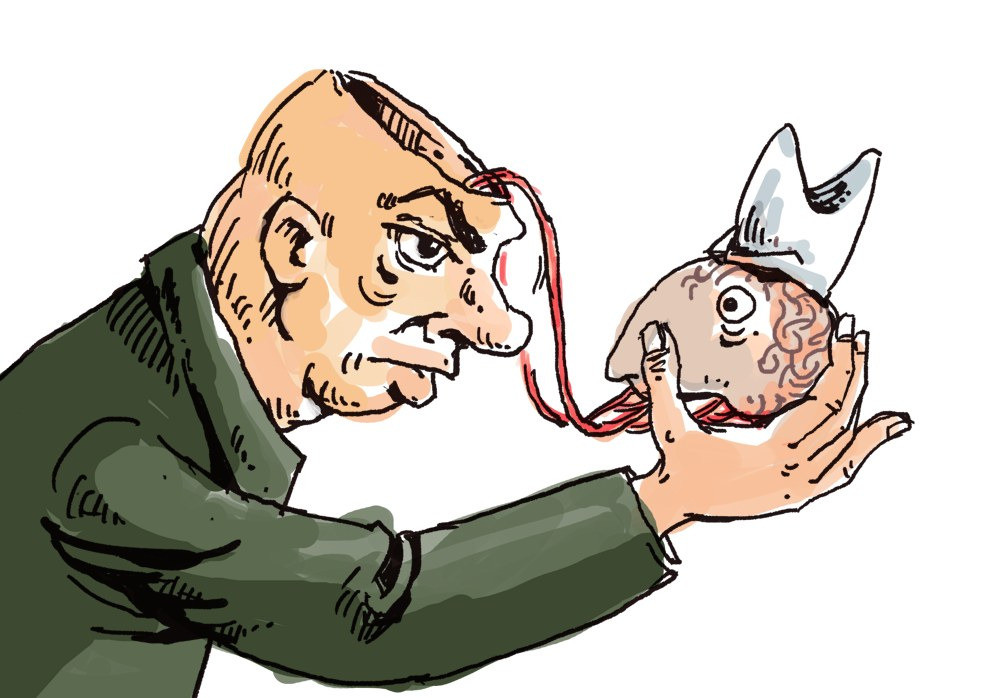
One is precise and rigorous, but slow and lazy. The other is always on the lookout and on the move... but lacks precision. That's a fine scenario for a film in which two anti-heroes line up clumsily. Except that here, it's inside your skull that the story is played out!
This scenario is presented to us by Kahneman, winner of the 2002 Nobel Prize in Economics. An unusual Nobel Prize winner, since he never took an economics course. He is a psychologist, interested in how we approach problems.
However, Kahneman denies that he is trying to explain to us how the brain actually works on a neuronal level. These two systems are merely practical categories to explain how we think.
Along with his colleague Tverski, Kahneman is the father of behavioral economics, which aims to understand and predict behavior. System 1 and System 2, published in French in 2012, is the fruit of five years' work and draws on a wealth of experience. Some are classics in the Human Sciences, others are less well known. They give this book, with its uninviting title, a lively "look", and also explain the 700 pages of the paperback edition.
System 1
System 1 reacts spontaneously. It includes all involuntary thoughts and automatisms. It's the kind of functioning we need for everyday life, and it's sufficient in most situations. It's fast and behaves like an autopilot, without consuming much energy. System 1 is intuitive, allowing us to detect the emotions of our interlocutors, for example. It is also capable of making associations between very different ideas, without always being able to explain them a posteriori.
Its qualities are also its shortcomings. Because it works by association, it is a victim of priming. Depending on the environment in which it is immersed, or the words used a few minutes beforehand, it will produce different conclusions. A famous example is the question of the age of Gandhi's death. If I've talked about old people, or if I've started with a question like: "Was it after or before 80?"I'm going to get a higher response than if I ask the question spontaneously.
Kahneman shows us that system 1 will be the first and only one to be called upon if we feel confident, if the problem seems familiar or if we're in a good mood... On the other hand, if the problem is presented in a less favorable setting, or if the font forces us to slow down the pace of reading... system 2 will take over, and the results will be better!
System 1 will detect what seems out of the ordinary and out of normality. It will react and establish cause-and-effect relationships, but quickly, so that two contiguous events may appear to be the cause of each other. This is very useful when you need to make an immediate decision, in a situation of danger or to keep your mind clear. But System 1 can also produce unreliable reasoning. Kahneman's book contains several hundred pages devoted to the cognitive biases that can be attributed to it.

Among the examples cited, Kahneman returns to the Marchmallows test, which earned Walter Mischel a major publishing success. In this experiment, children are given a choice. Walter Mischel reports that, a few years later, those who waited did better at school.
The quick and immediate response, valued in a digital world where responsiveness and authenticity are essential, is not always the best. Always ready to help, system 1 and its spontaneous associations often mislead us. System 2, much slower to wake up, is more reliable.
System 2
System 2 takes its time, evaluating, analyzing and dissecting, and consumes a lot of energy because of its need to concentrate. This is the system that mobilizes when we sit down and try to focus all our attention on a question. It's critical and doesn't stick to a first solution.
System 2 moves more slowly. Kahneman describes it as an editor who agrees to express what system 1 proposes, or who takes over when faced with a particular difficulty. "System 2 "rereads" the behavior, while the actual writing is done elsewhere, essentially in system 1. But system 2 can block an article or modify it, or mobilize another editor to take care of it."
But system 2 is a lazy editor, and it often validates the just plausible explanations produced by system 1. But Kahneman refrains from opposing the two systems, or condemning the former in favor of the latter. They often collaborate very effectively. For example, system 2 can mobilize system 1. We think intensely about a problem, we fall asleep, and system 1 produces associations between the elements that have remained.
Kahneman's book is not an indictment of the human brain. He invites us to adopt a more conscious strategy between mobilizing the two systems. Distrusting plausibility and first intuition, forcing ourselves to slow down and reflect when there's something at stake, and questioning the obvious are the right antidotes when system 1 takes over and system 2 fails to wake up.
In today's world of frequent solicitations and demands for rapid reactions, we have to make sure that our editor-in-chief doesn't take too much time off!
Illustrations: Frédéric Duriez
Resources
To find out more:
In 2018, behavioral scientist Nick Chater published a more radical work, The mind is flat translated into French as "Et si le cerveau était bête? "
https://www.decitre.fr/livres/et-si-le-cerveau-etait-bete-9782259265195.html#ae85
In it, he shows with definite literary talent that representations that oppose two systems, two parts of the brain, a superficial self and a deep self, are wrong. The brain is flat. The reasoning and implicit theories we attribute to it are merely a posteriori justifications.
Daniel Kahneman Système 1/Système 2: Les deux vitesses de pensée, Flammarion, September 28, 2012, 560 p.
https://www.decitre.fr/livres/systeme-1-systeme-2-9782081211476.html#ae85
https://www.scienceshumaines.com/rencontre-avec-daniel-kahneman-pensee-lente-pensee-rapide_fr_30249.html
https://www.scienceshumaines.com/systeme-1-systeme-2-daniel-kahneman_fr_31981.html
See more articles by this author