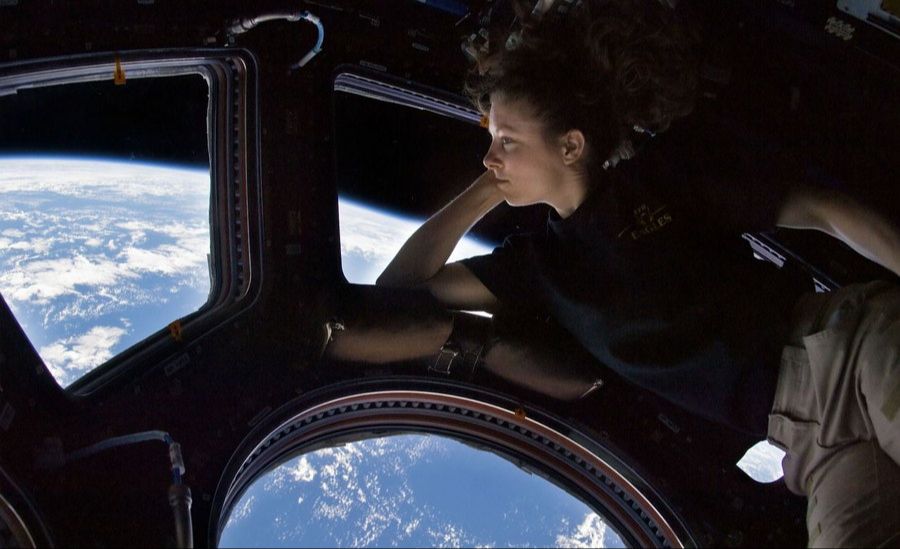
We have all lost something at least once in our lives. From then on, we look to the right and then to the left, but nothing helps: the object remains unaccounted for. It's always in these moments that someone asks you the fateful question: "What were you doing the last time you saw it? That's when the magic happens, we close our eyes and in an immobile inner journey we reconstruct the scene.
What a strange idea to close our eyes to see better! And yet, this is just a glimpse into the doctoral work of Maryam Fourtassi. Her dissertation entitled "Study of eye movements during visual mental imagery, in healthy subjects and in those with representational neglect or homonymous lateral hemianopia" proposes to study our visual mental representations by measuring our eye movements.
Why take a look
Don't be scared off by neuroscience, underneath this discipline lies a bevy of exciting topics like Maryam Fourtassi's. In her introduction she will offer you the basics to understand her work through an affordable review of the works related to her research topic (visual mental imagery, eye movements and pathological context).
Once armed with this knowledge, the author invites you to discover in the second part of her manuscript, her quadruplet of research articles conducted and published during her thesis. In the third part, Maryam Fourtassi proposes to put into perspective all of her work between them and with those of her peers. The style of the text is both clear and elegant. The narrative of this thesis is coherent and the theoretical and experimental research work allows the reader to learn a great deal about a phenomenon that may seem trivial at first glance.
See this by candlelight
"Try to answer the question, "Which city is located further east of Paris, Lyon, or Grenoble?" To do this, you will most likely imagine the map of France, and locate the two cities on it before you can mentally judge the distances and give an answer.
This ability to form mental images of objects or scenes from memory, is a very useful cognitive activity that allows us to solve common problems in everyday life. For example, when we want to choose curtains for our living room, the first reflex is to recall an image of this living room that we "look at in our head" with an "internal eye" in order to verify if the preferred curtains fit in the decor or not. In the same way, when you can't find your keys, once you're at the office door and before you go back to get them, you first try to recall the breakfast scene, and mentally scan it for the image of the keys left in an unusual place.
Given its major role in several cognitive activities (recall of memories, elaboration of strategies in a spatial task, mental calculation... etc.), mental imagery, arouses a lot of interest in contemporary research currents that try to identify the anatomical substrates serving as a support for it and the physiological processes at the basis of its functioning.
In this context, the use of pathological models with precise neurological lesions sometimes proves to be very useful, especially when they display disturbances of the studied phenomenon (representational neglect). Indeed, on the one hand, the study of the deficits presented by these patients allows researchers to better understand the physiological mechanisms whose disturbance is at the origin of these deficits. On the other hand, any breakthrough in understanding the neural processes involved offers clinicians a better approach to the cause behind the patient's disability, and therefore opens the way to possible therapy.
During visual mental imagery, our eyes move in the same way they would if we were looking at a real scene. Thus, these rapid eye movements called "saccades" will adopt horizontal directions; when judging the distance of cities east of Paris, or vertical directions; when appreciating the proper length of curtains for the living room window. [...]"
Getting a grip
Maryam Fourtassi's work has characterized the processes of visual mental imagery.
Thus, in healthy subjects, the author reveals that the latter is created in a sequential and fragmented manner, but also that its significant correlation constitutes a signature of visual imagery use. The spatiality of mental imagery is maintained in some subjects with fixed gaze and manifests as microsaccades of eye movement.
The author shows that specific neurological contexts such as that of Unilateral Spatial Negligence (USN) and that of Homonymous Lateral Hemianopsia (HLH) can alter subjects' visual mental imagery processes in distinct ways.
Subjects with NSU do not have any ophthalmologic or visual information processing disorders, however a neurologic lesion affects their abilities to perceive and conscious one side of their field of vision and memories. This pathology can lead to surprising situations in which the patient eats only one side of his plate or turns only in one direction to move. The results of this dissertation appear to show that the visual mental representational ability of these patients is disrupted across the entire field of vision.
Subjects with HLH have loss of vision in one half (left or right) of the visual field due to a lesion at the optic chiasm of the visual cortex limiting information processing. The results seem to show that the mental representation in these patients is spatially coherent and that it is shifted in the visible part of their visual fields.
Maryam Fourtassi's thesis supports Kosslyn's imaging model from cognitive psychology, according to which visual mental representations share properties with real images (shapes, colors, and spatial relationships) and allow us to make predictions for a given situation by mentally simulating it, based on our experience, and giving us the ability to mentally move in time and space in them.
This work on the visual mental representations we make for ourselves, may allow us to better understand the mental processes offering the most imaginative among us the power to deconstruct and explore imaginary worlds. We may wonder if this capacity of our brain can be improved, trained, or even stimulated to project us into simulated environments independent of our past experience...
Good reading...and good mental representation!
Thesis presented and defended on December 16, 2016. Work performed at the Lyon Neuroscience Research Center (CRNL); CNRS: UMR 5292; INSERM: U1028 and within the Neurosciences and Cognition (NSCo) doctoral school: ED 476; Claude Bernard Lyon 1 University; University of Lyon (Lyon France).
Sources
Maryam Fourtassi. Study of eye movements during visual mental imagery in healthy subjects and in those with representational neglect or homonymous lateral hemianopia. Neuroscience. University of Lyon, 2016. French. ⟨NNT: 2016LYSE1287⟩. ⟨tel-01616846⟩
Thesis link:
Page: https://tel.archives-ouvertes.fr/tel-01616846
PDF: https://tel.archives-ouvertes.fr/tel-01616846/document
See more articles by this author