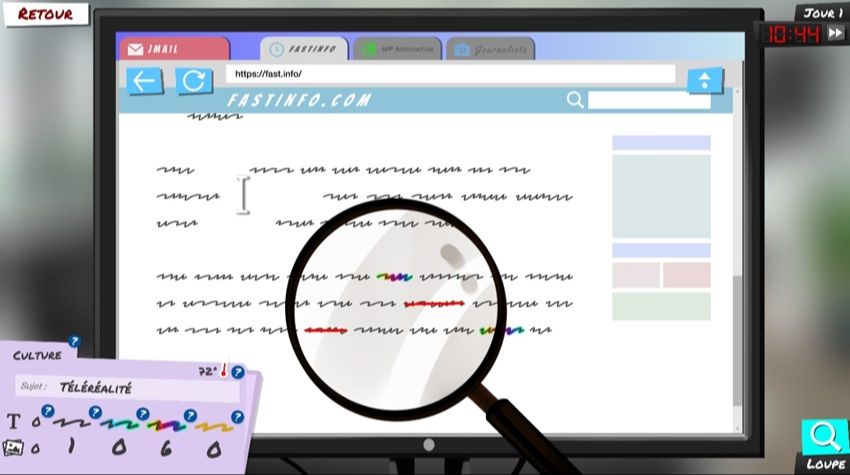
Newscraft: the game that puts you in the shoes of a reporter
A serious game that explains and brings to life the notion of news selection and the editorial line of different types of media.
Publish at March 14 2022 Updated March 18 2022


The topic of sexual violence is nothing to celebrate, but in a period following the "#MeAlso" phenomenon, more liberated speech is lifting the veil on all sorts of preconceived notions. Thus, works of fiction have transmitted to us the image that a victim of assault or rape will struggle, scream and show her disagreement. However, the reality could not be further from it according to scientific research.
A huge part of the victims, as this Le Monde report shows, undergoes psychic sideration. That is to say, the context is so psychically and psychologically violent that the higher brain functions that allow to react do not receive any signal. Only the section governing fear acts.
For that matter, the production of cortisol (stress hormone) is so strong that the brain has to shut off this feeling in order not to become intoxicated. As a result, people experience dissociation as if the situation is not real or they feel like they are seeing it from the outside.
Both of these phenomena contribute to the fact that few victims file complaints out of shame at having to answer the question, "But why didn't you do something?" When the guilt should instead go to those who commit these criminal acts.
Time: 8min15
Photo: Melanie Wasser on Unsplash
Learn more about this resource
You might also like:
Newscraft: the game that puts you in the shoes of a reporter
A serious game that explains and brings to life the notion of news selection and the editorial line of different types of media.
The sharing economy has led to small changes in various economic sectors such as transportation, housing, etc. This approach has changed the relationship of citizens for different services, now cheaper and offered by their fellow citizens. However, who actually benefits from this new economy? The people or the companies in question? A U.S. newsgame shows how the life of Uber drivers isn't as lucrative as one might think.
Koam, playing with balanced nutrition
A veritable showcase for public health, Koam was developed by Nutrikeo, a consulting firm specializing in nutritional strategies. Supported by BPI France, the Nouvelle Aquitaine region and Europe, Koam is the result of two years' work by a team of leading specialists in nutrition, childhood, pedagogy, sociology, digital and behavioral theory.
A multiplayer game designed for people with disabilities
Video games designed for people with disabilities are already a rare resource. An experience that allows multiple players is even rarer. Yet this latest creation from "Ludociels for All" challenges players to light up an entire maze by walking balls of light.