Anticipating the inflections of a popular teaching method: "co-development
Publish at April 13 2022 Updated April 21 2022


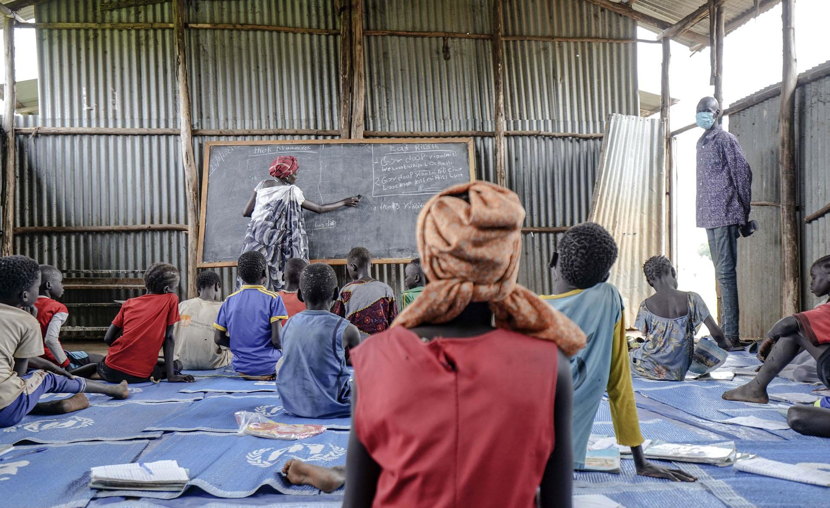
At the worst of the health crisis caused by the COVID-19 epidemic, more than 1.6 billion learners of all ages were affected, representing 94% of the world's school-going population.
During this period, IIEP supported the education systems of UNESCO's member states with key documents, policy recommendations, and technical support.
This support covered many areas, including coordination across sectors, safe reopening of schools, and ongoing support for learners, families, and teachers.
In 2021,
This is a critical time for education globally. The COVID-19 pandemic has radically changed the interactions between students, teachers and administrators, as well as the overall learning environment. It also accelerated innovation: in such a short time, schools around the world went online and embraced new technologies.
As countries continue to adapt and ultimately recover from the crisis, IIEP hopes that the lessons of this momentous period will help education systems better build for the future. IIEP will also host a new strategy in 2022-the 11th Medium-Term Strategy-to implement transformative change. We invite education practitioners - planners, policymakers, managers - to engage, plan, and build the future with us.
Ten value chains guide IIEP's work with its target audiences, particularly ministries of education around the world.
These value chains-defined in the 11th Medium-Term Strategy 2022-2025-are embedded in all of IIEP's training, technical cooperation, research and development, and knowledge-sharing activities, underscoring the Institute's commitment to the 2030 Global Education Agenda.
Download the "IIEP in Action 2021" report: French, English, Español,
You might also like:
The political dimension of the game
A game is not an innocent object. No matter what form it takes or how much fun it is, it transmits positive or negative values. With this in mind, pedagogical specialists see the possibility of creating a variety of games (tabletop, role-playing, video) to transmit values or confront those of learners.
Humans in continuity with their environment
A plea text that shows that knowledge passes through a human, its environment and transforms itself, and is not a cut-out of the living. On this condition, knowledge is alive and regenerating.
Start a lesson with a test on the previous lesson: much better for retention!
In distance learning, it could be better to place small tests not at the end of a lesson, but at the beginning of the next one...
Unplugging for better development; summer camps have understood this
Summer camps have always offered young people what parents fear most. In the past it was the wilderness, the exposure to the raw elements, and today it's not being able to join their beloved offspring for a week or two.