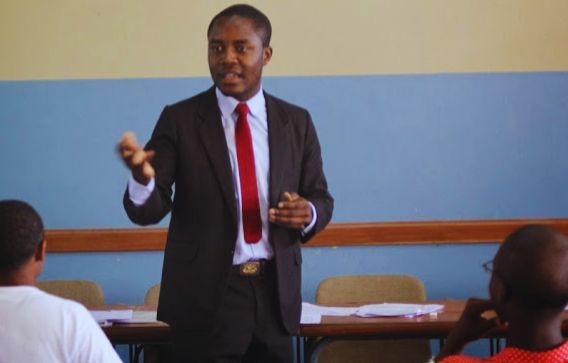
"I was a stutterer and debate-structured cured me," was the phrase uttered on December 9, 2021 by Binyou Bi-Homb Marius Yannick, during the general assembly of the Senghor University Oratory Art Society (SAOS), in Alexandria.
The founder of the Cameroon Debate Association (CDA) and the International Network for the Promotion of Oratorical Art in Africa, the Caribbean and the Pacific (RIPAO) to explain his passion for Oratorical Art, regularly hammers out that he has been relieved of stuttering by practicing it. This statement leads us to question the relationship between orality and the well being of speakers, hence the concept of oralth therapy.
But before returning to oralth therapy, as we conceive it, we should first rule out any confusion with oral therapies and specify the type of orality we are talking about here, then we will return to the benefits of oratory games and finally we will give some leads for people wishing to take advantage of the positive effects of oratory games.
Beyond Oral Therapies, oralth therapy and speaking games
The evolution of medicine and the treatment of various pathologies has given rise to what is called in medical jargon the oral therapies. These are processes of monitoring and especially accompanying patients through speech. This accompaniment is conducted by specialists in the medical field such as psychologists, oncologists and many other specialists. This article is not about these medical therapies but about another form of relief that involves speaking in the context of a game: oratory games.
We understand by oralth therapy an activity based on orality that, through its playful purpose, provides well-being to the person who practices it. This makes it different from oral therapies, usually provided by another person, possibly a specialist in the medical field. The orality we are talking about is the one based on public speaking games.
The public speaking games group a set of playful activities based on public speaking.
As part of a research we conducted in 2021 on oratory games within the CDA, we distinguished four main oratory games:
- storytelling,
- slam,
- individual speaking[1] or eloquence and
- debate-eloquence or debate-structured[2].
Public Speaking Games, Language Learning and Development
Public Speaking Games are language learning and development activities. Let's revisit the case of Binyou, who claims to have resolved his stuttering with the practice of debate eloquence. The stuttering is not a disease as such but a language disorder that is characterized by involuntary speech interruptions. It is treated through speech practice sessions with an orthopedist.
However, Binyou just like many children in Africa, had no means of consulting to treat stuttering. Moreover, few people know that it can be solved through specific exercises. Marie-Ève Bergeron-Gaudin[3], a speech therapist, proposes, among other solutions to resolve stuttering, listening, articulation, patience, in short, language learning techniques. All these approaches are also applied in the context of speaking games.
A speaker is always seeking to improve his expression. So we can understand the reason why Binyou would have solved his disability by practicing debate speech.
Play therapy
The orally therapy is nothing but play therapy. Slamming, storytelling, eloquence, and debate-speech are first and foremost games and therefore have the same functions as those of play activities: to entertain, to move, to de-stress etc.
Oratory games as they are practiced not for the primary mission of treating or predicting abnormalities but their practice cannot be without an effect on the practitioner. In the research prompted, several children participating in the ORATORIUM contest affirm that public speaking games, while entertaining them, allow them to overcome their state of sadness and especially to overcome the phobia of public speaking.
There is a "play therapy applied by specialists to treat or accompany the treatment of patients, especially children. This therapy does not specify what games to use. According to Cindy Dell Clark, "Play therapy, by formalizing a context in which children guide play, emphasizes the importance of play in adaptive healing in general. Children's deep engagement, including play themes, can reveal underlying unresolved issues, especially in sick children."[4].
Speech games are also part of this dynamic. Solange Langenfeld (2008) taking the case of storytelling, demonstrated how it was used to treat characteristic disorders in a little girl. We can also cite the case of slamming, which is increasingly being promoted to prevent Alzheimer's disease in the elderly. It constitutes a "excellent therapy".
When speech frees itself and you
Speech frees. The simple fact that a patient explains his or her health problem allows the doctor to better identify the pathology just as the fact that a person recounts the ups and downs of his or her life allows the psychologist to better accompany the patient. It is therefore a word that must be done in a precise context and at the right time so as not to become a source of distress.[5]
Speech is not only liberating if one adopts a clinical approach, even in the case of oratory games, it is an undeniable opportunity to express oneself, to share one's thoughts.
In the case of debate-lecture, the debater is asked to debate on some topic. He or she must work on his or her strategy in order to convince not only the speakers on the opposing side but also the judges and the audience. In a political context where public speech can be susceptible to censorship, as is the case in his country Cameroon, the debater Gaetan Nguetchuechi makes us understand that this is the only time during which he says what he thinks in public without fearing reprisals, since he is doing so as part of a game.
Speech games thus become places of freedom of speech and in turn bring well-being to the practitioners.
Some tips for enjoying oral therapy
If you are looking for new passions or distractions that emphasize speech, there are three possibilities:
- You can approach public speaking societies or associations promoting public speaking games. If you are in France, the Francophone Debating Federation can accommodate you. In Cameroon, the Cameroon Debate Association is the ideal place. The Debate Oratories (DO) open their doors greatly to you in Bukina Faso etc.
- Participate in championships or national or international eloquence or oratory events. Among other events, we have:
- the International Francophone Debating Championship in Lebanon,
- the Pan-African Debating Cup in Africa (COPAD),
- the International Competition of L'université Paris 1 Panthéon-Sorbonne,
- the International Eloquence Competition of Senghor University in Alexandria, and
- the International Meetings of the Arts of Orality (RIAO).
- Failing to practice oratory games directly, you can go to the various online sites dedicated to oral practices in order to enjoy audio and video content on orality: Idebate, CDA, RIPAO, FFD, Polydébat etc.
In short, just as you get up in the morning to jog, play soccer, sing and so on, you can also practice speaking games to entertain yourself or relieve some of your difficulties both physical and psychological.
Public speaking societies or public speaking game associations organize regular fun activities with speech as their main tool. Their number is clearly growing and they are becoming important in the lives of many members. Their health benefits are multiple and the only thing you will lose by integrating them is unhappiness.
Talking, debating, storytelling, slamming, in a playful way brings you happiness.
Bibliography
Afsané Sabouhi et al, "Does Speech Cure All Illnesses?", 2021,
https://www.caminteresse.en/societe/la-parole-soigne-t-elle-tous-les-maux-11153305/
Bergeron-Gaudin, Marie Ève, J'apprends à parler Le développement du langage de 0 à 5 ans, 2018.
https://www.decitre.fr/livres/j-apprends-a-parler-9782896196432.html
-Clark CD. "Play therapy" in Tremblay RE, Boivin M, Peters RDeV, eds. Smith PK, ed. theme. Encyclopedia on Early Childhood Development, 2013,
https://www.enfant-encyclopedie.com/jeu/selon-experts/therapie-par-le-jeu
-Fomekong, Narcisse, "Oratory Games in Africa and the Promotion of Intangible Cultural Heritage,2021
https://www.academia.edu/56828260/Jeux_oratoires_en_Afrique_et_promotion_du_patrimoine_culturel_immat%C3%A9riel_Fomekong_Narcisse
________________________________________
[1] This is individual public speaking that is done with the aim of convincing through the force of the arguments and the beauty of the word. It is the main activity of eloquence competitions.
[2] It is "a discipline of oratory games consisting of opposing two teams with opposite or different perspectives that, from a specific format, must analyze a motion (topic) in order to draw out its relevance, and this in the presence of a jury and an audience. " (Fomekong, 2021:53).
[3] Bergeron-Gaudin, Marie Ève, J'apprends à parler Le développement du langage de 0 à 5 ans, 2018.
https://www.decitre.fr/livres/j-apprends-a-parler-9782896196432.html
[4] Clark CD. "Play therapy," in Tremblay RE, Boivin M, Peters RDeV, eds. Smith PK, eds. Encyclopedia on Early Childhood Development, 2003, https://www.enfant-encyclopedie.com/jeu/selon-experts/therapie-par-le-jeu
[5] Afsané Sabouhi et al, "Does Speech Cure All Evils?", 2021, https://www.caminteresse.fr/societe/la-parole-soigne-t-elle-tous-les-maux-11153305/
See more articles by this author