Graphic facilitation is a set of techniques designed to share and bring out ideas and cohesion, using a mix of visuals, keywords and expressions. Images play an important role. And these images are all the more effective if they don't simply illustrate key words.
Here's a non-exhaustive overview of the most common techniques for producing images that are all the more telling for taking a detour.
Playing with archaisms: drawing on the history of objects
Our decade has seen the disappearance of many symbols. Whether you want to represent film editing, the telephone, photography or written exchanges.... the contemporary image will always be a black rectangle with a glass slab, and a tiny eyecup at the top center...
The smartphone is a formless object that supports many of our activities. So we often have to draw on the repertoire of images from the past to evoke these activities. The wired telephone, reel-to-reel film, silver camera, floppy disk or studio microphone are all still fresh in our minds. Many of us can't remember what a floppy disk is, but will recognize it as a symbol of memory. Gradually, these objects retain their metaphorical value as their use fades into oblivion. For example, a child may recognize a communication symbol in a picture of a rotary telephone without ever having seen the object!

Living metaphors: avoid catalog metaphors
For a metaphor to work, it has to evoke what it's aiming at without too much ambiguity, but it also has to attract attention, surprise and seduce. Yet the novice facilitator is eager for technique. "How do you draw such and such an object?" is a regular question. Drawing a car in a few strokes, or an animal in a few seconds, are not insignificant skills. But we probably need to go further.
If I use the cliché of the light bulb to talk about innovation, I can transform it, modify it, give it a shape or dimension that will slightly upset my audience and give more strength and relevance to the rendering. The incandescent wire can take on an original shape, just like the bulb or the metal part... The object can appear in a bubble, in a head, or come to life with two eyes and two arms. It can interact or communicate with its environment.
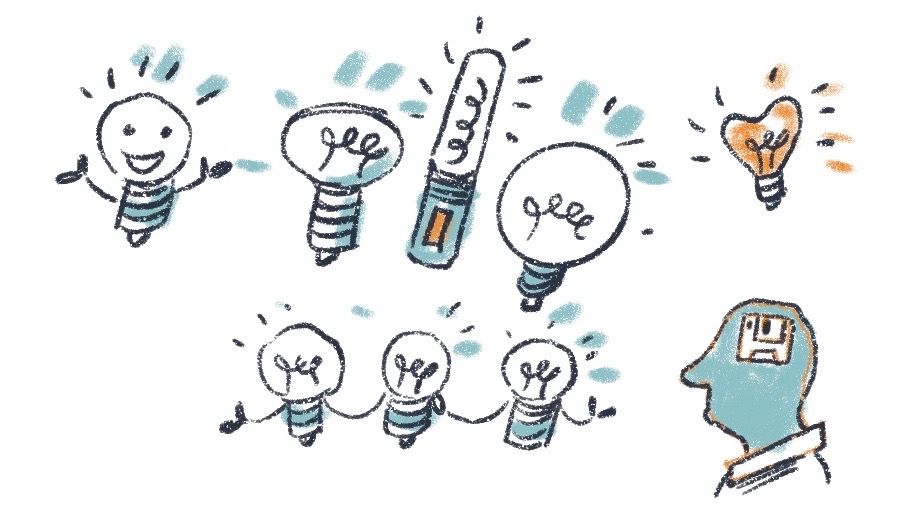
From the lamp in the credits of the first Pixar films to Wall-E, animation shows us how the most banal object can carry a meaning, an emotion and a sympathy that surpasses it as soon as it is animated like a living being!
The risk of metaphors: one meaning can hide another
The meaning of objects is evolving. A metaphor that made people dream a few years ago can, in certain contexts, become a turn-off. An engine or a rocket were inspiring images not so long ago. A laboratory full of chemicals could be a pretext for thinking about success factors...
Nowadays, these images are less likely to work. Above all, they tell us about pollution. And not everyone dreams of going to Mars... So we have to be careful with metaphors that refer to energy consumption, health, invasive species or technological optimism!
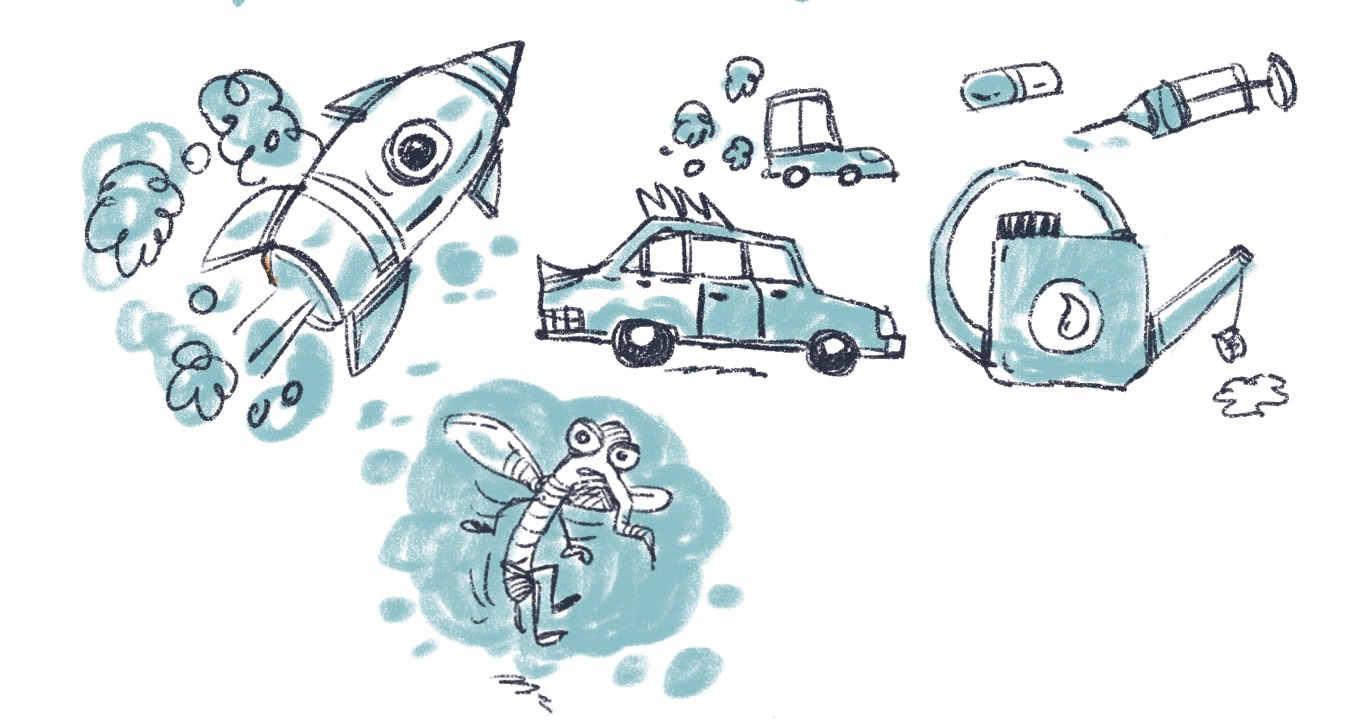
On the other hand, living things and plants, from country flowers to ivy and brambles, are inspiring images that can be used as metaphors to build projects or consolidate a vision. Let's stop trying to draw racing cars. Let's learn to draw complex, varied vegetation, with survival strategies and collaborations that can stimulate the imagination!
Variations on generic shapes
The story is told of Diogenes, who roamed the streets with a lantern, shouting "I'm looking for a man". Volunteers who came forward were ruthlessly chased away. "You're not ONE man, you're Leandros, Niketas, Thimotheos or Callias!". Let's keep this story in mind. Let's not draw men, but characters capable of carrying a story. Graphic facilitation benefits from moving away from generic forms and giving life to places and objects.
If I want to present a route or a journey, I canpresent a vehicle. But I can choose the vehicle. The nature of the vehicle, its accessories and its degree of realism will all make sense. The illustration below illustrates the method. A vehicle consists of a base, often parallel to the ground, and a curved line at the bottom. A complementary curve, rarely parallel, locates the top of the vehicle. The distances between the wheels, the height of the glass and the more or less aerodynamic curves are all part of the metaphor.

The basis of the variations: 1: draw a horizontal line, the base of the vehicle - 2: the main line - 3: define the space between the wheels by determining the number of wheels that could fit between them - 4: draw the curve of the top of the vehicle - 5: join the elements (green lines on the drawing).
I can also present a bicycle, which can of course also take many forms, a bus, steps, paths or paved roads, smoke trails, signs, a map... The list is almost endless.
Co-constructing the metaphor
Building the metaphor with the group in facilitation is an even richer approach! For example, Dina Scherrer's trees of life share common characteristics. The ground answers the question: "What do you need?", the trunk brings together qualities and skills and, in between, the roots present history, practices, motivations...
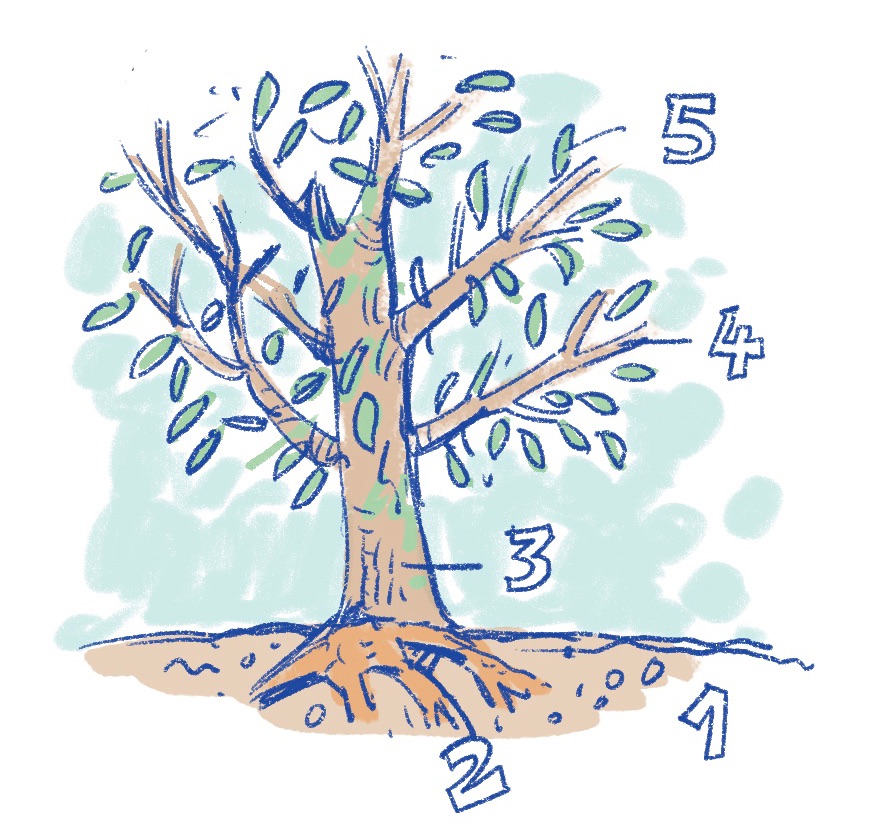
But the examples the author reproduces in her book show how each individual appropriates the form and proposes slight variations.
Values sometimes shift between the ground, the roots or the trunk, without this being troublesome; branches and leaves can also carry different meanings. What's important, however, is that these representations help to ask narrative questions and to bring out a story that fosters self-esteem.
Trees of life, like courses, boats or illustrated recipes, are among the classic metaphors left to the groups, who themselves come to put meaning onto an empty form. This "model" principle is undoubtedly one of the most powerful uses of metaphors.

Don't just pose the metaphor.
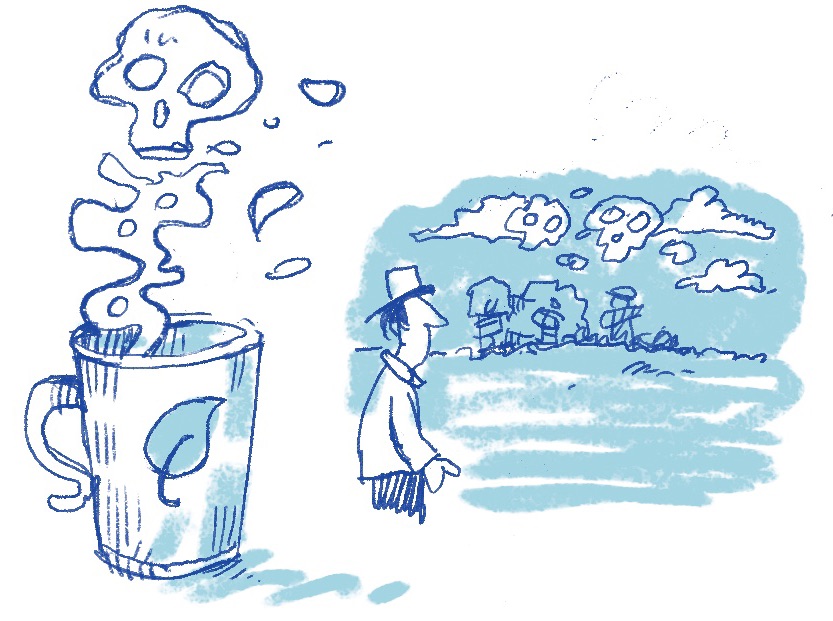 Metaphors can overlap, respond to each other or merge into a larger image. Clouds or the steam of a drink, islands on a map or cartoon phylacteries, for example, can take on forms that wink at participants.
The cartoon "bubble" can become a window, a grid, a scroll or even a light bulb, to bring this article full circle!
Illustrations: Frédéric Duriez
Sources :
Frédéric Duriez "Dix métaphores visuelles pour la formation" on Cursus.edu 2015
https://cursus.edu/fr/10192/dix-metaphores-visuelles-pour-la-formation
Scriberia is undoubtedly the group of professionals who share the most and with the greatest talent about storytelling and image production in facilitation and visual note-taking: https: //www.scriberia.com/
See more articles by this author