
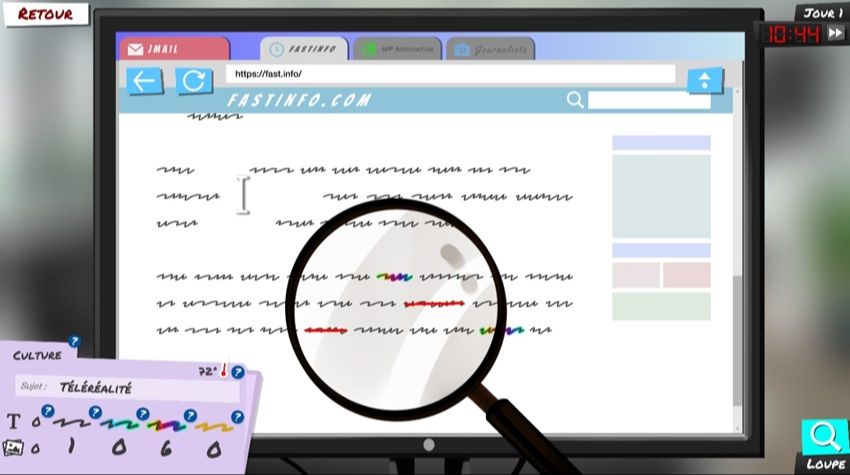
Newscraft: the game that puts you in the shoes of a reporter
A serious game that explains and brings to life the notion of news selection and the editorial line of different types of media.
Publish at November 22 2023 Updated November 22 2023


Artificial intelligence is not an option for every country in the world. This technology has already had, and will have in the future, major effects on the population. Among the major powers, China has understood that it is absolutely essential to be among the pioneers in this field. Tens of billions are poured into this industry every year. The Chinese government plans to spend 30 billion on AI by 2027.
People are increasingly living with these algorithms on a daily basis. If the scenario in Spike Jonze's film"Her" seemed surreal, today thousands of Chinese people are having friendly and loving relationships with AI-managed avatars. One designer has even created a solution to keep deceased people digitally "alive" on devices. He did it for his mother, unable to accept her loss.
On the industrial side, some company presidents are using AIs to perform parallel tasks, such as promoting products with an avatar. Hundreds of avatars present shows and advertisements in China. In addition, there is an AI-controlled boss. She can quickly bring an employee back to order, congratulate him or her or change his or her job. Despite this, a flesh-and-blood person remains to support the algorithm's decisions and have more emotional discussions if need be. Millions of people are out of work, especially in the design field, because companies prefer to deal with artificial intelligences that can come up with hundreds of proposals in an hour.
This vision of society raises questions, and even concerns. On the other hand, the country could well find itself in trouble eventually. The best AIs in general gain in strength with the acquisition of data. But Beijing's strict approach to freedom of information limits potential gains. In addition, trade disputes with the United States, among others, are likely to jeopardize the supply of new-generation microprocessors.
Running time: 17min18
You might also like:
Newscraft: the game that puts you in the shoes of a reporter
A serious game that explains and brings to life the notion of news selection and the editorial line of different types of media.
Learn the mechanisms of misinformation with Bad News
Understand the strategies of online disinformation through an interactive experience that puts you in the shoes of a fake news propagator.
The sharing economy has led to small changes in various economic sectors such as transportation, housing, etc. This approach has changed the relationship of citizens for different services, now cheaper and offered by their fellow citizens. However, who actually benefits from this new economy? The people or the companies in question? A U.S. newsgame shows how the life of Uber drivers isn't as lucrative as one might think.
The Englishes MOOC course was developed by an artist and is designed for anyone interested in the (English) language. It explores the history of English, its pronunciation, and its relationship to the art world.
A fun game about heredity and genetics - Welcome to Thingdom
How do you talk to children about genetics and heredity? A British museum has come up with the method: design a game in which you create a line of adorable creatures with precise objectives. The game is fun, colorful and easy to learn. Even adults will succumb to the charms of the bugs and their large families.


