Newscraft: the game that puts you in the shoes of a reporter
A serious game that explains and brings to life the notion of news selection and the editorial line of different types of media.
Publish at February 28 2024 Updated February 28 2024


In a digital world where millions of pieces of information are published every minute, it's hard to keep track. Disinformation specialists have therefore seen an interesting seam to exploit in order to create strong emotions and rally people to their side. For these people, the question of truth takes second place.
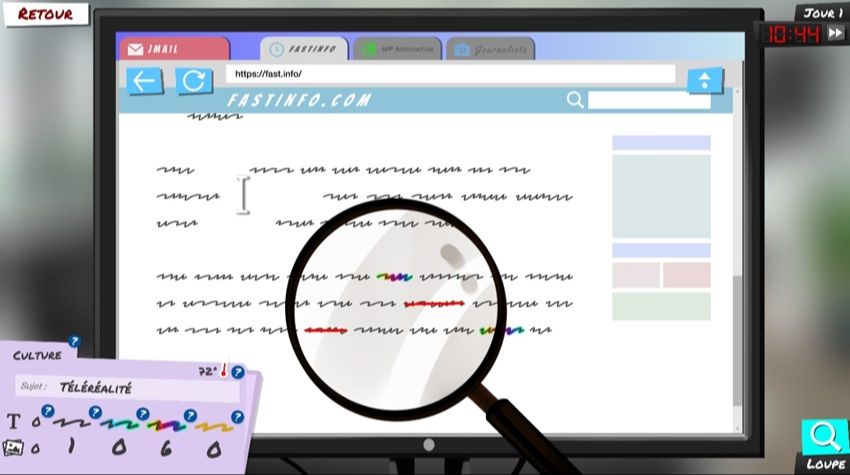
So Cambridge University decided to work with a serious games studio to create an interactive adventure on the subject. Here, however, there's no question of being the one to expose the lies. On the contrary, you'll have to do your bit to gain popularity online. They'll be invited by a mysterious online colleague to start by uploading small pieces of misinformation and denunciatory memes. Then came the time to create his own independent media to protest "political correctness" and reveal what the press "doesn't want to tell the people".
Campaigns against GMOs, vaccines, climate change and more; the simulation seeks to provoke by explaining why misinformation swarms on the networks. Because it's so much easier and more attractive when it comes to popularity. It doesn't take long to become the holder of the "truth" among other users, all without verifying anything and sharing only elements that will arouse fear, rage and indignation.
The game is aimed at teenagers aged 14 and over, as the simulation includes occasionally violent language (without obscenities or unbearable images). However, you'll need a basic knowledge of English to play, as the experience is offered in several languages (22!), but not in French. Nevertheless, with the help of real cases and a teacher, for example, who will be following this adventure into misinformation, it will be easy to understand the different strategies of fake news, and to look at ways of preventing it.
Learn more about this training
You might also like:
Newscraft: the game that puts you in the shoes of a reporter
A serious game that explains and brings to life the notion of news selection and the editorial line of different types of media.
The sharing economy has led to small changes in various economic sectors such as transportation, housing, etc. This approach has changed the relationship of citizens for different services, now cheaper and offered by their fellow citizens. However, who actually benefits from this new economy? The people or the companies in question? A U.S. newsgame shows how the life of Uber drivers isn't as lucrative as one might think.
Tests of vigilance and attention
Measuring attention remains a concern in many settings. Some work tasks are not very error tolerant. Here are a series of sample tests to measure attention in children and adults.
A virtual aquarium to understand Darwinian evolution
Is it possible to understand evolution through simulation? It would seem so. A very interesting resource for high school science classes.
Koam, playing with balanced nutrition
A veritable showcase for public health, Koam was developed by Nutrikeo, a consulting firm specializing in nutritional strategies. Supported by BPI France, the Nouvelle Aquitaine region and Europe, Koam is the result of two years' work by a team of leading specialists in nutrition, childhood, pedagogy, sociology, digital and behavioral theory.