Each environment has its own sound signature and communication protocols to facilitate relationships. For example, the characteristic hubbub of a schoolyard is made up of hundreds of shouts and words from interacting children. It's a safe bet that we'd be able to recognize the sound of a schoolyard regardless of the children's language, anywhere in the world. If we could remove all the noise from a construction site, an office, a factory or a store, and keep only the sounds of humans, we'd no doubt have a different soundscape, but one still made up of the messages exchanged by working people and the particular way in which they exchange them in that environment.
While some animals are capable of associating symbols with meanings, we don't yet know of any examples of animals leaving written traces. Animals don't know how to write; their language is essentially direct, in sound, gesture or olfactory mode. So, if we look at the instant messages we exchange, we get some idea of the kind of messages exchanged by the birds and animals that trace the sonic, visual and olfactory landscapes of each region.
Categories of common instant messages.
(Examples on social networks, in schoolyards, in air traffic control exchanges)
Type of message
| Social network
| Schoolyard
| Control tower
|
Greetings / contact / identification
| Hello Charles | Julie! | TangoZoulou Flight 362 |
Situation
| I'm just around the corner
| I didn't see you yesterday. Did you do your homework? | Approaching |
Planning
| I'll join you
| Are we going to play this game? | You'll have the main track in 3 minutes |
Acknowledgement / Response
| OK
| Yes | Roger |
| Appreciation | Emoticon
| Super | Clear 5/5 |
Affectivity
| Yé
| "Screams"
| Glad to hear from you
|
Comments
| Interesting
| She's the best | You're early |
Information
| The door is open
| The balloon is soft | Freezing temperature on the ground |
Requests
| How do I get there? | We need to find a pump | We need a technician |
| Reactions / Conflict resolution /Intimidation | I tried it and it's fine
| It's my turn | Priority |
End of communication
| Bye
| Ciao | Over |
It's not a question of anthropomorphism, but of trying to understand how context modulates message content, and what kind of protocol is common in any kind of direct communication.
A bird at the top of a tree, a dolphin in a bay, an elephant in the savannah, a cow in its field are all affected by the time of day, the ambient temperature and climate, the presence of wind, current, terrain, biological rhythms (mating season, migration time) and above all by the presence of other members of their species, predators, food sources and other beings more or less significant to them.
Logically, there should be specific signals according to the importance of the interaction: a cry for the presence of danger, a call for a mate, the position of this or that element in relation to another, information on food, etc. Each category of instant message should be present in the same way. Each category of instant message should be found in one way or another.
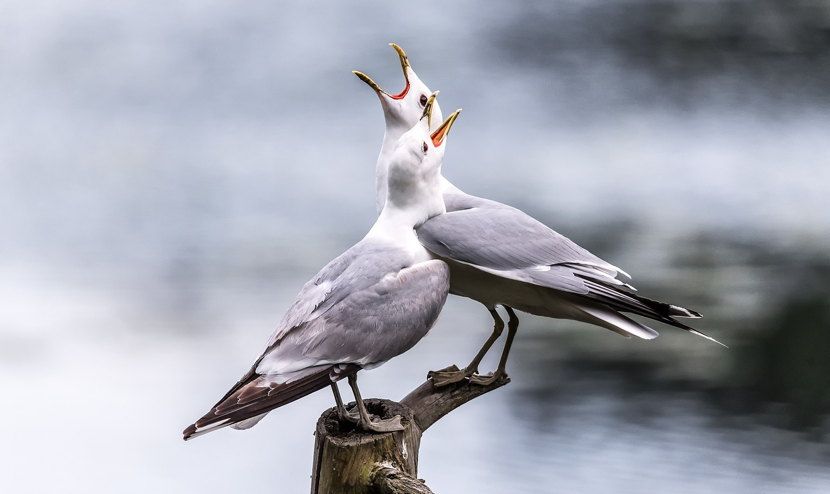
Seagulls call their mates when they find a food source they won't be able to obtain on their own. The call must be very distinctive, as the others swoop in. Is the sound of the caller more important than the message, if there even is a message? We don't know that yet, but we're sure of it for elephants and certain whales: everyone knows who the message is addressed to and who it comes from, like "Ici Radio France".
The question of protocol, of the conventional structure of a message, is also considered. Each species has its own repertoire of calls and songs. Some birds seem to have just a few calls that, to our ears, always sound the same, but whose modulations are imperceptible to us and which carry the essence of the messages, while others are much more elaborate.
The endlessly repeated "chirps" of sparrows have a reason, but one that is far removed from our conception of symbolic communication. The song can just as easily say
"Tchirp, I'm a sparrow (you can hear that), Tchirrp, I'm from the Great Lake (I've got that special accent), Tchiirp, I belong to the group from the abandoned bell tower (I'm not alone, there are at least 200 of us, otherwise I wouldn't scream like that, I'd be too scared), Tchiiiirp, myname is Le Rayé and I'm quite capable of defending the territory I occupy with my friends, Tchiiiirpp, I've found plenty of food around here (if I didn't have a full belly I wouldn't sing so much), Tchiirp Tchiirrp, (I repeat, because it reassures me and I don't have a very good memory.).
I'm kidding, we don't really know what they say to each other in detail, but songs and calls are recognized as having functions of identification, positioning in space, coordinating group activities, warning of danger, intimidation, requesting food, indicating emotional states...
"The nature of the notes and syllables or their variety would inform the female of the male's state of health or experience".
Bird song: a sophisticated mode of communication
Acoustic Communications Team - CNRS
The challenge for those working on trying to decode the language of animals (dolphins, whales, elephants and others) using artificial intelligence is to specifically identify each transmitter, to position it in relation to others and to important cues (time of day, position in space, weather conditions, season, important event, presence of food, etc.) and to relate all this to recorded messages. Add to this scents, postures and gestures, and we have an idea of the complexity of the messages and signals animals use to communicate, including with strangers to their species.
It seems clear that, with the help of artificial intelligence, the development of our understanding of animal signals will lead us to change our conception of our relationship with animals and with nature in general. Perhaps we'll finally find our true place in the web of life, without destroying it.
Illustration: Per-Arne Larsen on Pixabay
References
The "sense of number" in birds - Mathias Germain - La Recherche - 2023
https://www.larecherche.fr/le-sens-du-nombre-chez-les-oiseaux
African elephants address one another with individually specific name-like calls - Pardo, M.A., Fristrup, K., Lolchuragi - Nature Ecology & Evolution - 2024
https://doi.org/10.1038/s41559-024-02420-w
Scientists learn to speak whale language - BBC News
https://www.bbc.com/afrique/articles/cqvne8wj6d1o
I listen, I decode, I identify (birdsong)
https://www.jecoutejedecodejidentifie.fr/
Bird song: a sophisticated form of communication (.pdf)
Thierry Aubin, Fanny Rybak and Hélène Courvoisier - Acoustic Communications Team - CNRS
https://www.bruit.fr/revues/78_13191.PDF
"What are the most common messages on instant messengers?"
Question asked on Chat GPT, on Copilot and on Claude AI
See more articles by this author