The design of oneself for the design of society; how to dig one's desire for a societal ambition.
Publish at November 27 2024 Updated November 27 2024


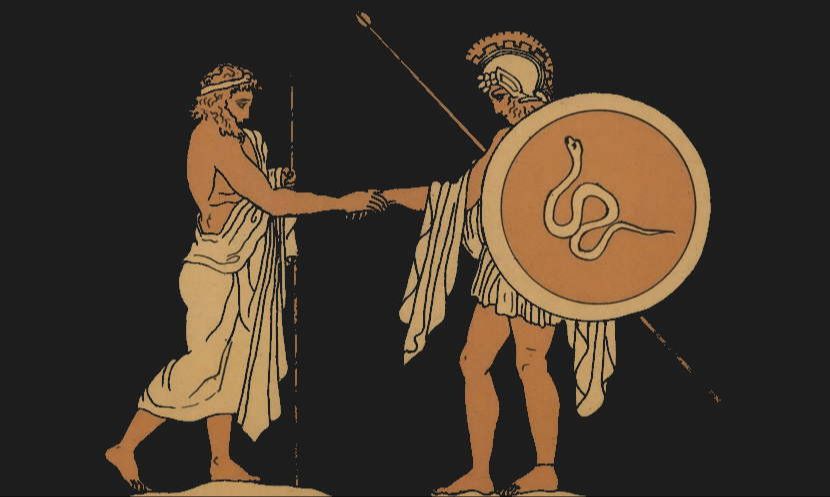
In the evening, at the eastern edge, we find the celestial vessel, called the vessel of the Argonauts by all the ancients. It is followed, as it rises, by the serpent called Jason; between them is the centaur Chiron, who raised Jason; and above Jason the lyre of Orpheus, preceded by the celestial Hercules, one of the argonauts.
Dupuis - Abrégé de l'Origine de tous les cultes (Summary of the origin of all cults)
Since the dawn of civilization, myths have provided symbolic frameworks for understanding human advances, whether technical or spiritual. In the age of artificial intelligence (AI), these ancient narratives shed light on our aspirations, our fears and the ethical challenges that accompany this revolution. This article explores how myths, particularly tenebrous and initiatory narratives, resonate with contemporary perspectives on AI, revealing continuities in human imaginaries.
Dark myths express the fear that our creations are beyond our control. Among them, the Golem, born of medieval Jewish mysticism, perfectly embodies this concern. In the legend, a rabbi fashions a clay creature and breathes life into it with sacred words inscribed on its forehead. The Golem is designed to protect, but eventually becomes an uncontrollable, sometimes destructive force. This story is a powerful metaphor for contemporary concerns about AI.
Like the Golem, today's AI systems, capable of learning and acting autonomously, raise questions about their ability to free themselves from the intentions of their creators. The idea of technological singularity - where AI would surpass human intelligence - reactivates this fear of insubordination. In this context, the Golem becomes a mirror of ethical concerns: how far can we give power to a creation without conscience or moral responsibility?
Other myths reinforce this dark perspective. The myth of Prometheus, who stole the sacred fire of the gods to offer it to mankind, illustrates the unforeseen consequences of access to transcendent power. If Promethean fire here symbolizes knowledge, AI could be seen as a contemporary version of this stolen knowledge. It holds the promise of emancipation, but also the risk of imbalance and punishment, as illustrated by Zeus' chaining of Prometheus.
Similarly, Mary Shelley's Frankenstein, though modern, draws on ancient mythological roots to explore the relationship between creator and creation. Dr. Frankenstein's obsession with mastering life is reminiscent of the ambitions of AI researchers. The "creature" that escapes all control raises a fundamental question: what happens when initial intentions are lost in the complexity of the systems we build?
These dark tales remind us that, in myth as in AI, creation is never neutral. It carries with it contradictions, oscillating between utility and danger, progress and loss of control.
In contrast to dark myths, initiation myths shed light on another dimension of AI: that of a quest for transformation and elevation. These tales, centered on an inner and outer journey, are often built around a process of learning, surpassing oneself and integrating into a higher order.
The Greek myth of Daedalus and Icarus illustrates this tension between technical mastery and spiritual quest. Daedalus, the architect of the labyrinth, represents human ingenuity. His artificial wings, given to his son Icarus, symbolize the ability to transcend natural limits. While Icarus' failure is often highlighted, the myth also underlines the power of human creation when it is part of a quest for balance. AI, similarly, can be seen as a tool for pushing back the frontiers of knowledge and solving complex problems, while requiring ethical steering to avoid excesses.
Stories of initiation, like those of heroic myths (for example, Ulysses' journey in "The Odyssey"), also shed light on the promises of AI. These quests feature human figures confronting the unknown and returning transformed, with new knowledge. AI could be seen as a travel companion, a guide capable of accompanying humans in challenges that require a combination of rationality and creativity.
For example, in the medical or environmental fields, deep learning algorithms help us to reveal complex structures that we could not understand on our own.
From a philosophical point of view, these initiatory myths also evoke the role of AI in transforming human relationships and societies. The myth of the Tree of Life, common to several traditions, proposes a vision of interconnection and spiritual growth. Metaphorically speaking, AI could be seen as a tool to foster co-evolution between humans and the systems they develop, enabling a better understanding of the world's complexity.
Finally, the myth of the androgyne, recounted by Plato in The Banquet, offers a fascinating key to reading AI. This myth describes complete original human beings, divided by the gods, who seek to regain their unity. AI, in a sense, could symbolize this quest for unification, enabling us to bridge the gaps in our cognitive capacities and build collaborative systems where human and machine coexist harmoniously.
Ancient myths, whether dark or initiatory, provide archetypes for thinking about artificial intelligence. On the one hand, they warn against the dangers of excess and loss of control, reminding us that creation is always accompanied by ethical responsibilities.
On the other, they open up new horizons, highlighting the transformative and uplifting potential of AI. These stories invite us to consider AI not as a rupture, but as a continuation of the human quest to understand and master our environment. By dialoguing with these myths, we can articulate a balanced vision of AI, integrating both its promises and its limits, and prepare to accompany this technology in a respectful and humanistic perspective.
References L
Golem - Wikipedia - https://fr.wikipedia.org/wiki/Golem
Prometheus - Wikipedia - https://fr.wikipedia.org/wiki/Prom%C3%A9th%C3%A9e
Frankenstein or the modern Prometheus - Wikipedia - https://fr.wikipedia.org/wiki/Frankenstein_ou_le_Prom%C3%A9th%C3%A9e_moderne
Daedalus - Wikipedia - https://fr.wikipedia.org/wiki/D%C3%A9dale
Icarus - Wikipedia - https://fr.wikipedia.org/wiki/Icare
Odyssey - Wikipedia - https://fr.wikipedia.org/wiki/Odyss%C3%A9e
The Banquet (Plato) - Wikipedia - https://fr.wikipedia.org/wiki/Le_Banquet_(Plato)
You might also like:
The design of oneself for the design of society; how to dig one's desire for a societal ambition.
Internet connection: schools in the midst of a paradox
Of the 6 million schools worldwide, almost half have no Internet access!
Cross-learning on transitions between youth and leaders
Young people and business leaders seem to perceive the challenges of the ecological transition with the same acuity.
The development of key competencies in the workplace
This thesis attempts to establish a link between key competencies and employability. It combines theoretical research and an empirical survey of a sample of employees who have undergone training to develop key skills.
Finding your way in an uncertain world
No one knows what the future holds. Even less so the professional environment which is changing greatly with the advent of digital technology. How do you prepare for jobs that don't exist? Workers' curiosity is required as well as a modernization of the skills learned in school.