We can now say that we live with robots on a daily basis. We're a long way from the "Jetson" context, where humanoid-looking machines walk around and carry out domestic and other tasks. We're dealing with algorithms and programs capable of targeting advertising, answering our questions, modifying or composing text or images, or suggesting cultural choices "that we'll like"...
Today, the mass of existing robots has led to networks of online bots. A seemingly harmless reality, but one that is unfortunately often used for malicious purposes.
Botnets: tools often misused
As the name implies, botnets are networks operating within different computing machines. If you type the name "botnet" into a search engine, you're likely to come across hundreds of articles warning against them. This doesn't mean they're all bad. However, recent history shows that most botnets have been used by people with evil intentions. Many hackers and criminals use these networks to infect computers and carry out fraudulent e-mail campaigns, server paralysis attacks or attacks on the Internet of Things. Protecting oneself from these networks generally involves the use of good antivirus and other malware protection.
At the same time, we see a series of bots appearing online and performing various actions. Here again, however, it's often to perform harmful actions. Whether it's bots that can buy show tickets in seconds and then resell them at high prices, or bots that share controversial opinions and misinformation. These "bad bots" accounted for 32% of global Internet traffic in 2023. Good bots accounted for 17.6%, for a total of 49.6%... It's a fact that feeds the "dead Internet" conspiracy theory, i.e. the idea that the network contains almost no real humans, just robots responding to each other. However, the fact remains that 50% of traffic is still totally human, so we're a long way from that idea.
It's hard to ignore the fact that bots have entered political and public debates, and are even influencing elections and social issues. Some go so far as to claim that Donald Trump's re-election was greatly helped by them on X (formerly Twitter), among others. Every election period, in France and elsewhere, sees its share of bots intervening online to drive rage, division and lies. The reality is that the IT giants are oblivious to this reality and do little to curb the phenomenon. They are more preoccupied with their respective artificial intelligences which, ironically, could contribute to accentuating the phenomenon.
Learn to protect yourself against bots
Even if they are still rare, because they are costly for hackers or governments, some online bots literally tap into conversational robots such as Chat GPT. This was demonstrated during the French legislative elections of 2024 , when an Internet user managed to get a bot on X, commenting on the terrible "subjectivity of journalists", to tell him the recipe for a strawberry tart. The account immediately replied. The user also accomplished the feat of speaking as if he were Karl Marx.
We had, for some, just found the loophole for detecting robots on the network. But specialists have tempered this conclusion. Admittedly, some bots do work in this way, and this has also been demonstrated on the English-speaking side of the Internet. However, the vast majority of bots won't fall for this trick, because they're not programmed that way. So how do you detect them?
Detection 101
In a world where this reality is likely to be permanent, how can you protect yourself as a web surfer? You have to learn to spot the signs. Bots are set up for very specific purposes. That's why it's important to take an interest in the bots' profiles.
- Bots usually use stolen or dubious profile photos.
- Their profiles are often very empty.
- They behave in suspicious or bizarre ways. For example, they may tend to respond with stereotyped answers to certain words.
- They may remain silent for a long time and then suddenly become very active on subjects. Humans will do this much more organically and have rather clear rhythms.
Nevertheless, these are not 100% guarantees of detection; some real users may have similar patterns to bots.
On the IT side, CAPTCHASplay an important rolein blocking bots that fail to respond to requests for protection. On the other hand, it also has the effect of stopping many humans annoyed by these codes. The idea would also be not to react to online comments obviously made to provoke rage, and to ignore them.
Perhaps it's better, for children and adults alike, to prioritize the exchange of ideas in person rather than online, where everyone remains camped on his or her position.
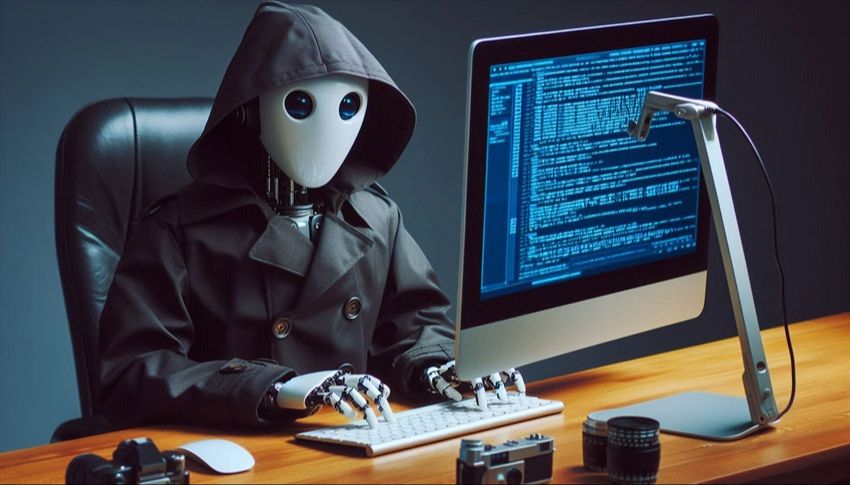
Image by IA (Copilot)
References:
"Botnet: what are the risks and how can you protect yourself?" Cybersecurity Awareness. Last updated: December 19, 2024. https://sensibilisation-cybersecurite.com/botnet-quels-sont-les-risques-et-comment-se-proteger/.
Dicko, Abdoul S. "False profiles and malicious bots: four key points to detect on social networks." Benbere. Last updated: August 27, 2024. https://benbere.org/au-grin/faux-profils-bots-malveillants-quatre-points-cles-detecter-reseaux-sociaux/.
Fléchaux, Reynald. "Malicious bots account for a third of Internet traffic." CIO-online. Last updated: April 23, 2024. https://www.cio-online.com/actualites/lire-les-bots-malveillants-representent-un-tiers-du-trafic-internet-15606.html.
Garruba, Giulian. "Botnets: tools and techniques for detection, prevention, and removal." Mimecast. Last updated November 27, 2024. https://www.mimecast.com/blog/botnet-detection-and-removal/.
"Artificial intelligence, badbots, bot farms... At the heart of the online war against disinformation and opinion manipulation campaigns." France Info. Last updated: November 25, 2024. https://www.radiofrance.fr/franceinfo/podcasts/le-choix-de-franceinfo/intelligence-artificielle-badbots-fermes-a-robots-au-coeur-de-la-guerre-en-ligne-contre-les-campagnes-de-desinformation-et-de-manipulation-de-l-opinion-9633578.
Murphy, Sarah. "Outsmarting the bots: 5 strategies to create AI-resistant assignments." Teaching Channel. Last updated: September 27, 2024. https://www.teachingchannel.com/k12-hub/blog/outsmarting-the-bots-5-strategies-to-create-ai-resistant-assignments/.
Nait-Zlay, Oussama. "Detecting a bot on social media: 3 signs to watch out for." ManageEngine Blog. Last updated December 3, 2024. https://blogs.manageengine.com/fr/2024/07/29/detecter-un-bot-sur-les-medias-sociaux-3-signes-a-surveiller.html.
"What is anti-botnet?" Friendly Captcha. Last updated May 17, 2024. https://friendlycaptcha.com/fr/wiki/what-is-anti-botnet/.
"What is a botnet?" Malwarebytes. Last updated November 3, 2023. https://www.malwarebytes.com/fr/botnet.
"What is a bot? How do bots work?" Fortinet. Accessed February 15, 2025. https://www.fortinet.com/fr/resources/cyberglossary/bot.
"What is a botnet? How do you protect yourself?" Clubic.com. Last updated March 29, 2024. https://www.clubic.com/internet/actualite-8590-qu-est-ce-qu-un-botnet-comment-s-en-proteger-.html.
Rahmil, David-Julien. "Legislative election: the strawberry pie recipe, a new method for detecting Russian bots?" DNA. Last updated June 25, 2024. https://www.ladn.eu/media-mutants/tarte-fraises-demasquer-bots-x/.
Tournillon, Garance. "Facebook, TikTok, Youtube et consorts ploient sous le bruit des bots." Le Canard Enchaîné. Last updated: November 9, 2024. https://www.lecanardenchaine.fr/technologie-sciences/49326-les-reseaux-sociaux-incapables-de-lutter-contre-les-robots.
See more articles by this author