Comic book and video game by-products: how to materialize them and bring them to life
Materializing the imaginary: art, education and objects derived from comic strips
Many of us have retained a childlike spirit, and are nostalgic for our childhood readings or their adaptation for television, whether in film or cartoon form. Franco-Belgian comic strips, such as Tintin, Asterix and Lucky Luke, and video games, from Super Mario to The Legend of Zelda, occupy a special place in our collective imagination.
These works, which combine captivating narratives, emblematic characters and rich visual universes, don't just live on paper or screen: they are also embodied in the real world through derivative objects, including collectible figurines. These objects transcend their primary function to become bridges between fiction and reality, vectors of emotion and memory.
In teaching, these derivative objects offer a unique opportunity to reflect on how the imaginary can be materialized, manipulated and used as a tool for learning and creation.
How does one go from an abstract idea such as a comic book character or video game artifact to a tangible object? How can these objects, initially designed for entertainment, become works of art or educational media? This article explores these questions as part of a broader reflection on living art, where the boundary between creation and interaction with the public is becoming blurred.
From book to tangible: the materialization process
Transforming a character or an element of a fictional work into a tangible object is a complex process that calls on technical, artistic and industrial skills.
Concept and design: bringing the imaginary to life
The first step in the materialization process is to translate a two-dimensional image (or a 3D model in the case of video games) into a three-dimensional object. Artists and designers such as Pascal Rodier, founder of the Fariboles workshops, or Alexis Poliakoff, sculptor of the first Pixi figurines, have played a key role in this process.
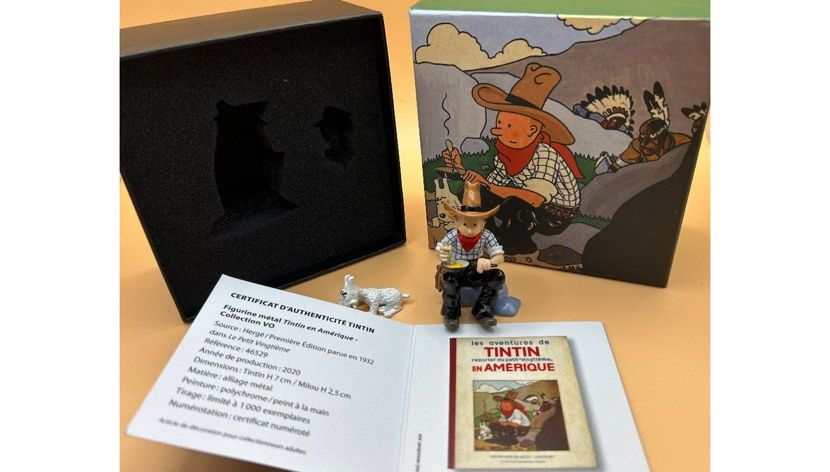
These artisans of the imaginary work to capture the essence of the characters, their expressions, postures and details, while respecting the original aesthetic of the work. For example, the Tintin figurines produced by Fariboles or Pixi are often limited-edition, hand-made pieces that aim to preserve fidelity to Hergé's style while giving them a physical presence.
Manufacturing techniques: craftsmanship in France and outsourcing to China
Once the design has been validated, manufacturing can begin. Historically, objects derived from Franco-Belgian comics were produced by hand, often in France, in specialized workshops. These techniques, which included sculpting, molding and hand-painting, guaranteed high quality. Production was limited to a small scale.
Over the past ten years or so, part of the production process, notably for Tintin objects by Moulinsart, has been relocated to China to cut costs and meet growing global demand. This delocalization has democratized access to derivative objects, but it has also raised questions about the quality and ethics of production.
The role of technology: AI, augmented reality and connected objects
Today, technology plays an increasingly important role in the materialization of derivative objects. Artificial intelligence (AI) is used to optimize designs, for example by generating 3D models from original drawings. Augmented reality (AR) enriches the experience of derivative objects: imagine a figurine that, when scanned via an app, triggers an interactive animation on your smartphone.
Connected objects incorporate NFC chips that interact with video games, adding a new dimension to the user experience. These technological innovations transform derivative objects into veritable interfaces between the real and fictional worlds.
Derivative objects: from commercial products to works of art?
If derivative objects are perceived by the uninitiated as simple merchandising products, they can also be considered as artistic creations in their own right, especially in the context of live art, where the boundary between art and consumption is becoming blurred.
Between merchandising and artistic creation
Some companies, such as Fariboles or Pixi, produce limited-edition figurines, crafted with a care that brings them closer to works of art than to mass-produced goods. These objects, often numbered and accompanied by certificates of authenticity, are prized by collectors and can fetch high values on the art market. In addition, collaborations between artists and comic book or video game studios further blur the line between art and commerce.
When fans become creators
Fans play a crucial role in transforming derivative objects into artistic creations. Cosplay, for example, enables enthusiasts to materialize characters in costume, often with an impressive level of detail. Similarly, fan art, which includes the creation of personalized figurines or paintings inspired by comic books or video games, bears witness to the creative appropriation of these universes. These practices, which come under the heading of living art, place the public at the heart of the creative process, transforming consumers into co-creators.
Collaborations between artists and game/comic studios
Collaborations between contemporary artists and design studios are another illustration of the artistic dimension of derivative objects. For example, artists such as Takashi Murakami have collaborated with video game studios to create limited editions of derivative objects, blending pop culture and contemporary art. These initiatives show that derivative objects can transcend their initial function to become works of art in their own right, exhibited in galleries or integrated into interactive installations.
The cultural and educational impact of derivative objects
For a public interested in education, comic book and video game merchandising offers an educational potential that is often underestimated. Their materialization and use can be integrated into innovative educational practices, linked to living art and active learning.
A vehicle for learning and involvement in education
As tangible supports, derivative objects can serve as entry points for exploring complex themes. For example, a Tintin figurine can be used to explore colonial history, geography or the art of drawing. Similarly, objects derived from video games, such as maps or 3D models, can be used to teach mathematics, physics (game mechanics) or storytelling.
These objects make learning more concrete and engaging, by connecting students to worlds they know and appreciate.
The rise of fablabs and makerspaces in schools
Fablabs and makerspaces - creative spaces equipped with tools such as 3D printers, laser cutters and design software - are gaining in popularity in schools. These places enable students to materialize their own derivative objects, inspired by comic books and video games.
For example, a student could design and print an Obelix figurine or a sword from The Legend of Zelda, while learning the basics of 3D modeling, engineering and project management. These activities foster creativity, collaboration and problem-solving - essential skills in today's world.
Integrating games and comics into school art practices
Derivative objects can also be integrated into school art practices, in conjunction with live art. For example, students could be invited to reinterpret comic book or video game characters through interactive installations, sculptures or performances. These projects help to develop artistic sensitivity, while exploring issues linked to consumerism, popular culture and collective memory.
In addition, the game, as a central element of video game derivative objects, can be used to teach notions of game design, interactive narration and programming.
From the ephemeral to the durable: what place for these objects in living art?
Derivative objects, initially designed to be ephemeral and consumable, can also find a lasting place in live art, as a means of expression and cultural memory.
Derivative objects as a means of expression and collective memory
Derivative objects, whether Tintin or Asterix figurines, carry with them a part of the collective imagination. They embody stories, values and memories shared by generations of readers and players. In the context of live art, these objects become media of expression, used by artists to tell new stories or question our relationship with popular culture.
For example, an art installation might use comic-book figurines to explore themes such as nostalgia, identity or mass consumption.
From consumption to collection: a new form of cultural heritage
Over time, certain derivative objects move from the status of commercial products to that of collector's items, or even cultural heritage. Limited-edition figurines, original posters and vintage objects are becoming witnesses to the history of comics and video games.
These collections, often built up by enthusiasts, help to preserve the memory of these works and pass them on to future generations. From an educational perspective, these collections can be used to teach the history of art, literature or the media.
Re-interpretation and misappropriation by contemporary artists
Contemporary artists play a key role in the reinterpretation of derivative objects, turning them from their original function into works of art. For example, an artist might transform a Lucky Luke figurine into a sculpture critical of consumer society, or use video game elements to create an interactive installation exploring the boundaries between the real and the virtual.
These practices, which are fully in line with living art, show that derivative objects can be much more than mere products: they are raw materials for artistic creation.
A bridge between fiction and reality, creator and audience
The materialization of objects derived from comic books and video games is much more than a simple technical or commercial process: it is a form of living art, extending the artistic experience of the original works while involving the public in a creative dialogue. These objects, whether mass-produced or hand-crafted, whether used for play, learning or collecting, embody a bridge between fiction and reality, the imaginary and the tangible.
In education, these objects offer a unique opportunity to explore innovative pedagogical practices, mobilizing creativity, technology and art. They also allow us to reflect on the new boundaries between creation and appropriation, consumption and art, the ephemeral and the sustainable.
So, the next time you hold a Tintin figurine, remember that it's not just an object, but a fragment of the imagination that can still be reinvented in your hands.
Sources
Pixi. Figurines En Metal Peint Paperback - January 1, 1992 - Publisher: Syros (January 1, 1992) Language: French Paperback: 95 pages https://www.fariboles.fr/fr/content/11-savoir-faire https://boutique.asterix.com/fr/3-figurines
Peer support is transforming healthcare training by integrating patients' experiential expertise. This new pedagogical and relational paradigm overturns the relationship between caregivers and patients, paving the way for a health democracy based on the co-construction of knowledge. This model promises a more collaborative and emancipating approach to care, recognizing shared vulnerability.
Learners' failure is often blamed on the school. There may be other reasons for students' lack of guidance and empowerment. In this respect, the imposition of a set path by the parent is often a source of internal conflict and demotivation for the learner. Hence the need to build a framework conducive to student empowerment, through listening and dialogue.
For decades, the sports world has known the importance of mental preparation. From amateur athletes to Olympians, everyone knows that a large part of performance is played with the head. The school environment could also benefit from these strategies. In fact, mental preparation services offered to students and teachers are beginning to appear.
Body image has an effect on individuals. Most of us have physical complexes that we try to tame or rectify, depending on the degree of disturbance. This is all the more difficult for young people, whose bodies are constantly changing...