Fear of failure is a deep-rooted problem in our society. Failing an exam, an interview or achieving a goal, whatever it may be, is an obstacle for many people, who sometimes dare not take the plunge. But what about the fear of success, which is sometimes more difficult to admit and apprehend?
This fear is often disguised as an invisible obstacle to personal and professional fulfillment. It manifests itself not only in procrastination, but also in limiting beliefs that condition individuals to prevent themselves from taking the plunge, or even just dreaming of another life.
The origins of the fear of success: a seemingly absurd contradiction
The fear of success is a duel between our aspirations and our apprehensions, often resulting in the victory of the apprehensions. This fear can stem from a lack of self-confidence, often defined as impostor syndrome: the feeling that you don't fit in and that you're surrounded by far more competent people. It's all the more difficult to admit this anxiety in a society that pushes every individual to excel in order to succeed. We've put our finger on a major point here: social pressure to succeed can lead to harmful and counter-productive guilt-tripping.
The report Unpacking Grind Culture in American Teens (2024), produced by Common Sense Media in collaboration with researchers from Harvard and Indiana University, highlights the effect of performance culture on the mental equilibrium of American teenagers.
The study reveals that 81% of teenagers feel negative pressure in at least one area of their lives, including their future, academic performance, appearance, social life, friendships and civic engagement. Social networks play an ambivalent role in this phenomenon. While some teenagers find comfort and inspiration online, a majority feel that these platforms amplify the pressures they feel, not least by constantly exposing them to idealized examples of success.
The fear of success can stem from a number of factors. One of these is the social consequences that success might bring. Success is often equated with upward mobility.
This fear of success was popularized by Matina S. Horner. The psychologist explains that this feeling is common among women, who tend to censor themselves and curb their own efforts to avoid appearing threatening. In some circles, success can be synonymous with estrangement. Fear of upward mobility through success is a particular facet of the fear of success. It mainly affects people from modest or working-class backgrounds, and is deeply linked to mechanisms of guilt, family loyalty, identity dissonance and implicit social pressure. They have to learn to "translate" their codes, their language, their attitude, which can be exhausting and generate a strong sense of imposture.
In Les Armoires vides, Annie Ernaux, born of working-class parents, evokes the tension between her original social background and the bourgeois milieu she encountered during her studies in modern literature. The theme of guilt figures prominently in her work.
Limiting beliefs and fear of heightened expectations
Limiting beliefs are often rooted in low self-esteem, but they are also strongly influenced by social determinism. Generally lodged in the unconscious mind of each individual, they influence their behavior. These internalized beliefs sometimes stem from affirmations made during childhood.
A child who is constantly told by a reference figure that he or she is not cut out for long studies, that he or she has no future, will eventually become convinced of this, and imagining success, or at least starting out on the road to achieving his or her goals, will be all the more difficult. This idea was conceptualized by psychologists Rosenthal and Jacobson with the Pygmalion effect: a person from a modest background who is implicitly discouraged from aiming for higher education or an ambitious career may end up censoring himself, believing that he is not capable of it.
The term labeling is also a factor in this censorship. When a social or psychological label is attached to an individual, that person ends up conforming to it.
Conversely, an individual accustomed to success ends up making it a norm in his own eyes and in the eyes of those around him, who almost naturally expect it. As successes accumulate, they cease to be perceived as exceptional and become norms to be maintained. Those around you become accustomed to this level of performance and unconsciously demand it. This can lead to chronic stress, a fear of disappointment, and even a form of self-sabotage, in order to escape this pressure.
This mechanism can be found in profiles marked by the "good student" syndrome, who associate their self-worth with their ability to succeed, or in those subjected to the injunction to perfection, for whom mistakes are not allowed. Success becomes a vicious circle: each victory is no longer a relief, but an additional burden. This fear leads some people to deliberately put the brakes on their ascent for fear of failing to live up to future expectations.
Fear of success and fear of the unknown
Abraham Maslow introduced the concept of the "Jonah Complex", the fear of realizing one's full potential. According to this theory, some people deliberately avoid success for fear of the responsibilities and changes it entails. This leads them to stay in their comfort zone rather than face the unknown associated with success.
The fear of success is sometimes rooted in an anxiety that the actual success will not live up to the ideal. When we invest a great deal of time, energy and emotion in a goal, be it academic, professional or personal, we build around it an often idealized imaginary of a glorious, fulfilling and gratifying "after". Yet the reality rarely lives up to these expectations.
This disparity between fantasy and reality can become a powerful obstacle. Take, for example, an artist who hesitates to publish his work for fear that it won't receive the reception he'd hoped for. The work of creation is so intimate that, once completed, the idea of exposing it to the gaze of others can generate a fear of rejection. The success hoped for over the years becomes a source of anxiety: what if the work, in the real world, doesn't have the effect imagined? In this case, the fear of success is also a fear of the emotional void after the achievement.
The theory of cognitive dissonance, developed by Leon Festinger, suggests that when the results of intense effort fall short of expectations, psychological tension arises. To counterbalance and reduce the discomfort of this dissonance, individuals tend to re-evaluate their goals downwards, or even avoid committing themselves fully to them for fear that success will not match the effort.
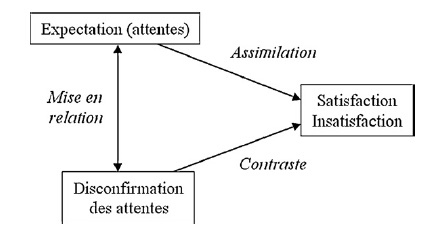
EDT Expectation Disconfirmation Theory (after R. Oliver, 1980)
This is the origin of self-sabotage, a mechanism by which the individual carries out tasks that are harmful to him, or on the contrary remains inactive at a decisive moment for him. Although the term is increasingly used, it is not always understood, and is often hidden in the unconscious. Yet it's one of the main consequences of the fear of succeeding.
To squander your potential is to avoid exploiting it to the full and thus achieving that dreaded success. This can take the form of procrastination, deliberately forgetting important events and tasks, or denigrating one's own abilities.
How can we overcome this fear of success?
Understanding the root causes of this fear is a major first step towards dismantling the pattern that blocks those who suffer from it. Fear of success does not always manifest itself consciously: it takes the form of avoidance behavior or a form of self-censorship.
It is often rooted in limiting beliefs, forged by upbringing, social norms or past experiences where ambition was perceived as threatening or pretentious.
Deconstructing these representations is essential: it involves recognizing the associated emotions, identifying negative self-talk, and realigning with a personal vision of success that is more progressive and free. By making this invisible pattern visible, we enable the individual to reappropriate his or her own trajectory, without shame or fear of overstepping the limits that have been unconsciously imposed.
Illustration: Pintera Studio - Pixabay
References
Unpacking Grind Culture in American Teens (2024), produced by Common Sense Media: https: //www.commonsensemedia.org/sites/default/files/research/report/2024-unpacking-grind-culture-in-american-teens_final-release-updated-for-web.pdf
"The fear of success" by Matina S. Horner: https: //www.jstor.org/stable/2777204
Ernaux, Annie. Les Armoires vides. Paris: Gallimard, "Folio" series, 1974.
The Pygmalion effect by Rosenthal and Jacobson: https: //ien-colombes1.ac-versailles.fr/IMG/pdf/effet_pygmalion.pdf
Abraham Maslow's "Jonah Complex": https: //jonahcalinawan.com/blog/jonah-complex/
Cognitive dissonance theory by Leon Festinger: http: //www.sietmanagement.fr/la-decision-cognitive-festinger-azjen/
Self-sabotage file - Thot Cursus - https://cursus.edu/fr/dossiers/11435/auto-sabotage
See more articles by this author