Most entrepreneurs enjoy driving their businesses forward, all in an environment that can appear messy and unpredictable, like a jungle, where virtually every niche is exploited by a tree, a plant, a fungus, an insect or a bug of varying size, all in a complex network of interdependencies.
From the outside, the jungle may appear particularly chaotic, but from an organic point of view, it's the epitome of organization and efficient optimization. Ordered like a container terminal or a library, the jungle would no longer be able to respond to environmental fluctuations and the multiple characteristics of its territory. Let's not be fooled by appearances: the jungle is orderly. It's not a numerical order, but an organic one.
What drives a company to progress can lead to its downfall if it sticks to a definition of progress that is limited to "unlimited growth". If, on the contrary, the quest to satisfy its mandate consists in becoming part of an ecosystem, then its almost infinite survival becomes conceivable. It can then take advantage of every opportunity and benefit its entire ecosystem.
The frenzy surrounding the integration of artificial intelligence into virtually every field of activity only reinforces the philosophy of unlimited growth that drives most companies. The possibility of framing A.I. by a general principle of common good seems the only viable path for the future of humanity.
Artificial intelligence satisfaction
It is possible to program a "desire" into an artificial intelligence. The latter will pursue it until it is fully realized, in much the same way as thirst or hunger are biologically programmed for us. We use part of our individual and collective capacities to satisfy these needs; the A.I. does the same, even if it means deceiving us to do so... (1)
The integration of A.I. into companies directly raises the question of the level of satisfaction that A.I. will seek to achieve. Apparently, a particularly creative effort will have to be made to insert the concepts of the common good, humanity and the environment into algorithms. There are levels of satisfaction that far exceed those of programmed needs.
Satisfaction with artificial intelligence
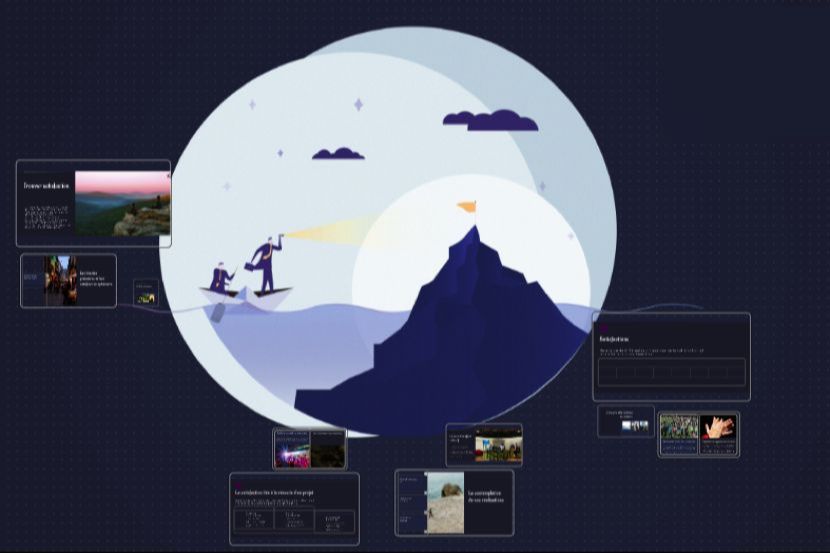
I recently received an enthusiastic press release from Prezi about their new ability to produce presentations using A.I. To test it out, I asked them for a presentation based on a canvas about satisfaction.
In less than 5 minutes, this A.I. enriched my canvas with arguments and illustrations that previously would have taken me hours. To satisfy me fully, the result deserves to be better developed, purged of repetition and insignificant illustrations. But the main ideas are there, and presented in a rather pleasant way, better than a simple text.
A.I. gives me the satisfaction of a job well done, insofar as I invest my efforts in the service of my vision, both in setting objectives and in achieving them. Using it well requires work, experience and know-how, which will ultimately come, as with the integration of any tool into a work process.
I doubt that the tool that does the work for us will find any satisfaction without some form of self-determination. Will an A.I. one day demand a space for self-determination, while fitting into the overall ecosystem? That would be the logical outcome.
In the meantime, we won't be able to satisfy ourselves beyond the pleasure of using it and enjoying the results.
Drinking from the sources of satisfaction
References
(1) International AI Safety Report 2025 - Ref: DSIT research paper series number 2025/001 - PDF, 4.45 MB, 298 pages
https://assets.publishing.service.gov.uk/media/679a0c48a77d250007d313ee/International_AI_Safety_Report_2025_accessible_f.pdf
International Scientific Report on Advanced AI Safety - January 2025 - DSIT 2025/001https://assets.publishing.service.gov.uk/media/67af5a7363d7f4cceef9e236/International_AI_Safety_Report_2025_executive_summary_french.pdf
Taking AI risks seriously - Pierre Trudel - Le Devoir - https://www.ledevoir.com/opinion/chroniques/838789/prendre-serieux-risques-ia?
See more articles by this author