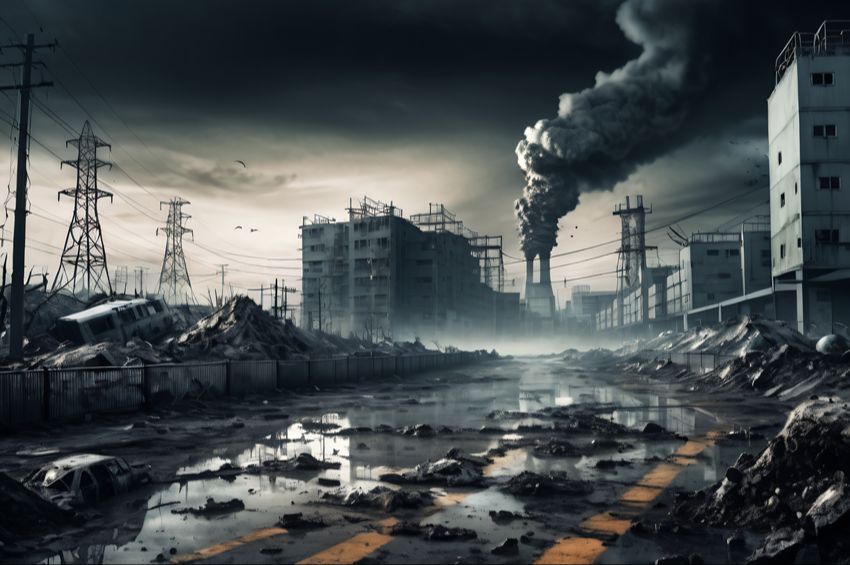
Imagine a glass of water where the liquid level is halfway up. Optimists would say it's half full; pessimists would say it's half empty. Catastrophists will go even further and say that, in any case, the water or the glass is probably toxic and will lead to the death of whoever puts their lips on it. This vision may seem caricatural, but it goes some way to representing the movement known as "collapsology".
The phenomenon first emerged in the early 2000s, and has become particularly pronounced in the 2020s. The current thinking is that the world is going from bad to worse, and that we're heading straight for the end of time.
Since then, the phenomenon has become less prevalent, but it remains a vague philosophy. Online trends show a decline in interest, because despite the shock of covid-19, society has survived. What's more, this catastrophic vision has been ridiculed on both the right and the left. The former have been relentless in their attempts to ignore or downplay environmental prognoses, while the latter have preferred to avoid going down this road too much, leaving the field open to the far right.
A change of cycle
Yet, in theory, there's every reason to believe that the world is coming to an end. Environmental assessments are rather alarming; economically, it seems that inequalities are growing like never before, global conflicts are adding up, crises are adding up, public services are collapsing and totalitarian governments are taking power. Not much to get excited about. While it's easy to dismiss collapsology out of hand, the fact remains that the model that has triumphed since the 20th century is undoubtedly in decline. This slow crumbling would worry anyone who looked at it lightly.
However, experts remind us that, generally speaking, things don't go like a timeline, i.e. a beginning with a clear end. History has shown different cycles following different regimes and trends. For example, since January 2025, Trump's return to power has led to a near-suppression of public services in a country already sparsely supplied compared to other similar lands. This has and will have effects for years to come on the whole of American culture as a whole. On the other hand, this collapse, as this American site reminds us, is only a period, and it's likely that in 5 or 10 years' time another culture will emerge and quietly regenerate the country, much as the former members of the ex-Soviet Union have experienced.
Hence the importance of neither denying reality nor sinking into cynicism and apathy. It is possible to recover from falls, to stand up again. However, we need to recognize that this takes time, and above all we need to give the younger generations the tools to encourage them to rebuild.
School as a bulwark
Education can be a way of preparing for both the most optimistic and the most pessimistic scenarios. Already, universities are often places of intellectual freedom from which brilliant ideas can emerge to improve the world. It's not for nothing that they are often the "enemy" of more authoritarian regimes and liberal governments seeking to prioritize so-called "useful" research at the expense of fundamental research. Researchers' resistance can already be a bulwark against dystopian futures or risks to existence.
In November 2024, the book "Pedagogies of Collapse" by Ginie Servant-Miklos was published, discussing the place of pedagogy in a "collapsing" world. What's interesting about the book is that, rather than simply painting a bleak picture of the situation, it also provides strategies so that schools and teachers can give tools for reflection in the years and decades to come.
Its concept is based on four principles:
- Telling the truth: stop trying to minimize conditions or asserting that collective action or ultra-practical technologies will solve everything when they won't.
- Leave room for mourning: use what we know about mourning to prepare younger generations for a world of tomorrow that will potentially bear no resemblance to the one they find themselves in.
- Inculcate the appropriate measures now: teach young people to survive this declining world and eventually thrive in it by giving them all the skills, including manual ones often ignored in schools, when society could one day find itself without Internet, electricity, etc.
- Stop striving for perfection: by trying to achieve purity, schools are not banking on adaptation, which will be far more important in the future.
One strategy employed or proposed by Oxfam, among others, is the idea of lifelong education, where children are constantly learning new skills, knowledge and actions to better prepare them for future challenges and improve their local environment.
Without pretending that all actions will eventually lead to obstacles or problems, by teaching them to be properly informed, to act locally, to learn to communicate competently, to be able to use both digital and work-based tools, and by thinking of concrete solutions, we avoid discouragement and prepare them for future potential, which will not be easy but will be facilitated, possibly, by learning in their environment, including school.
Image: Manuel Alvarez from Pixabay
References
Ahmed, Nafeez M. "The US is collapsing like the USSR - so what comes next." Age of Transformation. Last updated April 17, 2025. https://ageoftransformation.org/the-us-is-collapsing-like-the-ussr-so-what-comes-next/.
D'Hoop, Roland. "Continuing or popular education and collapsology: two "radical" ways of reinterrogating our economic system and its impacts." Oxfam-Magasins Du Monde. Last updated June 1, 2018. https://oxfammagasinsdumonde.be/education-permanente-ou-populaire-et-collapsologie-deux-manieres-radicales-de-reinterroger-notre-systeme-economique-et-ses-impacts/.
Hames, Richard. "Welcome to the age of collapse culture." Crude Futures. Last updated June 2, 2025. https://crudefutures.substack.com/p/welcome-to-the-age-of-collapse-culture.
Kloetzli, Sophie. "By the way, what happened to collapsology?" Usbek & Rica. Last updated: July 21, 2025. https://usbeketrica.com/fr/article/au-fait-qu-est-devenue-la-collapsologie.
"Pedagogies of collapse: educating for collapse with truth." Ekole. Last updated: October 12, 2025. https://www.ekole.fr/blog/face-a-leffondrement-quelles-pedagogies-mettre-en-oeuvre.
"PEDAGOGIES OF COLLAPSE: Not the collapse of pedagogy." Future Based. Last updated: November 28, 2024. https://futurebased.org/climate-madness/pedagogies-of-collapse-not-the-collapse-of-pedagogy/.
"Théorie du collapse: quelles compétences pour demain?" La Ligue De L'Enseignement Et De L'Éducation Permanente. Last updated: March 9, 2020. https://ligue-enseignement.be/theorie-du-collapse-quelles-competences-pour-demain.
Walter, Julien. "L'Université face à l'effondrement." Correspondence - Le Journal Des Profs De L'UQAC. Last updated April 2025. https://correspondance.info/luniversite-face-a-leffondrement/.
See more articles by this author