Perseverance, the aptly named robot that has been criss-crossing the planet Mars since February 2021, has collected numerous samples along its 30 km route. Assigned to explore an ancient river delta in the Jezero crater, its operators are seeking to identify traces of what might indicate past biological activity - in other words, extraterrestrial life.
And in July 2024, they began to think they might have found some...
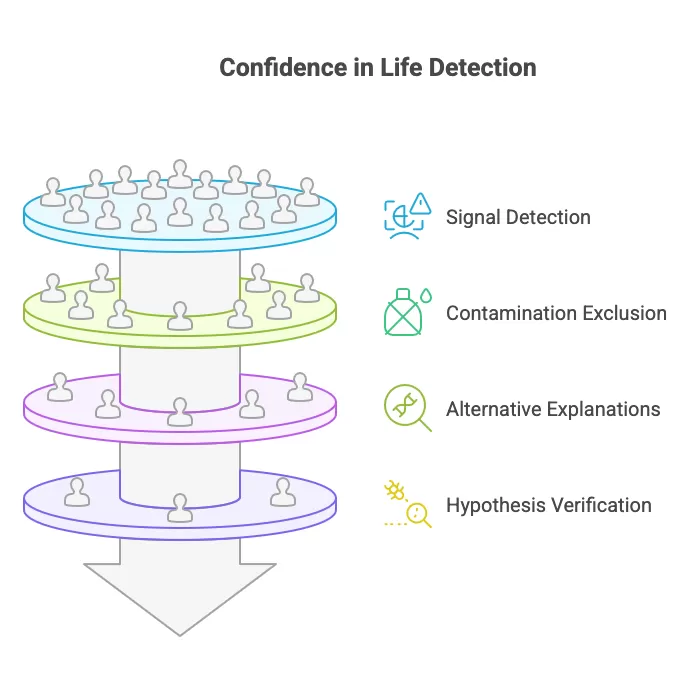
The Confidence of Life Detection Index - CoLD
CoLD stands for Confidence of Life Detection, a graduated scale of biosignature certainty:
- Detecting a significant signal
Several different samples have been taken from an environment offering significant potential, in this case a river delta.
- Exclude all forms of contamination
On Mars, Perseverance does not contaminate samples, and the data transmitted is raw and confirmed by several repetitions of the measurements.
- Searching for alternative explanations and possibilities The processes leading to the compounds detected may be biological or purely chemical in nature, under conditions different from those on Earth. The hypothesis remains to be verified.
- Only then can we start talking confidently about life on Mars.
As it turns out, the ground teams leading Perseverance, together with associated researchers and advances in artificial intelligence in the interpretation of data transmitted by Sherloc (Scanning Habitable Environments with Raman & Luminescence for Organics & Chemicals), WATSON, a high-resolution camera, and PIXL (Planetary Instrument for X-ray Lithochemistry), have made it to level 3.
The study they published describes minerals (vivianite (iron phosphate) and greigite (iron sulfide)) and textures (spots of chemical reduction) which, on Earth, are often associated with microbial activity.
Chemistry or biology?
But we know that certain chemical processes can also result in related mineral formations. Other non-biological processes unknown under Earth conditions could also explain these observations. Researchers remain cautious: none of this proves that metabolism has taken place in the delta mud, only that the chemical conditions are right for it. The data obtained by the equipment indicates the composition of the samples, but there is insufficient information on their molecular structure to determine whether they are chemical or biological compounds. They look like it.
"Organic carbon appears to have participated in post-sedimentary redox reactions that produced the iron phosphate and iron sulfide minerals observed. The geological context and petrography indicate that these reactions occurred at low temperatures. Against this background, we review the different pathways by which redox reactions involving organic matter can produce the observed series of iron-, sulfur- and phosphorus-containing minerals in natural and laboratory environments on Earth."
Not yet proof, but potential proof of biosignature of life on Mars, this is the closest NASA has been to discovering a real trace of life so far on Mars said Nicky Fox, deputy administrator of NASA's Science Mission Directorate.
But if we can demonstrate that it's possible to create these same compounds abiotically (without microbial involvement), then we'll have to wait even longer before we can say there's ever been life on Mars.
Being certain of life on Mars
For hope, the other avenue is that once the samples have been brought back to Earth, through the study of isotopes, microtextures and the precise organization of carbon in the samples, we'll be able to separate the metabolic signature from the purely chemical one. By then, we'll be at level 4!
References
Nasa Perseverance interactive Map - https://mars.nasa.gov/maps/location/?mission=M20&utm_source=cursus.edu
The Detective Aboard NASA's Perseverance Rover
https://www.nasa.gov/centers-and-facilities/jpl/the-detective-aboard-nasas-perseverance-rover/
Here's How AI Is Changing NASA's Mars Rover Science
https://www.jpl.nasa.gov/news/heres-how-ai-is-changing-nasas-mars-rover-science/
PIXL - NASA's New Mars Rover Will Use X-Rays to Hunt Fossils
https://www.nasa.gov/solar-system/nasas-new-mars-rover-will-use-x-rays-to-hunt-fossils/
Raman Scattering - https://fr.wikipedia.org/wiki/Diffusion_Raman
What would it be like to colonize Mars? - Thot Cursus
https://cursus.edu/en/14582/what-would-it-be-like-to-colonize-mars
Hurowitz, J.A., Tice, M.M., Allwood, A.C. et al - Redox-driven mineral and organic associations in Jezero Crater, Mars - 10 September 2025
https://www.nature.com/articles/s41586-025-09413-0
https://doi.org/10.1038/s41586-025-09413-0
NASA announces "groundbreaking discovery" of life on Mars
https://www.earth.com/news/nasa-announces-discovery-of-life-on-mars-with-high-degree-of-confidence
Clear evidence of liquid water, not just frozen ice, discovered on Mars
https://www.earth.com/news/wave-ripples-discovered-mars-surface-indicate-liquid-water-present-4-billion-years-ago/
SLIMMEST: modeling hundreds of species of interacting microorganisms - Thot Cursus
https://cursus.edu/fr/22818/slimmest-modeliser-des-centaines-despeces-de-micro-organismes-en-interaction