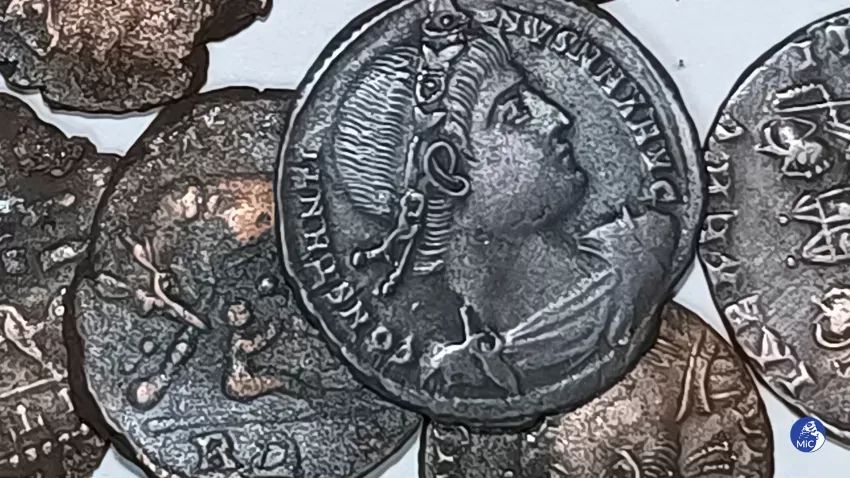
The movements of the seabed sometimes reveal surprises for those who know how to observe. Along the coast of Sardinia, an island off the coast of Italy and north of Tunisia, near the town of Arzachena in the north of the island, an occasional diver noticed on the seabed the presence of several metal coins scattered over a fairly extensive perimeter, between the beach and marine plants.
After alerting the authorities to his discovery, a more precise inventory eventually led to an estimate of between 30 and 50,000 bronze coins dating from the 4th century, accompanied by fragments of African and Middle Eastern amphorae.
Clues
In this area of currents, the excellent state of preservation of the coins is due to the aquatic plants that rapidly accumulated sediment around the scattered remains of a shipwreck, the possible wreck of which has not yet been found.
The fact that this discovery has only now been made also indicates that the environment is disturbed by both natural and man-made phenomena, leading to the resurgence of the coins.
Compared to other coin finds, the sheer scale of this one will provide a much better understanding of money flows and trade dynamics in the Roman Empire at the time of Diocletian (244-311).
The first items identified
These coins are mainly "follis", silver-coated bronze coins weighing around 10 grams and minted at the time of Diocletian and his successors. They were used as currency and were accepted throughout most of the empire, although their silver plating and weight diminished as Rome's financial difficulties worsened.
This isn't the first discovery of a large quantity of coins from the Roman era, the one at Seaton Down Hoard in Devon, England in 2013, still counted over 20,000 coins, but when such a large quantity of coins concentrated in one place is discovered, it raises several hypotheses as to the "why", in this case, the type of transport carried out: Whether it was trade, the pay of civil servants, taxes and tributes brought back to Rome, all possibilities are open until we can reconstruct the fragments of the cargo that accompanied it. We don't even know if the artifacts came from one or two different incidents.
What a large number of pieces tell us
The icons, inscriptions and workshop marks on each piece indicate the names of the rulers and the mottos of the time. Their composition makes it possible to trace where each coin was minted. In terms of production, it's possible to see the evolution of techniques as well as the representations on the coins.
But compared to a few coins found here and there, finding a large number of coins in the same place reveals much more. The most recent coin allows us to pinpoint the era of the shipwreck, but when we take into account the distribution statistics of thousands of coins at that precise moment, trends emerge. An increase in issues for one emperor may coincide with a military campaign or a change of power, while the distribution of coin production workshops allows us to sketch out trade routes.
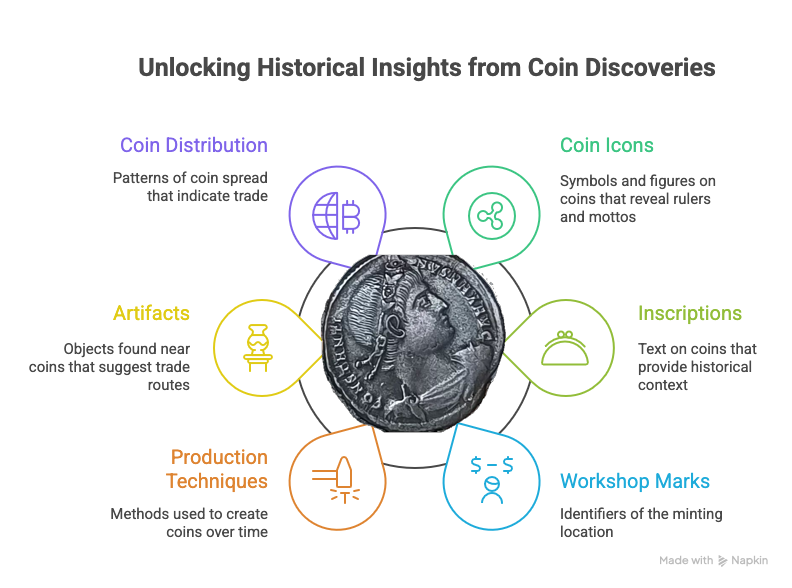
What's more, it's possible to relate the various artefacts found in the vicinity to the places of production, value and importance of trade in a given trade corridor. In short, the full potential of this discovery has yet to be realized.
Illustration: Italian Culture Minister and
Napkin
References
Amateur diver finds 50,000 coins from the 4th century hidden under the sand
https://www.earth.com/news/amateur-diver-finds-50000-coins-from-the-4th-century-hidden-under-the-sand/
Tens of thousands of ancient coins have been found off Sardinia, sparking search for shipwreck
https://www.nbcchicago.com/news/national-international/tens-of-thousands-of-ancient-coins-have-been-found-off-sardinia-sparking-search-for-shipwreck/3269715/
Unlocking the mysteries of Roman Britain with the Seaton Down Hoard
https://museumcrush.org/unlocking-the-mysteries-of-roman-britain-with-the-seaton-down-hoard/
Understanding money, a time-varying unit of measurement - Régis Vansnick - Thot Cursus
https://cursus.edu/fr/22616/apprehender-la-monnaie-une-unite-de-mesure-qui-varie-dans-le-temps