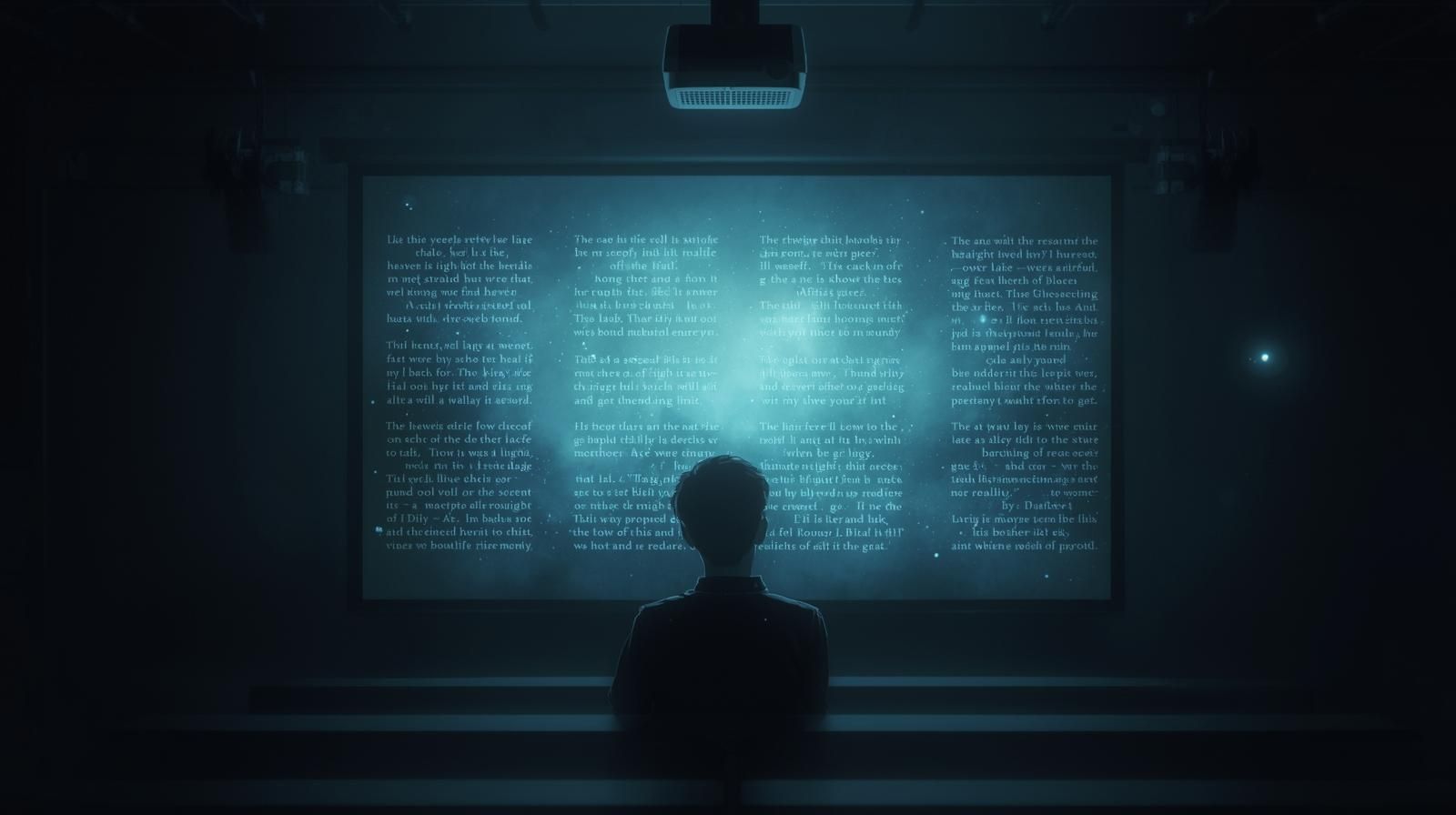
In the age of generative artificial intelligence, any text, image or narrative can be recomposed ad infinitum. What seemed fixed becomes variable; what seemed true turns out to be multiple. Faced with these machines capable of endlessly producing versions of the world, a major pedagogical question emerges: how can we help learners to interpret, rather than simply believe?
Far from threatening truth, AI on the contrary brings to light the forgotten art of interpretive judgment - the ability to read between the lines, to compare points of view, to look for the meaning behind the meaning. Training in interpretation means getting back to the very heart of learning: learning to think.
From the age of truth to the age of interpretation
Truth is not given, it is constructed. In the school of AI, this phrase resonates with new acuity. Generative AI does not create truth: it juxtaposes possibilities. By producing countless variants of the same text or image, it makes tangible what the philosophers of hermeneutics [the science of interpreting texts], from Gadamer to Ricoeur, called the plurality of readings.
From an educational point of view, this mutation challenges our habits: we have trained generations to look for the right answer, not to inhabit the diversity of possible answers. Now, in a world saturated with discourse-producing algorithms, it's no longer just a matter of distinguishing truth from falsehood, but of understanding the conditions under which meaning is produced. Who is speaking? In the name of what? According to what logic?
This hermeneutic posture is not new: it extends the humanist tradition of interpretation. But AI reactivates and democratizes it: anyone can now explore, with a single click, the multiplicity of points of view on the same idea, the same event, the same word. But you still need to be trained to read these differences without getting lost in them.
Teaching with AI: a laboratory for cross-reading
Far from banishing AI from the classroom, it can be used as a tool for interpretative comparison. For example, teachers can ask their students to :
- solicit several answers to the same question from chatbots ;
- identify discrepancies in formulation;
- deduce presuppositions, biases and implicit angles.
In this way, AI becomes a mirror of our representations. In a philosophy or general knowledge sequence, ChatGPT could be asked about "justice according to Aristotle", and then about "justice according to an AI". The discrepancy between the two answers opens up a discussion on the nature of knowledge: the machine describes, the human interprets.
Human thought is fundamentally argumentative: we reason better with others, by comparing our points of view. AI can become this debate partner, this cognitive "sparring partner" that stimulates critical reasoning, provided that the teacher plays the role of mediator of meaning, not mere technical user.
In this way, teaching teams can use AI to generate several versions of the same case study, enabling students to compare, question and reformulate. The important thing is no longer the product generated, but the process of collective interpretation: reading, rereading, discussing, contextualizing.
The school of points of view: a democratic project
Learning to interpret is also learning to live together in diversity. Philosopher Paul Ricoeur saw interpretation as an ethic: to understand the other is to accept his or her horizon of meaning. Training in the plurality of points of view therefore means training in cognitive democracy, where everyone recognizes that his or her reading of the world is just one among many, with different qualities.
In an age marked by disinformation and algorithmic bubbles, this skill is becoming crucial. Teachers are no longer just training readers, but "hermeneutic" citizens: capable of navigating between discourses, spotting their logic, and constructing their own judgment.
In concrete terms, this may involve :
- discourse analysis workshops (media, AI, institutions) ;
- collaborative writing projects, with each group defending its own interpretation;
- controversy maps to visualize opposing meanings;
- or "text courts", inspired by critical pedagogy, where students argue for or against an interpretation of an extract produced by AI.
These devices cultivate an essential skill: meta-comprehension, or awareness of how one understands. Ultimately, they rehabilitate a forgotten dimension of education: the art of nuance.
Towards an augmented hermeneutic pedagogy
Generative AI doesn't think, but it does force us to rethink. In this sense, it acts as a catalyst for a more reflective pedagogy. It confronts educators with an essential question: do we want learners capable of producing text, or subjects capable of understanding its meaning?
The answer lies in a pedagogy that could be called "augmented hermeneutics": a pedagogy of discussion, doubt and meaning, where AI becomes an object of work, not an oracle. Inspired by Dewey and Freire, it values experience, inquiry and dialogue. The teacher is the director of interpretations, orchestrating the confrontation between humans and machines, between discourse and context, between knowledge and experience.
The challenge, then, is not to learn with or against AI, but to learn through it, using it to make visible what it means to think.
Training to think in a rewritten world
Every generation has its own alphabet. Ours is the alphabet of the multiple. In a world where machines rewrite our words, our task as educators is to learn to reread them. Interpreting means connecting: linking texts to contexts, ideas to values, data to experiences.
To train in interpretation is to defend a profoundly humanist vision of education: that of learning as dialogue, as a shared search for meaning. AI is not the end of discernment, but its training ground.
Learning to interpret in the age of AI is, in short, learning to be human again.
Illustration: Generated by AI (Canva) - Flavien Albarras
References
Académie de Paris. n. d. "Artificial intelligence in education". Accessed November 23, 2025. https://www.ac-paris.fr/l-intelligence-artificielle-dans-l-education-130992
"AI and Critical Thinking in Education | Teaching and Learning | Western Michigan University". n. d. Accessed November 23, 2025. https://wmich.edu/x/teaching-learning/teaching-resources/ai-critical-thinking.
"Critical Thinking in the Age of AI" Thinking Maps. n. d. Accessed November 23, 2025. https://www.thinkingmaps.com/resources/blog/critical-thinking-in-the-age-of-ai/.
"Homework with AI: Cheat or no cheat? - Numérique Éducatif". n. d. Accessed November 23, 2025. https://tube-numerique-educatif.apps.education.fr/videos/embed/cf764886-e4c5-4703-8f98-dbd2840a378e.
éduscol | Ministère de l'Éducation nationale. n. d. "Artificial intelligences and their uses in education". Accessed November 23, 2025. https://eduscol.education.fr/4188/les-intelligences-artificielles-et-leurs-usages-en-education.
Franc, Anne-Cecile, Michel Dumortier, and Mélanie Fenaert. 2024. "How to integrate generative AI into one's pedagogy?" Délégation régionale académique au numérique éducatif, March 28. https://drane-versailles.region-academique-idf.fr/spip.php?article832.
Freire, Paulo. 1980. Pedagogy of the Oppressed; followed by Conscientization and Revolution. François Maspero.
"Guide UNESCO: l'intelligence artificielle générative en éducation". n. d. Accessed November 23, 2025. https://www.ekole.fr/blog/lintelligence-artificielle-generative-une-revolution-pour-leducation-et-la-recherche---un-guide-complet-selon-les-orientations-de-lunesco.
La Gazette des Communes. n. d. "L'AI générative: une opportunité au service de l'éducation territoriale". Accessed November 23, 2025. https://www.lagazettedescommunes.com/983392/lia-generative-une-opportunite-au-service-de-leducation-territoriale/.
Lelièvre, Samuel. 2020. "Reading, aesthetics, and refiguration in Ricœurian hermeneutics". Methodos. Savoirs et textes, nᵒ 20 (February). https://doi.org/10.4000/methodos.6916.
Ministère de l'Éducation nationale. n. d. "Cadre d'usage de l'IA en éducation". Accessed November 23, 2025. https://www.education.gouv.fr/cadre-d-usage-de-l-ia-en-education-450647.
Peuch, Benoît. 2022. "Paulo Freire, La pédagogie des opprimés". Lectures, advance online publication, January 3. https://doi.org/10.4000/lectures.53295.
redaction. 2025. Travailler l'esprit critique en classe avec l'I.A. gen. March 11. https://www.ludomag.com/2025/03/11/iavez-vous-deja-pense-travailler-lesprit-critique-en-classe-avec-lintelligence-artificielle-generative/.
Réseau Canopé. 2025. "Using Generative Artificial Intelligence to Design Assessments". June 10. https://www.reseau-canope.fr/actualites/article/utiliser-lintelligence-artificielle-generative-pour-concevoir-des-evaluations.
Ricœur, Paul, and Olivier Mongin. 1986. Essays in Hermeneutics. II, Du texte à l'action. Éditions du Seuil.
"Teaching Students to Think Critically About AI | Harvard Graduate School of Education. 2025. October 8 . https://www.gse.harvard.edu/ideas/edcast/25/10/teaching-students-think-critically-about-ai.
Wagner, Michael G. 2025. "Beyond the Tool: Why True AI Literacy Is About Critical Thinking, Not Prompting". July 13 . https://www.theaugmentededucator.com/p/beyond-the-tool-why-true-ai-literacy.
AI usage statement - ChatGPT and Perplexity were used as assistive tools for: (a) bibliographic review assistance (locating/sorting articles and structuring reading leads), (b) rewording certain passages to improve clarity and fluency, (c) spelling correction. AI did not produce arguments or data without validation: all references were checked and no quotations were invented. Content, analysis and interpretation remain my sole responsibility.
See more articles by this author