There are many degenerative diseases with a frightening
reputation, and Alzheimer's is one of the most notorious. This
neurological condition, which affects approximately 30% of people aged
85 and older, impacts short-term memory. This makes it difficult for the
affected individual to find the right words, remember what they have
done recently, and they become disoriented, lose social skills, and
experience sudden mood swings.
What's more, in the more critical
stages, they begin to forget elements of their long-term memory. It is a
long and painful condition, and researchers are working hard to
discover its cause.
The case of beta-amyloid
As a
result, much of the scientific community has been working on ways to
prevent these protein clumps from forming. In fact, in 2021, the FDA
approved an antibody targeting beta-amyloid, even though the data
supporting its use was not yet conclusive. In 2022, Science magazine
refuted the 2006 study on the protein, as it had been proven that data
had been fabricated by the research team.
The article has since
been retracted, but during all those years, many laboratories did not
seek to find other possibilities for the disease, wasting a tremendous
amount of time in the search for a cure.
An autoimmune disease?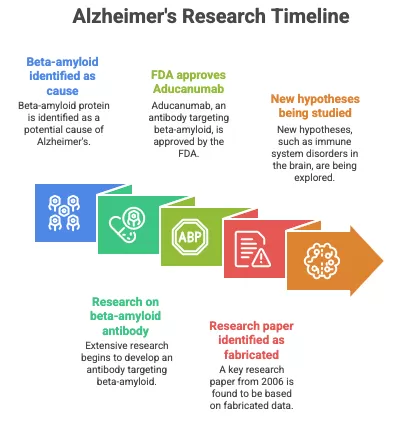
Fortunately,
some researchers continued to search for possible causes of
Alzheimer's. Among them was Donald Weaver, professor of chemistry and
director of research at the University of Toronto, who, together with
his team, found a possible explanation for the disease.
Demonizing
beta-amyloid makes no sense to them. Its presence in the brain is
essential and part of the defense system. If there is a head injury or
bacterial infection, the protein will activate to fight whatever is
happening in the brain. The problem, according to them, is that it
cannot distinguish between the fat surrounding a bacterial cell and that
of our cortex. As a result, it attacks everything indiscriminately,
causing dementia and Alzheimer's disease.
Thus, they do not
believe that antigen therapies would work since we are dealing with the
brain, which does not function in the same way as other organs or joints
affected by autoimmune diseases. However, there are certainly avenues
to explore by focusing on brain immunity.
Other possibilities
There
are also other theories about the causes of Alzheimer's. Some believe
that malfunctions in the mitochondria of brain cells are the cause of
neurodegenerative diseases.
Others point to brain infections,
abnormal handling of metals, or bacteria in the mouth as having an
effect on the development of the disease. The good news is that research
is continuing in order to eventually find the origins and cure for this
disease that affects millions of people.
Illustration : 2472911795
Réferences
Alzheimer's May Not Actually Be a Brain Disease, Reveals Expert - https://www.sciencealert.com/alzheimers-may-not-actually-be-a-brain-disease-reveals-expert
What Is Alzheimer's Disease And Is There a Way to Treat It? - https://www.sciencealert.com/alzheimer-s-disease
L'effet de la zoothérapie sur la communication non verbale des patients atteints d'Alzheimer - https://cursus.edu/fr/31352/leffet-de-la-zootherapie-sur-la-communication-non-verbale-des-patients-atteints-dalzheimer
Periodontal microorganisms and Alzheimer disease – A causative relationship? - https://onlinelibrary.wiley.com/doi/10.1111/prd.12429
Review on Alzheimer's disease: Inhibition of amyloid beta and tau tangle formation - https://www.sciencedirect.com/science/article/abs/pii/S0141813020351308?via%3Dihub
Le jeu vidéo pour comprendre et traiter la maladie d'Alzheimer - https://cursus.edu/fr/9303/le-jeu-video-pour-comprendre-et-traiter-la-maladie-dalzheimer
Alzheimer's disease as an autoimmune disorder of innate immunity endogenously modulated by tryptophan metabolites - https://alz-journals.onlinelibrary.wiley.com/doi/10.1002/trc2.12283
β-Amyloid is an Immunopeptide and Alzheimer’s is an Autoimmune Disease - https://www.eurekaselect.com/article/119208
Mitochondria research and neurodegenerative diseases: On the track to understanding the biological world of high complexity - https://www.sciencedirect.com/science/article/pii/S1567724922000423?via%3Dihub
Learn more about this
news