
All the methods to become a learning territory. Little by little, each one discovers the other and understands that he or she is part of a restorative community, a community capable of building its future without depending on external subsidies.
Publish at December 15 2025 Updated December 15 2025


When we think of ancient structures, the first images that come to mind are those of the pyramids in Egypt or the Acropolis in Athens. Connoisseurs will be able to point to Stonehenge, the Cairn de Barnenez in France or Çatalhöyük, in Turkey, which dates back to 7400 BC. Now, however, a team of researchers has found a structure even older than any previously discovered.
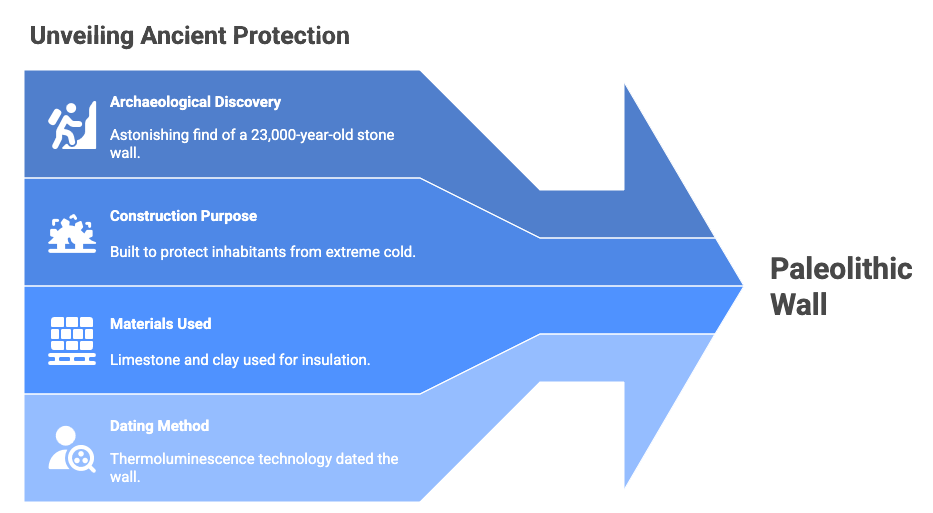
In Thessaly, Greece, there is a well-known archaeological site known as the Theopatra Cave. It lies in the limestone cliffs of the region and had already been studied by teams before. Nevertheless, what they discovered astounded them. In this cave, they found a stone wall built by Palaeolithic humans that would date back almost 23,000 years. That means a construction that would date back 17,000 years before the pyramids. It would have been built during the last glacial maximum. According to the archaeologists who found it, the purpose of this wall was to protect the cave's inhabitants from the extreme cold.
It would appear to be an early form of insulation, using limestone and clay as protection. However, specialists have seen nothing symbolic or ceremonial about it. The construction was dated using the thermoluminescence technique. In other words, the scientists wanted to calculate how long the wall had been heated in some way. So they took a sample and heated it. Certain types of material, including those of which this wall was made, accumulate energy when previously heated; when the object is subsequently heated again, for example for a laboratory sample, the previous radiation can then be measured. Based on the intensity, the age can be assessed. The wall, for example, has been dated at around 23,000 years.
This isn't the first incredible discovery to be made in Theopatra Cave. Children's footprints dating back 135,000 years, brazier remains from various millennia, stone tools, shell jewelry and even five human skeletons from different eras have been discovered. Evidence of barley, wheat and olive consumption, burial practices and even animal pens have also been found.
Its location and depth have enabled scientists to see the social behaviors, resource use and climatic resilience of early humans in this protected environment.
Illustration: Archaeology.wiki
References
World's Oldest Man-Made Structure Ever Discovered Is Older Than the Pyramids by 17,000 Years-And It's Still Intact - https://indiandefencereview.com/worlds-oldest-man-made-structure-ever-discovered-is-older-than-the-pyramids-by-17000-years-and-its-still-intact/
The Theopetra Cave in Thessaly: a 130,000 year old prehistory (Part 1) - https://www.archaeology.wiki/blog/2015/10/05/theopetra-cave-thessaly-130000-year-old-prehistory-part-1/
Out of the cave, into the cave [Thesis] - https://cursus.edu/fr/22241/sortir-de-la-caverne-entrer-dans-la-grotte-these
Theory of thermoluminescence - https://www.sciencedirect.com/science/article/abs/pii/S1350448707000157
The oldest human-made structure ever discovered may be three times older than the Pyramid of Khufu, at least 23,000 years old - https://evidencenetwork.ca/the-oldest-human-made-structure-ever-discovered-may-be-three-times-older-than-the-pyramid-of-khufu-at-least-23000-years-old/
The prehistory of the individual - https://cursus.edu/fr/13830/la-prehistoire-de-lindividu
You might also like:
All the methods to become a learning territory. Little by little, each one discovers the other and understands that he or she is part of a restorative community, a community capable of building its future without depending on external subsidies.
Preparing for the first school transition
All educational transitions are important and leave a deep mark on young people's memories. However, while much effort is put into the transition from primary to secondary school and to higher education, little attention is paid to the first transition: kindergarten. Some environments, such as in Quebec, have understood that this first stage is pivotal and therefore work to prepare children for their entry into school life.
Metacognition at school: useful learning
Reflecting on one's thinking methods is what metacognition proposes. This global analytical approach is seen as an educational strategy that helps all types of learners. So why is it not more widely adopted?


