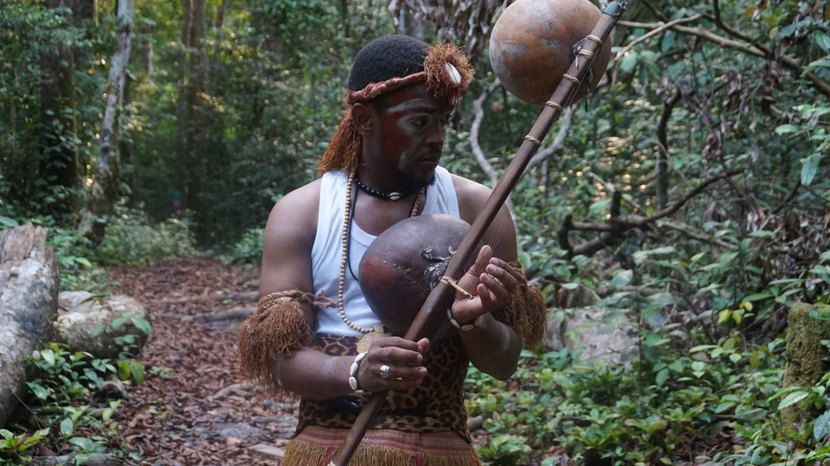
Understanding the transmission of oral knowledge through the Mvet
Understand the explicit functions of the mvet and highlight its implicit functions that go beyond the musical instrument.
Publish at January 14 2026 Updated January 15 2026


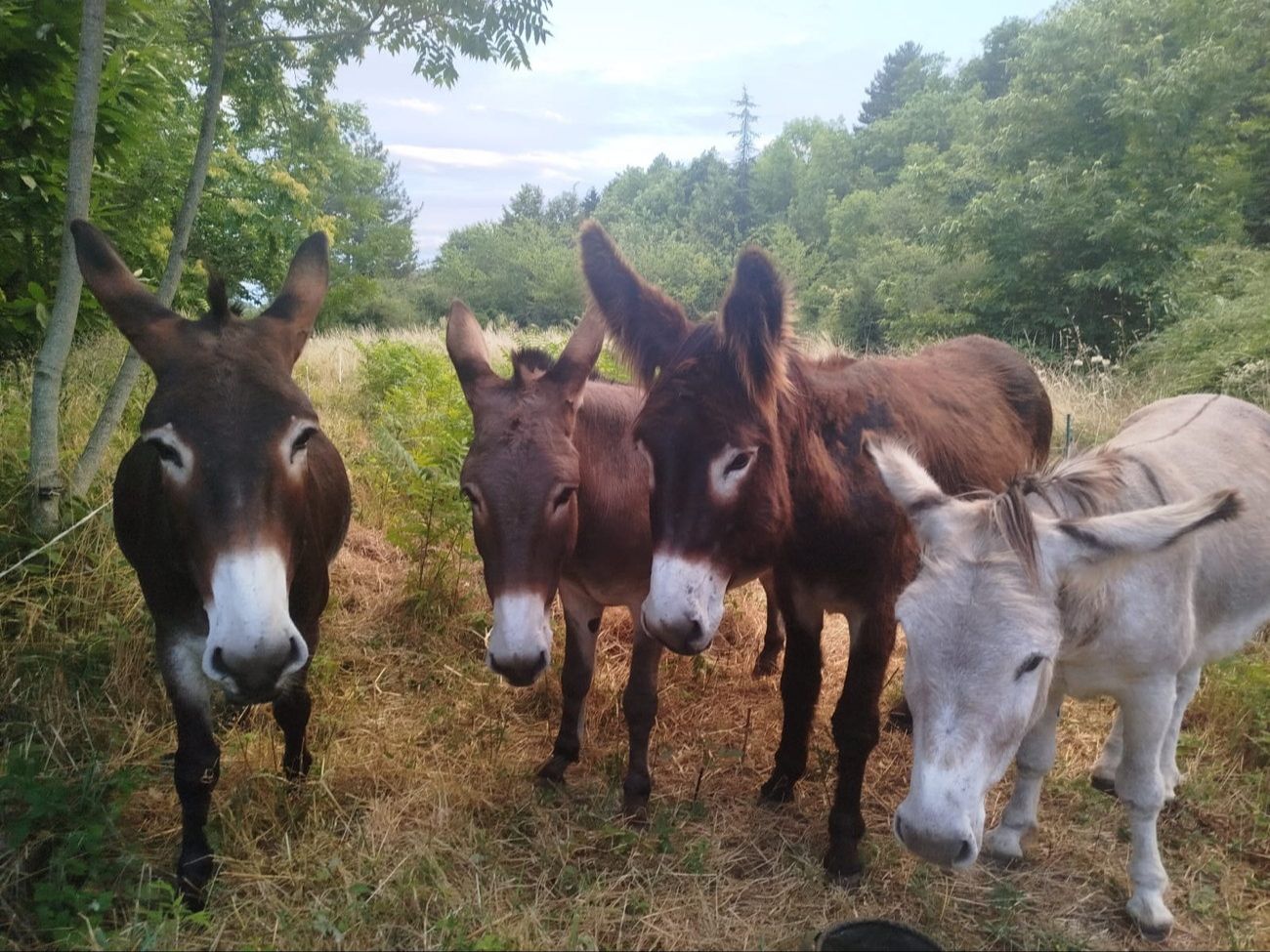
"The donkey is a donkey, not a degenerate horse". Buffon
There are companions on the road who don't talk, don't prescribe, don't theorize about learning. They walk. They observe. They wait. Donkeys belong to this rare category, teaching through their way of being in the world. Long reduced to a utilitarian or folkloric image (Pastoureau 2025), today they are revealing themselves as singular mediators of learning, invaluable for understanding what it means to move forward differently, individually, collectively and in relation to the environment.
The donkey doesn't just follow a path: it feels it, evaluates it and negotiates it. This subtle relationship with the terrain, the gradients and the tensions of the group transforms walking into an embodied learning situation. In the learning itineraries carried out in projects such as Rêve de Dan'A, the donkey doesn't just play a decorative role: it reconfigures group dynamics and invites everyone to revisit their relationship with power, decision-making, trust and commitment.
One of the first lessons he passes on is that of rhythm. Donkeys don't rush. His slowness is neither inertia nor resistance: it's ecological coherence. He pays attention to his feet. He moves forward when the terrain permits, stopping when he senses tension, and resuming when the relationship is re-established.
This particular tempo acts as a silent pedagogy. The human being, accustomed to urgency or performance, discovers another way of surveying the world: by adjustment rather than injunction. Walking with a donkey imposes a reduction in speed that opens up an inner space. It allows us to listen to what is lost in overly rapid rhythms: the micro-signals of the environment, bodily sensations, the subtle movements of emotions.
Work on embodied cognition (Varela, Thompson & Rosch, 1993) shows that slowing down promotes access to finer layers of perception. The donkey thus becomes a teacher of attention.
The donkey learns the path at the same time as we do, but not in the same way. It relies on the ground, the wind, smells and support. This sensitive relationship with the environment echoes Augustin Berque's (2010) notion of mediance: the relationship does not unite a subject and an environment, but a living being and its environment in a shared trajectory [back and forth between two poles].
Walking with a donkey means experiencing this co-emergence of the journey:
When the donkey hesitates, it forces the group to look differently:
With senses far more acute than our own, the donkey becomes the revealer of blind spots, the one who shows what humans, too focused on the objective, miss.
Donkeys don't stand up to force. Constraint produces resistance. Cooperation, on the other hand, produces availability. The way it works highlights a major relational principle for facilitation and training: the quality of the relationship and of care condition the quality of the action.
For a donkey to agree to move forward, it needs :
These elements are in line with contemporary work on psychological safety (Edmondson, 2019) and relational dynamics in adult learning (Carré, 2020). The donkey creates a terrain where these principles become tangible.
It acts as a relational mirror:
The donkey teaches the facilitating posture par excellence: the one that forces nothing and allows what must emerge to happen.
In our educational itineraries, the donkey is not just part of the scenery: it structures the learning process. Its presence encourages experiences of :
Each step becomes a micro-experience in explicitation: the body understands before speech. Explanatory interviewing (Vermersch, 2012), used in our research to highlight the power of the living in the service of learning, finds natural ground here: slow movement brings up the lived experience, enabling us to revisit it and grasp its fine gestures. The donkey acts as a mediator, providing access to tacit experience and reinforcing reflexive learning.
Groups that walk with a donkey experience a gradual transformation of their dynamics. The group learns to :
The donkey makes visible what many teams struggle to perceive in a traditional training room: the work of the collective is not an alignment of individuals, but a shared march. Through its rhythm and character, the donkey exposes tensions, reveals ephemeral leaders, opens up spaces for discussion, and invites slower, more robust forms of coordination.
The experience of walking with one or more donkeys becomes a living laboratory, a demonstration that cooperation is not taught by concepts but by gestures, situations and concrete adjustments. (cf. the experience of Dan'A's Rêve innovation laboratory).
At the end of an itinerary with a donkey, participants often testify to :
The donkey transmits an intelligence of the living: a way of situating oneself, of adjusting, of entering into relationships. It puts everyone in the right frame of mind, neither passive nor forced, where we move forward not because we are pushed, but because we feel that the environment, the group and the animal invite us to do so. It teaches what Berque calls trajectivity: the art of co-emerging with what surrounds us. The donkey is not a guide: he's a companion along the way, even part of the way to yourself. He reminds us of a simple truth: we really learn when we accept to be affected by the world and to walk at our own pace.
Bibliography
Berque, A. (2010). Médiance. De milieux en paysages. Belin.
Carré, P. (2020). Apprendre et faire apprendre. Dunod.
Edmondson, A. (2019). The fearless organization. Wiley.
Pastoureau, M. (2025), L'âne une histoire culturelle. Les éditions du seuil
Varela, F. J., Thompson, E., & Rosch, E. (1993). The embodied mind: Cognitive science and human experience. MIT Press.
Vermersch, P. (2012). L'entretien d'explicitation (7th ed.). ESF.
Le rêve de Dan'A laboratoire d'innovation pédagogique https://apprendre-autrement.org/reve-dana/
You might also like:
Understanding the transmission of oral knowledge through the Mvet
Understand the explicit functions of the mvet and highlight its implicit functions that go beyond the musical instrument.
Contemporary approaches to facilitation in the context of collective intelligence
Trends in collective intelligence facilitation are marked by AI, new managerial roles, diversified collective approaches and formats, and the institutionalization of research.
A.I. hallucinations: when it invents realities
AI can generate erroneous information or "hallucinations", with repercussions in critical sectors such as healthcare, justice and education. To mitigate these risks, we need to improve training data, design accurate prompts and encourage AI self-assessment. Education and responsible use are essential to limit these AI drifts.
Patient education and self-medication
In medical practice, although patient education is a necessity, it also leads to a proliferation of self-medication, which is not recommended by the medical profession.