It's easy to forget, but the beginnings of computing and the Internet were first and foremost those of thinkers in their apartments or garages, pondering the tools we use every day. At the outset, some wanted their creations to serve the common good and be accessible to all.
Tim Berners-Lee, founder of the Web, hoped that his foundation would give rise to a host of open, free initiatives. Unfortunately, his dream was short-lived. It wasn't long before Microsoft, Apple, Alphabet, Meta (formerly Facebook) and others swallowed everything up, as is their nature. Thus came the reign of GAFAM.
Of course, this didn't stop the production of free software, known as "open source", on the Web, to the delight of Internet users who didn't want to pay fortunes for desktop solutions, browsers or operating systems. Still, Linux has made its mark on the computing landscape. For many schools, these open-source applications have enabled creative uses that can be accommodated within the - often tight - budgets of the national education system. But can this almost protest movement survive in the age of proprietary AI?
The AI ogre
Now that artificial intelligence has taken center stage in the technophile discourse, everyone is trying to think about the uses of algorithms in different sectors of human activity. No one will be surprised to see that the GAFAMs have jumped on the bandwagon, each developing their own algorithms to serve their users: ChatGPT, Gemini, Copilot, Claude and so on. Usage has skyrocketed, with hundreds of millions of AI users.
Except that this new technology could well undermine the open code industry. This more marginal market, already difficult to monetize , has been weakened by artificial intelligence. The use of algorithms is akin to what is currently happening in the art world. AI swallows everything and uses data and queries to make statistical calculations, omitting questions of licensing. As a result, AIs tend to draw on documentation or other open code without disclosing that they are doing so.
The Creative Common or other license is concealed, erased by the algorithm. This is all the more ironic given that it is open-code technologies that have enabled generative AI to come into being, such as the Linux kernels of servers, Apache and Nginx, MySQL, which manage information, or TensorFlow, which has enabled automatic machine learning.
Artificial intelligence enthusiasts might claim that the democratization of AI offers people the chance to start creating their own open-code solutions. Certainly, the art of programming becomes a little more accessible with a conversational robot capable of analyzing and spitting out code according to a person's wishes. But quantity does not mean quality.
While hundreds of projects have emerged, most are the result of what programmers call "AI slop ". The same slop that pollutes social networks with obviously fake photos and videos, but quickly produced by Internet users. So much so that on GitHub, a network that enables developers to analyze coding projects, an option had to be added in February 2026 to close queries, despite this being the site's flagship function. Admittedly, code can be verified by AI, but it will never do as well as a human who can recognize problematic lines.
The black box effect
In such a context, the reflex would be to call for the development of open-code artificial intelligence, as is the case with software. Technically, this already exists, and Wikipedia has listed several examples. In fact, some are trying to take advantage of this by being less than honest about the openness of their code. OpenAI, behind the famous GPT model, has nothing really open about it. Researchers are warn ed against some claiming to be open, when in fact they are not.
It should be pointed out that an open-code AI seems almost impossible. Compare the idea with open-source software. In the latter, users normally have easy access to the code, so they can modify, add or remove features according to their level of comfort. This is because the coding is generally clear and we know what language is being used. Artificial intelligences, on the other hand, are far more obscure; we understand that they operate according to a developed neural system, a corpus and a training method. But even with this information, the black-box effect persists within artificial intelligence. Ordinary people cannot easily play with this technology, which limits the dream of open-code AI.
Dreaming of AI nationalization
This doesn't mean, however, that the dream of open-code AI is impossible. In fact, it seems that a movement is gradually emerging in which public authorities are turning their attention to the issue of open code. In fact, many are calling for the collectivization of AIs in order to truly regain control over a technology that is currently unregulated and threatens economic sectors, workers and social peace alike. Above all, it's something to think about in a context where knowledge must be preserved as a collective asset. This would be an opportunity to keep a close eye on who owns the data, and prevent it from being used by anyone and everyone without compensation.
It's an idea that has every reason to come true, especially given Europe's lag in the field of AI, which has been overtaken by the USA and China. A global continental policy requiring the use of open-code AI would enable real digital sovereignty, and even prioritize algorithms that are less energy-intensive and more frugal than those powered by GAFAM, which requires more and more data centers and energy around the world every year.
The use of open-source AI in governance would provide an opportunity to cut costs, ensure that data and queries remain the employment of a precise geographical milieu (village, town, region or country), all the while taking local realities into account. What's more , a recent study shows that open-source AIs are more effective than GAFAMs at citing and notating references in various research projects.
Does this mean that an open market in artificial intelligence could develop as software has? That remains to be seen.
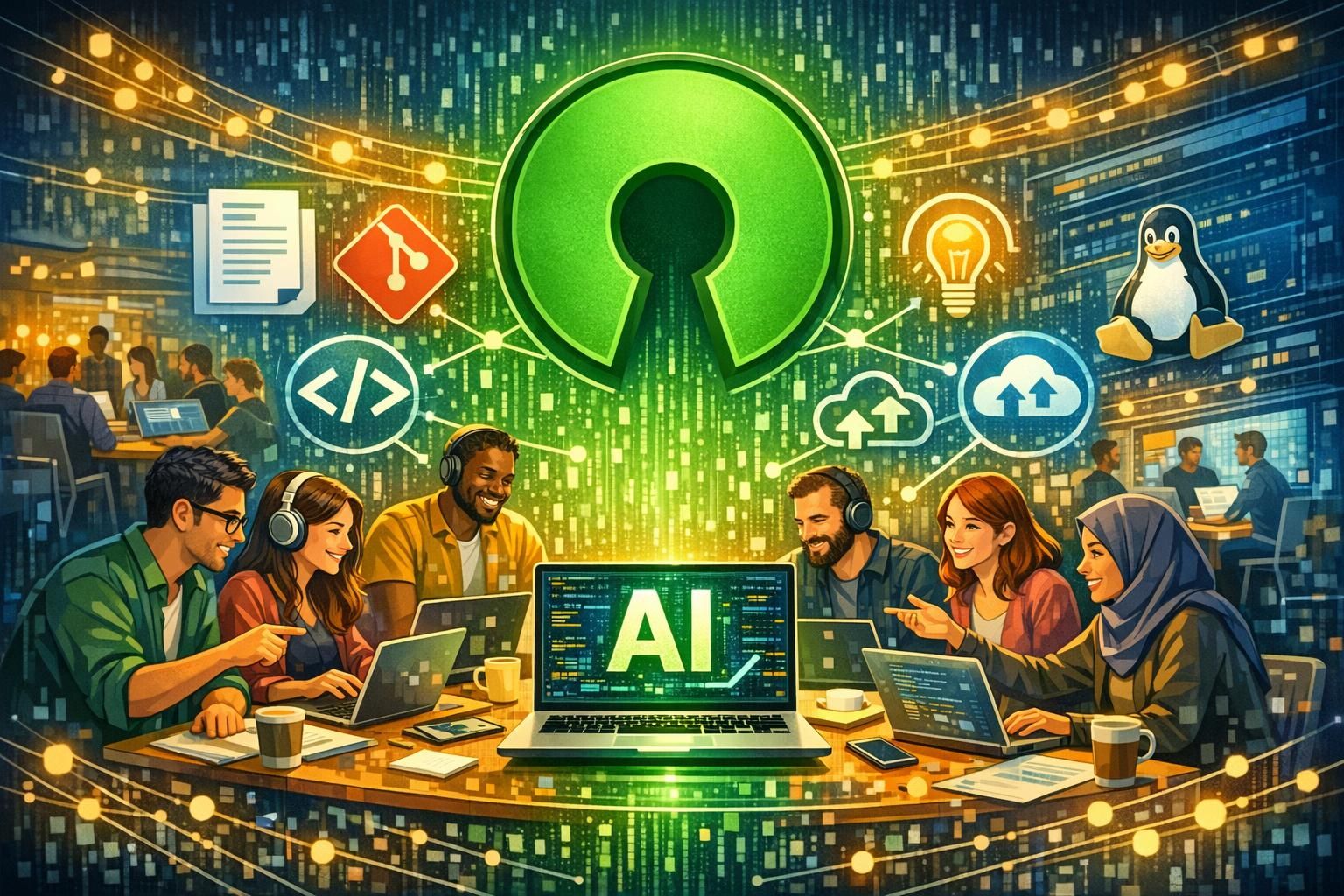
Image by AI (Copilot): "open source artificial intelligence in a community context".
References :
Barbier, Gilles. "Will AI kill open-source business models?" LinkedIn. Last updated January 10, 2026. https://fr.linkedin.com/pulse/lia-va-t-elle-tuer-les-business-models-de-gilles-barbier-vdise.
Brandom, Russell. "For open source programs, AI coding tools are a mixed blessing." TechCrunch. Last updated February 19, 2026. https://techcrunch.com/2026/02/19/for-open-source-programs-ai-coding-tools-are-a-mixed-blessing/.
Daigle, Louis-Gabriel. "Embracing open source AI: the future of AI and data sovereignty." Libéo. Last updated January 22, 2026. https://libeo.com/ia/ia-open-source-souverainete-donnees/.
Gaie, Christophe, and Laurent Denis. "How open source AI could modernize public services." Polytechnique Insights. Last updated March 20, 2025. https://www.polytechnique-insights.com/tribunes/digital/comment-les-ia-libres-pourraient-moderniser-les-services-publics/.
Geerling, Jeff. "AI is destroying Open Source, and it's not even good yet." Jeff Geerling. Last updated February 16, 2026. https://www.jeffgeerling.com/blog/2026/ai-is-destroying-open-source/.
Gewirtz, David. "Why open source may not survive the rise of generative AI." ZDNET. Last updated: October 27, 2025. https://www.zdnet.fr/actualites/pourquoi-lopen-source-pourrait-ne-pas-survivre-a-lessor-de-lia-generative-484026.htm.
Gibney, Elizabeth. "Open-source AI tool beats giant LLMs in literature reviews - and gets citations right." Nature. Last updated February 4, 2026. https://www.nature.com/articles/d41586-026-00347-9.
Jennings, Charles. "Faced with AI, only one solution, nationalization." Les Blogs D'Alternatives Économiques. Last updated: July 29, 2024. https://blogs.alternatives-economiques.fr/gilles-raveaud/2024/07/29/face-a-l-ia-une-seule-solution-la-nationalisation-par-charles-jennings.
Maffulli, Stefano. "'Open source' AI isn't truly open - here's how researchers can reclaim the term." Nature. Last updated: March 27, 2025. https://www.nature.com/articles/d41586-025-00930-6.
Nolan, Mike. "How 'open' is open-source AI?" Ada Lovelace Institute. Last updated July 23, 2025. https://www.adalovelaceinstitute.org/blog/how-open-is-open-source-ai/.
Pillot, Julien. "Open source and frugal AI: the key to European strategic autonomy?" The Conversation. Last updated: July 29, 2025. https://theconversation.com/lia-open-source-et-frugale-la-cle-de-lautonomie-strategique-europeenne-259748.
"Is Open Source Artificial Intelligence Possible?" LinuxFr.org. Last updated: February 26, 2025. https://linuxfr.org/news/une-intelligence-artificielle-libre-est-elle-possible.
See more articles by this author