Presence: welcoming the emerging future
An exploration of Otto Scharmer's thinking on the concept of presence, which he extends from the individual to groups and the planet as a whole.
Publish at June 18 2026 Updated June 18 2026


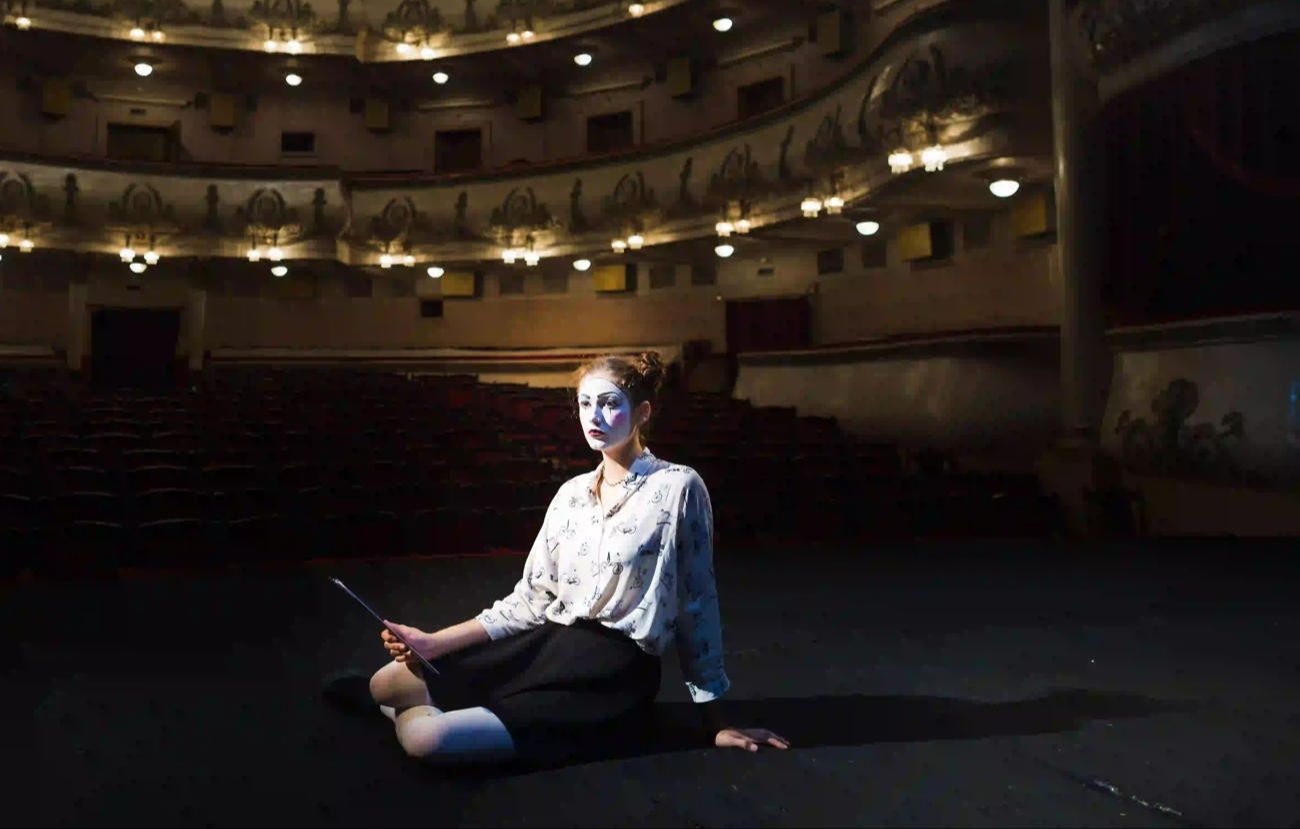
When the curtain rises, it isn’t always passion that speaks. Sometimes it’s something older, something deeper, that neither shyness nor reason can hold back for long
The musician trembling backstage before going on is unsure whether to go out there, yet he goes anyway. The dancer who has been rehearsing for months for a twenty-minute performance doesn’t calculate the return on her investment of time. She dances because she needs to dance in front of an audience.
This tension between fear and the irresistible allure of another’s gaze deserves to be examined beyond narratives of vocation or passion. Neuroscience, anthropology, and sociology offer a less romantic interpretation that may be more accurate: putting oneself on display may respond to a biological impulse that culture has learned to structure, not to create.
The human brain possesses a dopaminergic reward system that is activated during behaviors that promote survival: eating, reproducing, and forming social bonds. This same circuit is activated when an individual receives social approval, whether it be applause, an admiring glance, or collective laughter triggered by their presence.
Robert Sapolsky, in *Behave: The Biology of Humans at Our Best and Worst* (2017), shows that the biological mechanisms governing complex social behaviors are the same as those governing basic survival behaviors. Recognition by the group is not a luxury added to the human condition; it is a prerequisite for psychological stability.
Appearing on stage triggers a measurable physiological response: an increase in cortisol before the performance, a spike in dopamine during a successful performance, and a growing tolerance to exposure among regular performers—a process that resembles conditioning more than conscious learning. The body seeks to repeat what the brain has registered as rewarding. The stage, in this context, is not a platform; it is biological territory.
One phenomenon that is often misinterpreted is stage fright. It is readily portrayed as a barrier to be overcome, a weakness to be surmounted.
The work of Sian Beilock and Thomas Carr, published in 2001 in the *Journal of Experimental Psychology* under the title “On the Fragility of Skilled Performance: What Governs Choking Under Pressure, reveals a more nuanced reality: a decline in performance under pressure is not linked to fear itself, but to the way attention is directed during the performance. Expert performers, whose movements are automated, are less vulnerable to pressure than beginners because their attention is no longer absorbed by controlling their movements. It can be directed elsewhere: toward the audience, the space, the moment.
What this research highlights is that stage fright is an activation signal. The body prepares for a situation with high social stakes, just as it would have prepared, in the distant past, to face a life-threatening danger.
The fear that precedes going on stage is not an obstacle to be overcome; it is proof that the body is functioning normally. It signals that the situation is important. Treating it as a flaw amounts to misreading this signal.
Erving Goffman, in *The Presentation of Self in Everyday Life* (1959, .pdf), proposed an interpretation that remains one of the most robust frameworks for understanding human behavior in public spaces: every social interaction is a performance, in the sense that each individual constantly manages the image they project to others. The stage of a theater or concert hall is thus merely a formalized and ritualized version of what everyone does in an office hallway, at a family gathering, or on a bustling street.
This shift from everyday life to performance is not arbitrary. Denis Dutton, in *The Art Instinct: Beauty, Pleasure, and Human Evolution* (2009), argues that artistic and performative production is universal across human societies, making it a strong candidate for the status of an evolutionary adaptation. No known culture exists without song, dance, or stories shaped for sharing. Performance is not an invention of civilization; it is an anthropological constant that civilization has organized, professionalized, and sometimes monetized.
The distinction between the professional performer and the amateur who sings in a village choir or improvises at a street jam is therefore not one of kind, but of degree. One has turned their impulse into a profession; the other lets it express itself in the margins of their free time. Both fulfill the same need: to be seen, heard, and recognized by a group that chooses to pay attention.
The relationship between the stage and the audience is rarely analyzed in terms of its reciprocity. The audience is not a passive recipient. It comes seeking something that ordinary conversation does not produce: a shared experience in real time, within a defined space, with strangers.
The synchronization of emotional responses within an audience—collective laughter, held silence, simultaneous tears—produces what neuroscience calls intersubjective resonance, a form of coupling between organisms that reinforces the sense of belonging to the group.
This collective dimension is perhaps the oldest function of performance. Before stories were written down, they were told, sung, and danced around a fire. In *The Ritual Process: Structure and Anti-Structure* (1969), anthropologist Victor Turner calls this state of temporary fusion “communitas”—a state that emerges when a group shares the same experience at the same moment, outside of ordinary hierarchies. The gathering was not a cultural choice; it was the place where the tribe recognized itself as a tribe.
Summer festivals that bring together tens of thousands of people around a shared stage, operas where the audience falls silent for three hours in collective attention, synchronized drone flights that make entire crowds look up: these very different forms of performance share the same anthropological foundation. They create a sense of “us,” momentarily, in a world where the individual is often alone.
Interpreting performance as a response to a biological impulse does not diminish either art or the effort it requires. A pianist who spends ten years working on a Schubert sonata is not merely satisfying a dopamine-driven need. Understanding that the stage also responds to something that predates technique and ambition allows us to view differently those who take the stage without training, without a contract, for no other reason than the need to do so.
They are not naive; they are acting in accordance with a part of human biology that societies have always found ways to satisfy. Perhaps the real question is not why some people take the stage, but why others choose not to, and what they find as a substitute for this specific form of collective recognition.
Illustration: magnific - 2975758
References
The Art Instinct: Beauty, Pleasure, and Human Evolution, Denis Dutton, 2009,
https://books.google.com/books/about/The_Art_Instinct.html?id=jqb6WrXS68kC
Behave: The Biology of Humans at Our Best and Worst, Robert Sapolsky, 2017,
https://www.penguinrandomhouse.com/books/311787/behave-by-robert-m-sapolsky/
On the Fragility of Skilled Performance: What Governs Choking Under Pressure, Sian Beilock & Thomas Carr, 2001, https://www.researchgate.net/publication/11599664_On_the_Fragility_of_Skilled_Performance_What_Governs_Choking_Under_Pressure
The Presentation of Self in Everyday Life, Erving Goffman, 1959, https://crossculturalleadership.yolasite.com/resources/Goffman%20(1959)%20Presentation%20of%20Self%20in%20Everyday%20Life.pdf
The Ritual Process: Structure and Anti-Structure, Victor Turner, 1969,
https://archive.org/details/ritualprocessstr00turn
AI Usage Statement
Perplexity and Claude were used as support tools for:
The AI did not generate any arguments or data without validation: all references were verified, and no citations were fabricated.
The content, analyses, and interpretations remain my sole responsibility.
You might also like:
Presence: welcoming the emerging future
An exploration of Otto Scharmer's thinking on the concept of presence, which he extends from the individual to groups and the planet as a whole.
There are biological limits to collective functioning linked to the neocortex. But these limits evolve and vary with contexts and technologies.
When training organizations become learning organizations
Learning goes beyond the simple transfer of data from brain to brain in a dedicated room. Several axes are identifiable to develop as an educational organization promoting the desire to learn.
Scientific, cultural and artistic residencies
Use the model of scientific, artistic or cultural residences to learn differently, by giving oneself time and taking inspiration from favorable places.
Guidelines, instructions and teaching objectives
How do you ensure that instructions, guidelines and educational objectives are understood?