The changing face of books and reading in the digital age
Digital technology has brought about many changes in the book industry: in reading habits, in reading media, in the relationship between author and reader.
Publish at December 09 2014 Updated January 26 2023


Jasper Visser and Jim Richardson published an illustrated paper on designing and implementing a digital strategy in cultural institutions in 2013. It's a practical tool that provides pathways to begin the strategic work and includes very concrete exercises for getting to the point of digital planning in cultural venues. Digital Engagement in Culture, Heritage and the Arts was posted in 2014, under a Creative Commons license, on the Slideshare account of the annual European conference MuseumNext, founded in 2009 by Richardson.
So one can consult it online for free, download the sixty-page document in pdf format (also free), or purchase a hard copy of the book (30 euros + shipping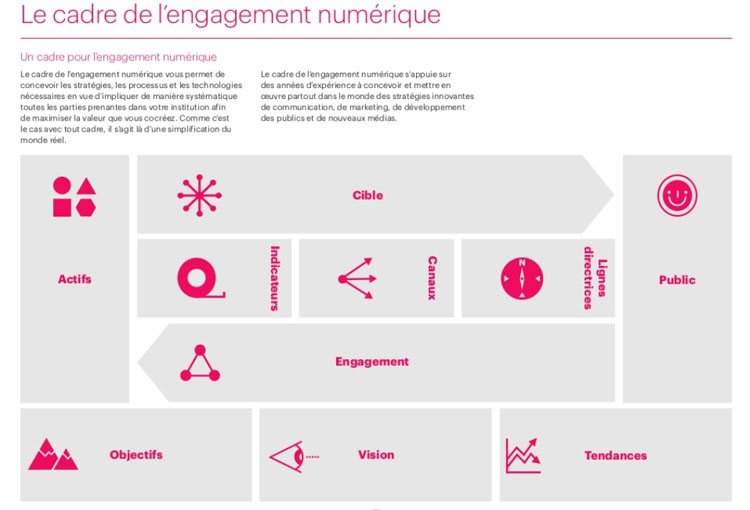 ) to be placed on a desk, prominently displayed in a strategic location in one's institution, as the authors recommend. This planning document is also available in French (and Italian), but the translation, French at least, is not quite up to snuff, and we would recommend consulting the original version instead, if possible.
A useful working outline is part of the document and will help initiate planning. It provides, in one page, a working outline with each part (assets, trends, audiences, etc.) having questions whose answers will help build the strategy. A diagram with empty boxes accompanies this template, and is to be completed based on the answers to the questions asked.
Steps in Planning
In the full document, each of the stages of strategic planning and case studies of different types of cultural organizations: libraries, heritage sites, exhibition projects, festivals... are presented, along with a work plan.
The authors' goal is to provide a toolkit for cultural organizations to choose the best approach to their use of digital media, online and in-person. These tools could probably be adapted to other areas. It emphasizes the importance of those doing the planning to work in concert with their colleagues and to have the confidence of their supervisors within the organization. Visser and Richardson have created a practical and visual framework for involving all stakeholders in the organization. The most important thing, for them, is to ask the right questions.
Vision and goals
If your organization were to disappear tomorrow, what would the world lose? This is the first question the authors propose to ask to identify the institutional vision. It involves defining the overall vision of the organization (of the project, artist, or entity for which the 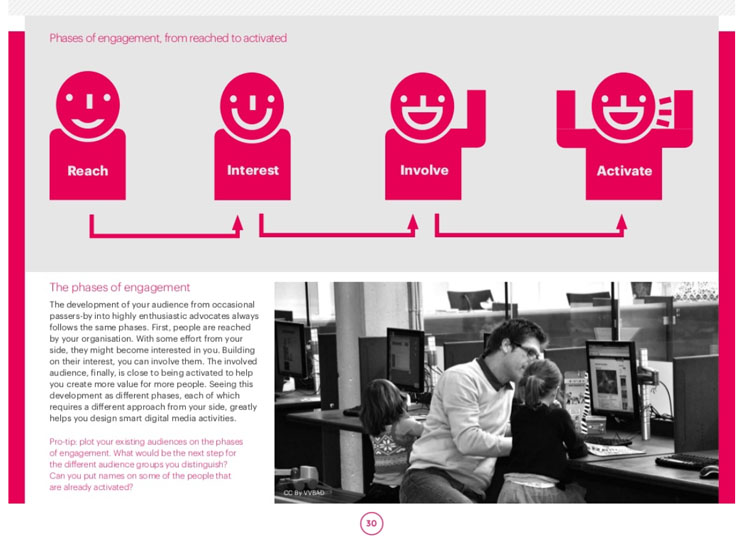 strategy) based on internal policy documents about the company and a consultation with everyone involved in the organization: staff members, visitors, non-visitors, administrators, etc. The answer should be a brief statement that goes beyond the day-to-day and the profitability issues, the two authors advise. This statement will become the basis from which short- and medium-term (3 to 5 years) goals can be defined, then broken down into annual digital creation or development projects.
Visser and Richardson emphasize the importance of keeping up with general trends in digital media and tools, which represent both challenges and opportunities for the organization. For them, it is essential to stay up to date on this subject, for example by conducting social media monitoring, going to specialized conferences, consulting available statistics, reading blogs by specialists in the field, etc.
Actives, assets, and audiences
The second step in the realization of a digital strategy would be to list all the assets of the organization, the obvious ones like visits, products, ... but also the ones that we don't think about a priori: quality of the reception, food served on site, professionalism of the team, etc. This directory of assets must include everything that opens a dialogue with the public. We should come up with about 100 assets, large and small, through consultation with the people involved, guest books, comments about the organization on social media, photos shared online, etc. It is these assets, as defined through consultation, that will later be transformed into digital content (audio, video, blog posts, etc.).
Engaged Audiences
After describing the organization's different audiences, the goals, interests, and values of each particular group, the authors suggest asking what online communities each group might belong to. The answer to this question should serve as a guide for creating digital activities that are meaningful to each audience, so that they become involved.
 Practical exercises to help define target audiences are present in the document. At each stage of the strategy planning work, the authors provide examples of questions to ask, actions to take, and outcomes or challenges to expect.
In the paper, the authors also discuss assessing engagement and writing guidelines for publishing digital content (p. 49) regarding, for example, the tone to use, the maximum time to give a response to an email or social media comment, whether at least two people should have reviewed the content before publication, etc.
Planning content
It is clarified that the strategic plan involves doing content planning as well, with content being a composite of existing content, content that can be easily produced in the short term, and high quality content to be produced in the long term. We must ask ourselves who will do what and when. Blog publishing is given as an example: how many posts per week, how many words per post, who reviews, who uploads, etc.
The paper ends with interesting examples from different types of cultural organizations that have completed the worksheet, each in their own way. This is followed by a sample timeline with tasks to be completed over ten weeks (p. 61) to arrive at a digital engagement strategy by working quickly and involving as many people as possible.
The Jasper Tool is a tool that can be used to help organizations develop a digital engagement strategy.
Jasper Visser and Jim Richardson's tool will certainly prove very useful to institutions, large and small, that don't want to reinvent the wheel and start from scratch in planning a digital strategy that fosters audience engagement; this guide could be a great starting point.
Sources
Digital Engagement in Culture, Heritage and the Arts: http://fr.slideshare.net/MuseumNext/digital-engagement-book
http://digitalengagementframework.com/
Images: screenshots, Digital Engagement in Culture, Heritage and the Arts on Slideshare, Creative Commons Attribution-Share Alike license. Copyright 2013, Jasper Visser and Jim Richardson.
Also see:
Derby Museums Digital Strategy (2010): http://www.collectionstrust.org.uk/item/1944-derby-museums
Smithsonian Web and New Media Strategy (2009): http://smithsonian-webstrategy.wikispaces.com/Executive+Summary+and+Moving+Forward
Tate Digital Strategy 2013-15: Digital as a Dimension of Everything (John Stack, 2013): http://www.tate.org.uk/research/publications/tate-papers/tate-digital-strategy-2013-15-digital-dimension-everything
You might also like:
The changing face of books and reading in the digital age
Digital technology has brought about many changes in the book industry: in reading habits, in reading media, in the relationship between author and reader.
The challenges of integrating AI solutions in NPOs [Thesis].
IA solutions for non-profit organizations (NPOs) bring added value, but it's important to ensure that they are aligned with the organization's mission.
Université Laval's Sustainable Development Strategy - Horizon 2030
The document "Stratégie de développement durable de l'Université Laval - Horizon 2030" reflects a serious commitment, and indeed testifies to the depth of Université Laval's sustainable development culture. It can serve as an example of large-scale institutional mobilization.
Honing your confidence with critical thinking [Thesis].
Information is so abundant that it is difficult to know who to trust. Critical thinking is a vector of emancipation with regard to the knowledge integrated in the school programs. But as a person, the teacher himself carries certain values and beliefs. How do teachers learn and master critical thinking? This is what Denis Caroti proposes to discover in his thesis.
The scientific approach to teaching critical thinking [Thesis]
How do you get young, gullible students to develop critical thinking skills?