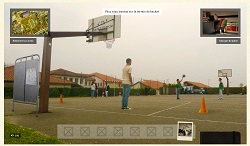
Is life a game?
In psychology, we often refer to life as a play in which we find ourselves either in the role of actor or spectator, depending on the moment.
In education, we might imagine life as a game in which we are pawns on a huge board with indefinable limits, so much so that we can't see all the pawns or the dice, and where bonuses and penalties come from all sides without our noticing.
We, the pawns, are born on the board and progress through the game, living and dying.
Hopscotch, a symbol of life
 Hopscotch is a very old game that exemplifies this metaphor. If we analyze the layout of hopscotch, it begins with a semicircle representing the earth, symbolizing birth, and ends with another semicircle representing the sky, symbolizing death. In the center are squares numbered from 1 to 9, each of which could represent our age groups by ten. The puck (pebble or other object used for throwing) would represent the soul. If we now remove the numbered squares to join the ends, we have a circle representing the Earth.
This analysis is representative enough to claim that life is a game, or at least that we play at life.
Admittedly, life is a more complicated game than this, with lots of rules, limits, winners and losers, objectives, competitions and so on.
A game that's hard to play, where you have to be able to use tricks to outwit your opponent. A hard, cruel game, but a very natural one.
And instead of being a manipulated pawn to be moved around the game, we play our own part.
 Yes, you could say that life really is a game.
In our modern society, we live according to specific rules and challenges, and who says dream and challenges, says game. Isn't just going to work every day a challenge where we have to get up every morning and get ready, with the aim of getting to work on time?
In the course of the game, we have to get ready and on the way, respect the rules of the road or the rules of civility depending on the means of transport we take.
It's been proven time and time again that game-based learning, whether for children or adults, leads to far more conclusive results than traditional methods. Numerous studies and articles have already confirmed this.

I've experienced this myself on several occasions in my work as a teacher, and it's been gratifying in more ways than one, as in the case of dyslexic children who have been able not only to improve their French and math skills, but also to regain their self-confidence. Or the case of the vicious circle of a disruptive child who had no interest in anything because he was always reprimanded for his poor results, and who one day played La Maison de Loupy, a game about good behavior with his pet. His dog was one of the few things he was interested in. His concentration was therefore more than usual, and what's more, at the end of the game he was awarded a diploma with his name on it, and congratulations from all concerned. The child had discovered the pleasure of being rewarded. To enable him to relive that heroic feeling, he began to adopt a more appropriate attitude as a good student.
Of course, we didn't turn him into an angel - far from it! But we did use the game to help him discover his inner potential.
Homo Sapiens, Homo Faber ... Homo Ludens
Human beings have always used play as a primary and natural means of learning. Learning to live in society, at first, within one's family or school environment, play makes us sociable. Johan Huizinga, a Dutch historian (1872-1945), already claimed at the time that play is innate in man (Homo Ludens), in the same way as knowledge (Homo Faber) and manufacturing (Homo Faber). These 3 characteristics are an integral part of mankind, and we didn't wait for New Technologies to reveal them.
Studies prove it
Numerous studies have been carried out on the psychological benefits of games, such as the case of a group of teenagers playing Tetris, who were shown to develop grey matter.
A study in a medical center found that surgeons who played video games for more than 3 hours a week made 37% fewer errors in the operating room than those who didn't, were 27 times faster in surgery and sutured 33% more.
European Schoolnet was commissioned by ISFE (Interactive Software Federation of Europe) to carryout a study on electronic games in the broadest sense of the term (educational, commercial, leisure, etc.) in 8 European countries: Austria, Denmark, Spain, France, Italy, Lithuania, the Netherlands and the UK. The study involved children from primary to secondary school, 500 students, some 30 policy-makers and experts, six case studies, a review of scientific literature and a specially-created Internet community. No distinction was made between teachers in terms of age, gender, level of seniority, experience with electronic games, age of their students or subjects taught.
An experimental group and a control group were formed. In the experimental group, students played alone or in small groups for 20 to 25 minutes a day, five days a week, ending on Fridays with a test.
Results from the experimental group showed a twofold improvement over the control group in terms of accuracy and processing speed. The weakest students in the experimental group progressed better than the gifted students in the control group, and showed an impetus to continue. Motivation was thus heightened, and students had a greater facility of comprehension.
Another extra-curricular experiment was designed to help students with severe difficulties, both in terms of academic performance and social adaptation. Initially, these students had negative feelings, such as guilt, weariness and discouragement, because their futile efforts were achieving nothing. Some had reached the stage of being phobic about attending school.
Play enabled them to reverse these feelings, while improving their skills and allowing them constructive criticism instead of punishment. This enabled them to feel more at ease on the school bench, so they were better able to concentrate and learn.
From the teachers' point of view, the success comes from the playfulness, but also from being confronted alone with challenges where everyone learns in their own way and at their own pace. Above all, failure is no longer condemned, but studied to learn from it. We learn from our mistakes.
An approach to collaborative work, and social and communication skills were also experienced more than usual.
Why are we better at gaming than we are at life?
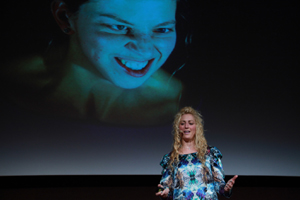 Jane McGonigal works as a computer graphics designer at the Institute for the Future in the USA, where she has been creating games for 10 years. Her main aim is to create a way for games to make saving the world as easy in real life as it is in online games.
In her dissertation, she studied the behavior of World Of Warcraft addicts to find out why they feel better in a virtual world than in real life. While they are able to take on challenges by spending hours solving problems, starting over as many times as necessary, collaborating and cooperating in the virtual world, why can't they do so in real life?
For Jane McGoniga, we don't think we're as good in life as we are in games. Perhaps precisely because it's a game, and everything is permitted and possible. In a game, we're willing to do anything to get what we want, so we become better at it. We are inclined to help other players and are willing to fight to solve a problem for as long as it takes. In real life, faced with failure and obstacles, we don't have the same mindset. We quickly feel overwhelmed. We feel anxious, sometimes depressed, frustrated or cynical. We never have these feelings when we play; they simply don't exist. Playing gives us the feeling of being able to accomplish anything.
That's why Jane McGonigal strives to find ways of transposing these positive in-game feelings into our everyday lives.
When you enter World Of Warcraft, you'll find characters who are just as different from each other, but all with the same attitude of trusting you to complete a mission. A mission you'll be able to accomplish according to your level. You'll never be given a challenge you can't meet, but one that's right up to the limit of your abilities.
Also, there's no unemployment in World of Warcraft. There's no twiddling of thumbs - everyone has something specific and important to do. There are also hundreds of collaborators. Wherever you go, thousands of characters are ready to work with you to help you accomplish your mission.
In real life, things are very different. When you leave school, you'll never see hundreds of people ready to trust you and offer you the opportunity to prove yourself. You'll never receive bonus points or level badges in life for a small task accomplished, because yes, it has to be said, life doesn't offer us gratification for all those little daily chores that aren't always easy to accomplish.
Again according to Jane McGonigal, all this time spent playing modifies our human capacities by making us more honest, more sociable, more collaborative and more persevering. Gamers are hopeful, superpowered individuals. They're people who believe they can change the world. The only problem is, they believe they can change virtual worlds, not real ones.
Your professional potential in the game
In the field of employment, games such as Hair be12, to name but one, enable a candidate's skills to be put into practice in the comfort of their own home, out of sight. Likewise, recruitment fairs organized in 3D virtual worlds give you the chance to present yourself without having to wear a suit and tie. Not only do these fairs enable you to discover candidates who will never come forward, but they also allow you to show off your potential by using an avatar to represent yourself, allowing you to forget your anxieties and frustrations.
Gaming cures frustration
Another very interesting case in point is one I've introduced in my introductory ICT courses for senior citizens. Some of them have real difficulty manipulating the mouse. This frustration is very real and is essentially due to a state of mind. By having them play Save Them Goldfish, a game in which they have to save goldfish by removing them from a frying pan, the role of savior unconsciously takes its place at the complex, enabling them to overcome this difficulty without even realizing it.
Play helps psychoanalysis
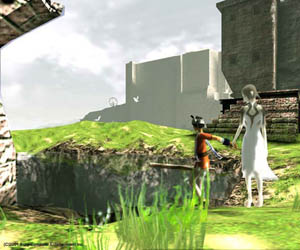 In psychoanalysis, play is playing an increasingly important role in therapy. Not only does it enable us to observe a person's behavior in order to understand it better, and to use a situation to release it in words, it also enables us to get to know ourselves better and to highlight the positive aspects of a person who devalues himself.
For example, Michael Stora, a psychoanalyst in Paris, uses the virtual fairy tale Ico, in which the child becomes the hero and must save and protect Princess Yorda from the evil queen and her soldiers.
The session involves one child playing the game, while the others, children and specialists, observe his or her behavior in the game.
A little boy in foster care was suffering from deep narcissistic wounds. The father was incarcerated and the mother a heroin addict, whom he had to look after himself. This little boy, in his very difficult family environment, had to take on the role of "carer" with all the responsibilities of an adult.
In Ico, he had to look after Yorda, who was none other than his mother. At one point in the game, he found himself alone and had to cross a chasm. To the astonishment of the others, instead of attempting to cross the obstacle, the child threw his avatar into the chasm. If the other children hadn't encouraged him, he would have left it at that, and the game would have been over. In fact, he had no incentive to continue, since he had to save himself rather than the princess. Of course, in his life, he'd never learned to look after himself, since he was responsible for his mom. So he took no pleasure in succeeding for himself. It was only thanks to the encouragement of his fellow pupils that Rachid took pleasure in continuing and discovering the pleasure of being important. Rachid's behavior also changed with his mother, whom he invited to take matters into her own hands.
This example proves that play can restore a self-effacing person's self-worth and help them discover the importance of having rights too.
Children and adolescents at therapeutic centers are often hyperactive, deficient or have violent behavioral disorders. They generally have difficulty expressing themselves orally. Playing enables them to communicate their desires, feelings and even aggressive impulses. The psychologist is thus able to better understand their pathology, and can help them by emphasizing their ego. By creating an avatar in their own image, for example, with the help of a specialist, patients can discover that the vision they have of themselves is quite different, and often more gratifying, in the eyes of others.
Still in the health field, there are also games to help diabetics, asthmatics or phobics manage their illness and feel less "out of place". Many diabetic children feel that they are not like the others, that they cannot live like the others. These games aim to prove them wrong.
Examples are a dime a dozen. This is just a brief overview of the opportunities offered by games. They're an effective way of highlighting strengths rather than weaknesses, because we're never objective with ourselves.
Sources
Hopscotch games - Laclasse.fr
Homo Ludens - Wikipedia
What uses for electronic games in the classroom?
Patricia Wastiau, Caroline Kearney, Wouter Van den Berghe - European Schoolnet
http://games.eun.org/upload/gis-synthesis_report_fr.pdf
Jane McGonigal, games can make the world a better place - TED Conference
https://www.ted.com/talks/jane_mcgonigal_gaming_can_make_a_better_world?language=fr
Les enfants du jeu - Speech by Michael Stora - Les Rendez-vous du Jeu
http://www.les-enfants-du-jeu.com/_dynamique/revuesPresses01/fichiers/intervention-michael-stora-22.pdf
When video games do good - Chloé Woitier - Le Monde
http://www.lemonde.fr/week-end/article/2011/02/11/quand-le-jeu-video-fait-du-bien_1467596_1477893.html
Video games: the peril of youth? - A. Joseph - Banque des Savoirs
http://www.savoirs.essonne.fr/thematiques/les-hommes/psychologie/jeux-video-le-peril-jeune/
See more articles by this author