Who has never been faced with a doubt in front of a reasoning or the feasibility of a project? One of those moments when you sense a flaw, but are unable to see it, let alone fix it. Whether it's exposing one's ideas to others or building one's own reasoning, drawing, whether it's a sketch or a highly accurate technical drawing, can be a great help.
In fact, intellectual reasoning without support, even if only schematic, tends to take shortcuts. These cause no immediate logical problems for its creator, but conceal flaws that listeners will see as real obstacles to understanding. The proof is that after a few days without having touched a presentation, it is common to modify an explanation to make it more logical, or even to modify a passage that one no longer understands oneself even though it was clear at the beginning. The graphic design then becomes a backbone to build on.
Drawing as a building block
If researchers and specialists in innovation or communication readily use storytelling, it is for a very simple reason. The combination of drawings and words allows to clarify the thought. Telling a story or a concept requires a precise breakdown to produce meaning and explain the point of view presented in the best possible way. The identification of the structure, from beginning to end, must appear, crystal clear.
If the drawing does not show certain parts (made invisible by perspective, for example), this does not prevent the designer from taking them into account when drawing. This is how the imbalances and flaws in his reasoning appear to him. To draw a table, it is necessary to break down its elements: top, central leg or several legs, etc. before drawing it from the right angle. Knowing that a table has four legs necessarily influences the representation that is made of it and therefore the understanding. For this reason, there are more or less precise graphic systems from the sketch to the technical drawing in particular.
Thus, the author's articulation appears in filigree, allowing one to better follow his thought. This preliminary analysis of the object of study makes it possible to clarify the subject before exposing it. Arrows, symbols, characters, frames... will take all their importance to translate dynamism and consequences, removing any static character to the graphic representation. To pose a drawing is above all to define a progression, a reasoning. Even the most abstract artists did not draw at random but responded to principles of harmony, meaning, philosophy, aiming for a certain balance to convey a message. It is the same on a diagram, sketch or other plan. They deconstruct to reproduce, in a more or less detailed form. It is not an aesthetic approach that is then aimed at, it is analytical.
Graphics as a demonstration tool
In the same way that drawing allows one to construct a thought more finely, graphic creativity offers many forms of exposure to the gaze of another. From the classic powerpoint, to the prezi through tables, pie charts and other graphic captations, the goal is to expose all the elements of the reasoning to make it intelligible.
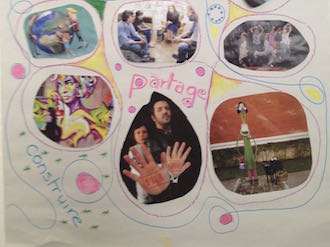
The software and computer applications are legion, but it is also possible to go through a more classic (even prehistoric) version through posters and other collages. A few magazines, scissors, a tube of glue and markers will be effective tools for learners who wish to model their thoughts on a subject through images. The benefit of this method is to show the difference in perception that can exist between individuals and the need to consider the full range of possibilities when digging into an issue.
The composition of this poster will be as indicative of the author's understanding and assimilation of an issue as it will be of the viewers, which can be extremely useful in a course or training.
Graphic creativity, going further
In the very act of graphically representing an object of study, there is a willingness to dig deeper, to think differently, to diverge. From the moment the child joins elementary school, he favors the tool favored by the school system: writing. Drawing is then globally abandoned, conditioning reasoning from words and no longer from images. Yet, visual thinking (which incorporates poetry as well) allows learners to explore an issue differently, to free the imagination, to enrich thinking.
Imagery allows for bounce, divergence, and communication. Where spelling and vocabulary can slow down some, less at ease with the language (dyslexics in particular), graphic design offers new prospects for exchanges, for enrichment. On the condition, of course, that drawing is valued so as not to create a new blockage, displaced from the linguistic to the artistic. It is an additional opportunity to mix techniques, to gain in palette of expression and tend towards diversity, complementarity.
Graphic creativity is used in a fairly minority way today. However, we note that companies increasingly favor this type of tool to better think or better communicate.
References
Technical Drawing - Allo Prof
https://www.alloprof.qc.ca/fr/eleves/bv/sciences/sciences-le-dessin-technique-s1405
10 web tools to know to boost your presentations - Alexandra Giroux - Presse Citron
http://www.presse-citron.net/10-outils-web-a-connaitre-pour-booster-vos-presentations/
Visual thinking: from mindmapping to graphic organizers - Marco Bertolini - Fromation 3.0
http://format30.com/2014/04/09/pensee-visuelle-du-mindmapping-aux-organisateurs-graphiques/
See more articles by this author