The SOSIE instruction method - And it works!
A method of transforming work through peer-to-peer learning, which also develops psychosocial skills. And it works!
Publish at January 11 2015 Updated September 25 2024


Who hasn't wanted to build teams motivated to work together? Or to energize their teams by allowing them to meet by affinity?
Any good teacher or manager will tell you that, with time and observation, he or she is capable of forming such sub-groups. This "art" of skilfully mixing similar or complementary personalities has a name: sociograms. After an overview of the origins of this practice, we'll present a few examples of tools that can be used to test your groups and, why not, make them a real strength for your team.
Jacob Levy Moreno (1889-1974) was born in Bucharest and pioneered sociometry, psychodrama and group psychotherapy. During the 1914-1918 war, he learned how to form affinity groups of refugees to help them survive in camps.
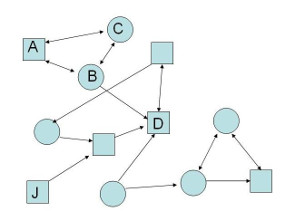
Arriving in the United States in 1925, after several jobs, he published a book in 1934 on affinities between students in different grades. His sociograms laid the foundations for sociometry. Based on a questionnaire posed to the members of a group, a diagram makes it possible to visualize the social links between each person. In the context of training groups or work teams, it has been shown that by taking into account the 3 possible relationships between human beings (sympathy, antipathy and indifference), the analysis of the results can promote the modeling of a system of inter-relationships.
By taking into account people who feel sympathy for each other, and thus bringing them together, the involvement of these groups is increased tenfold, or at least favored.
The questionnaire used to draw up a sociogram is fairly simple, and is based on cross-representations. Each person is asked 4 questions, while insisting on the anonymity of their answers:
For small groups, it's possible to retrieve the results and plot them manually on a diagram: colored arrows can be used to visualize the acceptance or rejection of particular members of a group. For a more detailed representation, applications exist:
The information provided by sociograms has no scientific value: based on representations, you can only get a fragmented view of a group's human relations.
However, knowing the effects of affinities on group dynamics, it can be interesting to rely on these data. It's important to remember that the same sociogram can encourage totally different groups to work together (bringing together the same affinities, getting people to work together who might tend not to want to collaborate, etc.), and that the role of the teacher or manager will be to provide the best possible support for production, by promoting a useful "socio-cognitive conflict" that is controlled because it's known in advance.
Links :
VISONE (VIsual SOcial NEtwork) - http://visone.info/
SOMETICS - http://www.sometics.com/
Google Sociogram - https://workspace.google.com/marketplace/app/sociogramme/298994610440?hl=fr
MySociogram.me - https://monsociogram.me/
GrouppDynamics - http://groupdynamics.en.softonic.com/
You might also like:
The SOSIE instruction method - And it works!
A method of transforming work through peer-to-peer learning, which also develops psychosocial skills. And it works!
Emotional leadership and learning
Emotional leadership becomes a key factor in the learning process.
Why take care of your teachers?
So it is better to invest in the recruitment and continuing education of one's teachers than in reducing class size! And if the professor has an observed effect on the performance of a class, we can assume that what replaces him or her in a distance course, the course tools and tutors, obey the same principles.
Which ways of teaching should be favoured in languages?
The journey from learning the first words of a foreign language to mastering it is different for each person, which leads us to ask ourselves what were the ways of teaching and learning it in the training courses we followed and beyond.
The concept of wu wei applied to professional training
There is an alternative to learning by objective: learning without intention