Learning to do what is not easy, by oneself and in a group, remains a challenge, almost in essence. The teacher is asked to step aside, to change his or her role...but not to step too far away anyway.
Why do we talk about facilitation?
In training, there is more and more talk of facilitation rather than group facilitation. For the presupposition of a trainer, who knows for others and guides them in the acquisition of knowledge, is enriched by a stronger dose of learner autonomy in their relationship to knowledge. This autonomy is at the crossroads of three dynamics it is simultaneously:
- a political and philosophical goal that can be called "emancipation," or increasing one's power to think and act,
- a consequence of societal and environmental transitions that encourage understanding the virulence of what is happening,
- an opportunity offered of opennessby the tools of communication and the multiplication of knowledge sources via the internet.
If this tendency to seek and invest oneself in knowledge spreads for self-taught people with the aim of increasing individual knowledge and power of action, it also develops for sociodidacts with the aim of increasing collective knowledge and power of action, then it is a matter of better understanding how it acts.
Facilitation a relational art of trust of openness and inclusion
Facilitation is a relational art made of interactions with groups. Interactions between facilitators and groups take different forms such as:
- Creating a caring, warm, and positive relational framework: This first act is the first gift to the group, that of a smile, an attention, a gesture, a little drink or food for the warmth, comfort, and well-being of the participants.
It comes through the anticipation and preparation of simple but heartfelt gestures for others and then through the reciprocal ripple effect that creates the nurturing framework.
- The inclusion of a new member or the inclusion of the group to itself: the first success of a facilitation is already the success of the inclusion of a new member or the group to itself.
It involves the emotional safety of each person, through the benevolence that is mutually established. Facilitation allows each person to include others, to welcome each other.
- The opening of an exchange : it is a maieutic work on a subject of strong and common interest, which arises from an individual feeling, from an enrichment of the word of the other; word which is gradually transformed into authentic question with personal, professional, individual or collective stake.
- Welcoming an emergence: this attitude is centered on spotting weak signals, opportunities, openings that are expressed either through words, striking adjectives, or phrases, or through breaks in rhythm or changes in ways of interacting. An emergence is a new possibility an idea, an insight in a learning situation.
- Regulation or reframing: correspond to the expression of the return to acceptable formal or informal rules of the exchange. Only the group knows what is acceptable in relation to the rules of communication.
Facilitation consists in perceiving the level of tolerance possible with regard to transgressions in the exchange. The return to the rules of the game, or collectively established reference points, allows for a reminder of the rule.
- The gaining of perspective on what is experienced here and now (meta posture) : All of a sudden, a member's (often the facilitator's) elevation changes the level of exchange and the way a situation is understood. It is thus possible to point to the level where a questioning is located that deals with the environment, to another level that evokes behaviors, or capacities, or beliefs, identity or even a spiritual level, to use Dilts' logical levels [1].
- Exploring one's internal states: 80% of human sensory sensors are focused on the interior of the body (proprioception). Facilitation participates in a better self-centeredness to better connect with others.
Learning to identify one's internal states allows one to move forward in a discernment of what is going on for an individual, self or group.
- Sharing emotions: emotions experienced are essential, they open the collective to more sense of possibility when shared.
- The return to the group of a process at work: facilitation is a collective effort to perceive and adjust continuously and harmoniously to the processes that are set in motion in groups.
Questioning the group about the emergences taking place and sharing with them what is felt participates in understanding these processes and the place of each person in this process.
- The reformulation of a synthesis of a vision: the vision is both a process and a stable state at a time of what can happen. The vision that is gradually woven together unites the threads of both toward the same goal.
Perspectives
If facilitation proceeds from a relational art, the first question that arises is to manage to practice it, to do its scales, to act to make exchanges more fluid, more coherent, more benevolent and respectful of others.
Introducing such practices into training requires welcoming new ideas, unplanned situations and issues, getting out of ready-made programs.
The second question is how to transpose this relational art to the digital context, whose interactions are more jerky, carried by a digital flow that cannot change as it unfolds, which is an essential characteristic of human communication that accepts and plays with vagueness, ambiguities, innuendo, irrational and instinctive changes. There is certainly much to explore in mastering this art of relating face to face or at a distance.
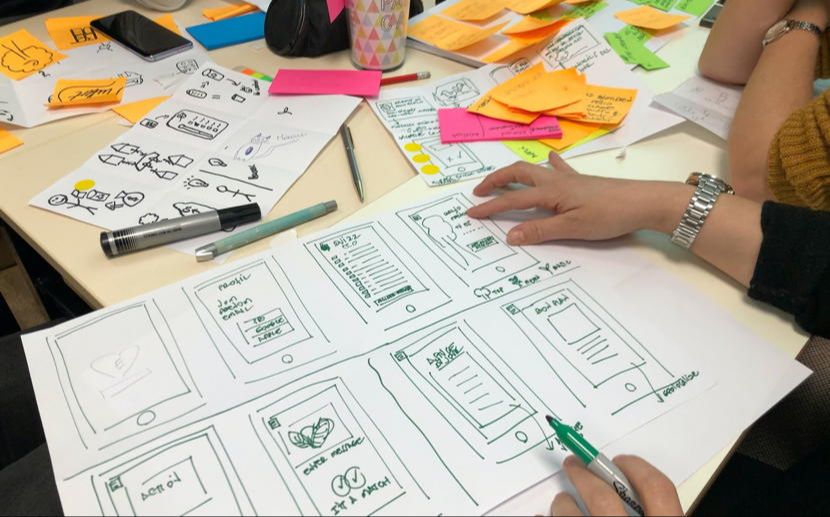
Illustration: Grainsore opens at the digital hub - REF-1080472 via photopin
See more articles by this author