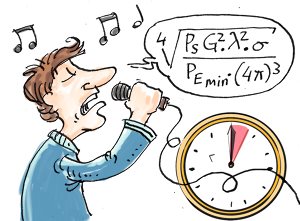
Writing a thesis conjures images of solitude and complex research that only a handful of people can understand. “It’s quite the opposite,” say the participants in the “My Thesis in 180 Seconds” challenge. Research is fascinating; it’s grounded in reality; it’s often tied to a personal journey; and, above all, we can all understand what’s at stake.
The challenge for these researchers is to present their thesis in three minutes, using just a single slide, in front of an audience.
But to achieve this feat of explanation, students must use communication techniques to explain their work and hold the audience’s attention, focusing it within a very brief timeframe. This is what this article sets out to analyze, drawing on the examples of three French-speaking winners.
Mathieu Buonafine and Mineralocorticoid Receptors
Mathieu Buonafine is more familiar with mice than with humans—at least, that’s what his research might lead one to believe. He studies certain factors that contribute to cardiovascular disease. To do so, he analyzes the characteristics of mice lacking one of the elements responsible for these diseases.
Mathieu Buonafine begins by engaging us with a pointed question: “Do you know what the leading cause of death is?” He teases us a bit, then quickly gives us the answer: cardiovascular disease.
He briefly introduces one of the factors responsible for these diseases, which isn’t entirely harmful and therefore cannot be eliminated... To highlight the ambiguity of the mineralocorticoid receptor—sometimes harmful, sometimes beneficial—he shifts from one position to another. When you only have 180 seconds, nonverbal cues are essential!
Mathieu Buonafine also uses a detective-style metaphor, which he carries throughout his presentation. Rather than referring to the receptor, he talks about a “suspect,” the “accomplice” NGAL, and the receptor’s “double life.” He uses slang specific to the world of crime novels: “they’re in cahoots.” So here are these molecules and receptors turned into stories, endowed with intentions...
Other metaphors establish a cultural connection with the audience, especially since they coincide with a movie release. The mutant mice become X-Men—more modest in appearance, but capable, too, of changing the world!

Mathilde Petton and Attention Drift
Like the previous winner, Mathilde Petton follows the 4 x 20 rule. The first twenty steps, the first twenty words, the first twenty seconds, and the twenty centimeters of the face are all important. She chooses to act out a scene of a lapse in attention. Just enough to make us start believing it, then she quickly recovers and demonstrates her mastery of oral communication. It’s a true art to feign awkwardness in such a brief speech.
But “attention lapses” are precisely the focus of this University of Lyon student’s research. After a humorous opening, she gives us a dramatic and concrete glimpse into the challenges of her research topic. A two-second lapse in attention is equivalent to 70 meters for a car on the highway. It is also sometimes the cause of academic failure for thousands of children...
Just as Mathieu Buonafine explained how to measure blood pressure in rats, Mathilde Petton shows us how she records brain activity. In both cases, the more visually inclined among us conjure up images related to the research—a far cry from the abstract notions typically associated with doctoral work.
Finally, she uses a deliberately very simple image, almost as if Docteur Maboule had crashed a medical lecture. Our heads are full of little dots. Attention occurs when some of them are stimulated while others are at rest... Attention disorders arise as soon as these little dots become active or reduce their activity without any consistency...

Bertrand Cochard and Reification
Bertrand is working on a thesis in philosophy. His thesis focuses on the work of Guy Debord, the author of *The Society of the Spectacle*. Here again, everything is perfect. The young philosopher captures our attention with a thought experiment. He places us in an all-too-familiar situation, where one person ignores another, as if denying them any humanity.
To hold our attention and interest, Bertrand uses an almost militant tone to describe the “spectacle” created by the world of media and advertising. He draws us in: “that person who ignores the other—that’s also me, that’s also you”…
Like the previous examples, he uses a few terms that help situate the whole discussion within a research framework: “reification” and “imagification.”
But the 180-second format forces him to take shortcuts and resort to clichés (the contemptuous boss who treats the cashier like an object). In a 3-minute format, it’s impossible to delve into a nuanced example!

This presentation, which focuses on the work of Guy Debord, author of *The Society of the Spectacle*, is itself a spectacle and borrows from the techniques of a sales pitch. This mise en abyme would undoubtedly have pleased the Situationist philosopher!
What can we take away from this in terms of communication?
These three examples demonstrate mastery of numerous communication techniques. The illustration below presents nine of them.
- Provide a glimpse into what happens on a daily basis in the lab
- Dramatize the situation by highlighting, for example, academic failure or accidents caused by inattention...
- Use metaphors
- Establish an intellectual connection with the audience
- Use nonverbal communication
- Show a sense of humor, especially in the conclusion
- Pay close attention to the introduction—or rather, the opening hook
- Engage the audience (“You’ve probably…”)
- Use one or two sophisticated words, but no more!

Illustrations: Frédéric Duriez
Resources
Camille Malnory and Elise Anne - “My Thesis in 180 Seconds: Mathile Petton” - Lyon Capitale - April 18, 2016
http://www.lyoncapitale.fr/Journal/Lyon/Actualite/Universite/Ma-These-en-180-secondes-Mathilde-Petton
My Thesis in 180 Seconds —website accessed June 17, 2016
http://mt180.fr/
Marine Miller - Le Monde - "My Thesis in 180 Seconds: PhD Students, the New Stars" - June 1, 2016
http://www.lemonde.fr/campus/article/2016/06/01/ma-these-en-180-secondes-les-doctorants-ces-nouvelles-stars_4929927_4401467.html
See more articles by this author