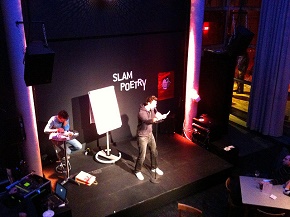
The very origin of slam was to breathe new life into poetry, turning it into something akin to an artistic competition
Like any form of writing, poetry takes many different forms. There are classic forms that have earned widespread recognition, such as Racine’s alexandrines or the melancholic verses of Émile Nelligan. But there are also more dynamic and modern forms, such as slam poetry.
We’ve already discussed this art form, which can be easily integrated into an educational setting. In fact, librarians and social education professionals are now taking training workshops to incorporate slam poetry into educational activities. This type of poetry is often associated with the widely popular musical style of rap, given the rapid delivery of the recitation.
And then there’s its free-spirited and socially critical nature, which is the key to the success of many slam poets around the world. Whether in Europe or Africa, everyone recognizes that this method of expression can convey important social messages. In fact, in Burkina Faso, an organization is working to integrate this form of poetry into schools to give students a way to express themselves about their society. Young people in Madagascar, for their part, have been able to participate for the past two years in an inter-school slam tournament. A tournament? Yes, because we tend to forget it, but that’s the unique aspect of slam: it’s a competitive form of poetry.
A Sport of Universality
In fact, when it was created in 1987, American factory worker Marc Smith wanted to find a way to breathe new life into poetry and turn it into a competitive sport. Slam was born, and with it came a plethora of tournaments. The World Slam Championship was even held in late May in Paris at the Théâtre de Verre. Here is a performance by a slam poet representing France during the competition. The video quality is average, but the focus is on the words.
However, he wasn’t the one who won the competition—it was a group of young people from Rodrigues. Like any sport, there are a few rules. Performances must not last longer than 3 minutes. Otherwise, there is a half-point penalty. A five-person jury scores the various poems. In some cases, members are chosen at random from the audience, and the jury is rotated throughout the competition.
As Catherine Duval, a teacher and president of the French Poetry Slam Federation, explains, contestants can recite anything during a competition. Someone could use a classic text, but they would be penalized for a lack of originality. As a result, most participants come with their own original work. And there’s no need to know it by heart. It just has to move the jury members.
Open to Everyone
For the teacher, slam has been a way to introduce her students to poetry. Why? Because there’s a more universal aspect to this oral art form. As this article exploring the phenomenon in Quebec City shows, unlike traditional poetry, slam poetry addresses themes that are less personal to the poet and more closely tied to the audience’s reality. With a rhythm closer to music, it becomes more engaging to listen to and even to watch, as it involves a true stage performance.
Regardless of the method used to promote slam poetry, there is a reason why so many people are seeking to integrate it into schools: because it fosters students’ oral (and written) expression. In this way, they see the endless possibilities for expressing emotions and perceptions—both negative and positive.
Clavreul, Clémentine, and Christian Kahnt. "Orality: Slam Poetry in Ghana, Côte d’Ivoire, and Germany." Goethe-Institut Côte d’Ivoire. Last updated: April 2016. https://www.goethe.de/ins/ci/fr/kul/mag/20749382.html.
Hendrickx, Sylvie. “Reflections on a Training Session: ‘Introduction to Poetry Slam.’” Interactive Website of the Interdiocesan Federation of Catholic Librarians (FIBBC). Last updated November 18, 2015. http://www.fibbc.net/Echos-d-une-formation.html.
How do you get people to discover and love ancient languages? Certainly not by multiplying conjugation and declension tables, says Andréa Marcalongo. Author of a declaration of love for ancient Greek, she invites us to discover some of its finer points and peculiarities. Her book, like those by Jacqueline de Romilly and Monique Trédé, invites us to travel and to shake up our categories of thought.
An American novelist recognizes in this magnificent text all that creators owe each other, in a permanent circulation of inspirations and tributes that knows no temporal barriers, economic barriers, or disciplinary boundaries.
Virtual reality is gaining momentum in the entertainment industry with video gaming. However, the education sector is not left behind since this technology offers increasingly realistic simulations. Consequently, for jobs where delicate manipulations are commonplace, virtual reality becomes a great asset. Examples.